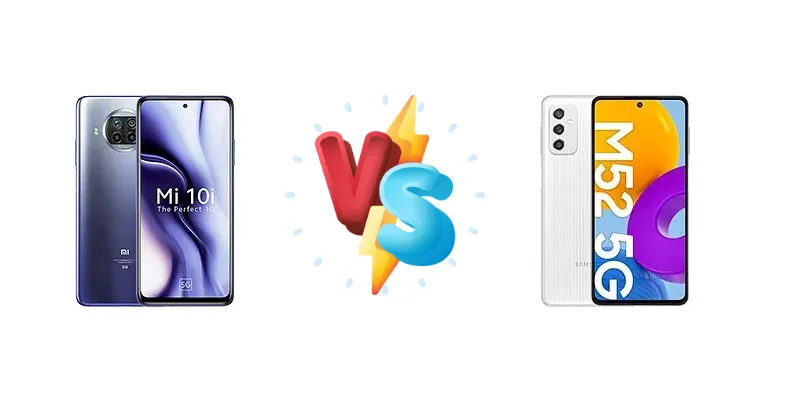
Both the Xiaomi Mi 10i 5G and the Samsung Galaxy M52 5G target the competitive mid-range 5G market, but they approach it with different strengths. The Mi 10i 5G prioritizes fast charging and a value-focused price, while the M52 5G leans on a more powerful chipset and a brighter display. This comparison dissects the key differences to determine which phone delivers the best overall experience.
🏆 Quick Verdict
For most users, the Samsung Galaxy M52 5G is the better choice. Its Snapdragon 778G chipset provides a noticeable performance uplift over the Mi 10i 5G’s Snapdragon 750G, translating to smoother multitasking and gaming. While the Mi 10i 5G offers faster 33W charging, the M52 5G’s superior processing power justifies the trade-off.
| Network |
|---|
| 2G bands | GSM 850 / 900 / 1800 / 1900 | GSM 850 / 900 / 1800 / 1900 |
| 3G bands | HSDPA 850 / 900 / 1900 / 2100 | HSDPA 850 / 900 / 1700(AWS) / 1900 / 2100 |
| 4G bands | 1, 3, 5, 7, 8, 38, 40, 41 | 1, 2, 3, 4, 5, 7, 8, 12, 17, 20, 26, 28, 38, 40, 41, 66 |
| 5G bands | 77, 78 Sub6 | SA/NSA/Sub6 |
| Speed | HSPA, LTE, 5G | HSPA, LTE, 5G |
| Technology | GSM / HSPA / LTE / 5G | GSM / HSPA / LTE / 5G |
| Launch |
|---|
| Announced | 2021, January 05 | 2021, September 24 |
| Status | Available. Released 2021, January 08 | Available. Released 2021, October 03 |
| Body |
|---|
| Build | Glass front (Gorilla Glass 5), glass back (Gorilla Glass 5) | Glass front (Gorilla Glass 5), plastic frame, plastic back |
| Dimensions | 165.4 x 76.8 x 9 mm (6.51 x 3.02 x 0.35 in) | 164.2 x 76.4 x 7.4 mm (6.46 x 3.01 x 0.29 in) |
| SIM | Nano-SIM + Nano-SIM | Nano-SIM + Nano-SIM |
| Weight | 214.5 g (7.55 oz) | 173 g (6.10 oz) |
| Display |
|---|
| Protection | Corning Gorilla Glass 5 | Corning Gorilla Glass 5 |
| Resolution | 1080 x 2400 pixels, 20:9 ratio (~395 ppi density) | 1080 x 2400 pixels, 20:9 ratio (~393 ppi density) |
| Size | 6.67 inches, 107.4 cm2 (~84.6% screen-to-body ratio) | 6.7 inches, 108.4 cm2 (~86.4% screen-to-body ratio) |
| Type | IPS LCD, HDR10, 120Hz, 450 nits (typ) | Super AMOLED Plus, 120Hz |
| Platform |
|---|
| CPU | Octa-core (2x2.2 GHz Kryo 570 & 6x1.8 GHz Kryo 570) | Octa-core (1x2.4 GHz Cortex-A78 & 3x2.2 GHz Cortex-A78 & 4x1.9 GHz Cortex-A55) |
| Chipset | Qualcomm SM7225 Snapdragon 750G 5G (8 nm) | Qualcomm SM7325 Snapdragon 778G 5G (6 nm) |
| GPU | Adreno 619 | Adreno 642L |
| OS | Android 10, MIUI 12 | Android 11, upgradable to Android 13, One UI 5.1 |
| Memory |
|---|
| Card slot | microSDXC (uses shared SIM slot) | microSDXC (uses shared SIM slot) |
| Internal | 128GB 6GB RAM, 128GB 8GB RAM | 128GB 6GB RAM, 128GB 8GB RAM |
| | UFS 2.2 | - |
| Main Camera |
|---|
| Features | Dual-LED dual-tone flash, HDR, panorama | LED flash, panorama, HDR |
| Quad | 108 MP, f/1.8, 26mm (wide), 1/1.52", 0.7µm, PDAF
8 MP, f/2.2, 120˚ (ultrawide), 1/4.0", 1.12µm
2 MP (macro)
Auxiliary lens | - |
| Single | - | 32 MP, f/2.2, 26mm (wide) |
| Triple | - | 64 MP, f/1.8, 26mm (wide), 1/1.97", 0.7um, PDAF
12 MP, f/2.2, 123˚, (ultrawide), 1/3.06", 1.12µm
5 MP (macro) |
| Video | 4K@30fps, 1080p@30/60/120fps, 720p@960fps, gyro-EIS | 4K@30fps, 1080p@30/60fps |
| Selfie camera |
|---|
| Features | Panorama | - |
| Single | 16 MP, f/2.5, (wide), 1/3.06", 1.0µm | 32 MP, f/2.2, 26mm (wide) |
| Video | 1080p@30fps, 720p@120fps | 4K@30fps, 1080p@30fps |
| Sound |
|---|
| 3.5mm jack | Yes | No |
| 35mm jack | Yes | No |
| Loudspeaker | Yes, with stereo speakers | Yes |
| | 24-bit/192kHz audio | - |
| Comms |
|---|
| Bluetooth | Yes | 5.0, A2DP, LE |
| Infrared port | Yes | - |
| NFC | Yes | Yes |
| Positioning | GPS (L1+L5), GLONASS (G1), BDS (B1), GALILEO (E1+E5a), NavIC | GPS, GLONASS, GALILEO, BDS, QZSS |
| Radio | FM radio | Unspecified |
| USB | USB Type-C 2.0 | USB Type-C 2.0, OTG |
| WLAN | Yes | Wi-Fi 802.11 a/b/g/n/ac/6, dual-band, Wi-Fi Direct |
| Features |
|---|
| Sensors | Fingerprint (side-mounted), accelerometer, gyro, proximity, compass | Fingerprint (side-mounted), accelerometer, gyro, proximity, compass |
| Battery |
|---|
| Charging | 33W wired, PD, 100% in 58 min | 25W wired |
| Type | Li-Po 4820 mAh | Li-Ion 5000 mAh |
| Misc |
|---|
| Colors | Pacific Sunrise, Midnight Black, Atlantic Blue | Icy Blue, Blazing Black, White |
| Models | M2007J17I | SM-M526BR, SM-M526BR/DS, SM-M526B, SM-M526B/DS |
| Price | About 250 EUR | About 300 EUR |
| SAR | 0.87 W/kg (head) 0.82 W/kg (body) | - |
| SAR EU | - | 0.79 W/kg (head) 1.40 W/kg (body) |
| Tests |
|---|
| Battery life | - |
Endurance rating 123h
|
| Camera | - |
Photo / Video |
| Display | - |
Contrast ratio: Infinite (nominal) |
| Loudspeaker | - |
-30.0 LUFS (Average)
|
| Performance | - |
AnTuTu: 504424 (v9)
GeekBench: 2796 (v5.1)
GFXBench: 28fps (ES 3.1 onscreen) |
Xiaomi Mi 10i 5G
- Faster 33W wired charging
- Potentially lower price point
- Good battery endurance (123h)
- Less powerful Snapdragon 750G chipset
- Likely inferior display brightness and contrast
- Potentially slower app loading and multitasking
Samsung Galaxy M52 5G
- More powerful Snapdragon 778G chipset
- Brighter 777 nit display
- Superior image processing capabilities
- Slower 25W wired charging
- Potentially higher price
- Similar battery endurance to Mi 10i 5G
Display Comparison
The Samsung Galaxy M52 5G boasts a significant advantage with its measured peak brightness of 777 nits, ensuring excellent visibility even in direct sunlight. While the Mi 10i 5G’s display specifications aren’t provided, Samsung’s figure suggests a superior outdoor viewing experience. The M52 5G also advertises an 'Infinite' contrast ratio, typical of AMOLED panels, which delivers deeper blacks and more vibrant colors compared to the likely IPS LCD panel on the Mi 10i 5G. The lack of refresh rate information for the Mi 10i 5G further solidifies the M52 5G’s display lead.
Camera Comparison
Both phones offer 'Photo / Video' capabilities, but detailed sensor information is lacking. However, the Snapdragon 778G’s image signal processor (ISP) is more advanced than the 750G’s, enabling better image processing, noise reduction, and dynamic range. While both likely feature a multi-camera setup, the M52 5G’s chipset provides the computational horsepower to extract more detail and quality from its sensors. Without specific sensor size or aperture data, it’s difficult to definitively declare a winner, but the processing advantage favors the Samsung.
Performance
The core difference lies in the chipsets: the Samsung Galaxy M52 5G utilizes the Qualcomm SM7325 Snapdragon 778G 5G (6 nm), while the Xiaomi Mi 10i 5G features the SM7225 Snapdragon 750G 5G (8 nm). The 778G’s 6nm process and more powerful CPU configuration – a 1x2.4 GHz Cortex-A78 prime core alongside 3x2.2 GHz Cortex-A78 cores and 4x1.9 GHz Cortex-A55 efficiency cores – significantly outperform the Mi 10i 5G’s 2x2.2 GHz Kryo 570 and 6x1.8 GHz Kryo 570 setup. This translates to faster app loading times, smoother multitasking, and a more responsive gaming experience. The 778G’s Adreno 642L GPU also provides a substantial graphics boost.
Battery Life
Both devices share an endurance rating of 123 hours, suggesting comparable real-world battery life despite the Mi 10i 5G’s 33W charging versus the M52 5G’s 25W. The faster charging on the Mi 10i 5G allows for a full charge in 58 minutes, while the M52 5G will take longer. However, the Snapdragon 778G’s more efficient 6nm process could partially offset the charging speed difference by consuming less power during typical usage.
Buying Guide
Buy the Xiaomi Mi 10i 5G if you prioritize rapid charging and are on a very tight budget, and your usage primarily revolves around everyday tasks and light gaming. Buy the Samsung Galaxy M52 5G if you value smoother performance for demanding apps, gaming, and content creation, and appreciate a brighter, more visible display, even if it means slightly slower charging.
Frequently Asked Questions
❓ Does the Snapdragon 778G in the Samsung Galaxy M52 5G get hot during extended gaming sessions?
The Snapdragon 778G is built on a 6nm process, which offers improved thermal efficiency compared to the 8nm process of the Snapdragon 750G. While some heat generation is inevitable during prolonged gaming, the 778G is generally well-managed and less prone to significant throttling, providing a more consistent gaming experience.
❓ Is the 25W charging on the Samsung Galaxy M52 5G significantly slower than the 33W charging on the Xiaomi Mi 10i 5G in real-world use?
While 33W is faster on paper, the difference in charging times isn't massive. The Mi 10i 5G reaches 100% in 58 minutes. The M52 5G will take longer, but the more efficient Snapdragon 778G chipset may reduce overall power draw, partially mitigating the slower charging speed. For most users, the convenience of faster charging isn't worth sacrificing the performance benefits of the 778G.
❓ How does the camera performance of the Samsung Galaxy M52 5G compare to the Xiaomi Mi 10i 5G in low-light conditions?
The Samsung Galaxy M52 5G is expected to perform better in low-light scenarios due to the superior image processing capabilities of the Snapdragon 778G’s ISP. This translates to less noise, better detail retention, and improved dynamic range in challenging lighting conditions. Without specific sensor details, it's difficult to quantify the difference, but the chipset advantage is significant.