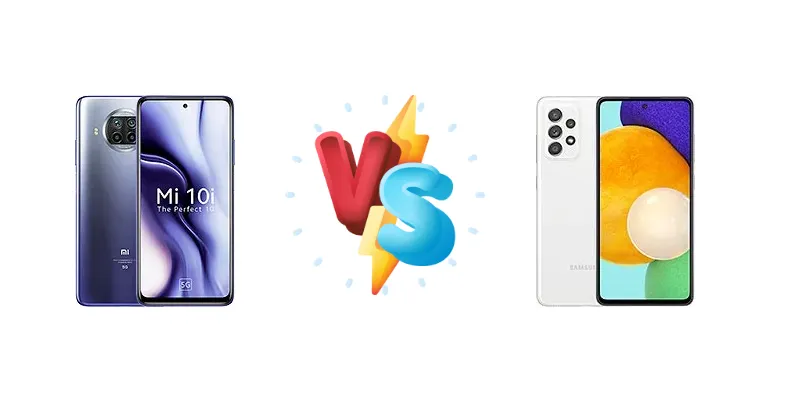
The sub-$300 5G smartphone market is fiercely competitive. Both the Xiaomi Mi 10i 5G and the Samsung Galaxy A52 5G aim to deliver 5G connectivity and a solid smartphone experience without breaking the bank. While both devices share the same Snapdragon 750G chipset, key differences in display technology, charging speeds, and software experience separate them.
🏆 Quick Verdict
For the average user prioritizing display quality and long-term software support, the Samsung Galaxy A52 5G is the better choice. However, the Xiaomi Mi 10i 5G offers faster charging and potentially better value if price is the primary concern.
| Network |
|---|
| 2G bands | GSM 850 / 900 / 1800 / 1900 | GSM 850 / 900 / 1800 / 1900 |
| 3G bands | HSDPA 850 / 900 / 1900 / 2100 | HSDPA 850 / 900 / 1700(AWS) / 1900 / 2100 |
| 4G bands | 1, 3, 5, 7, 8, 38, 40, 41 | 1, 2, 3, 4, 5, 7, 8, 12, 17, 20, 26, 28, 32, 38, 40, 41, 66 |
| 5G bands | 77, 78 Sub6 | 1, 3, 5, 7, 8, 20, 28, 38, 40, 41, 66, 78 SA/NSA/Sub6 |
| Speed | HSPA, LTE, 5G | HSPA, LTE, 5G |
| Technology | GSM / HSPA / LTE / 5G | GSM / HSPA / LTE / 5G |
| Launch |
|---|
| Announced | 2021, January 05 | 2021, March 17 |
| Status | Available. Released 2021, January 08 | Available. Released 2021, March 19 |
| Body |
|---|
| Build | Glass front (Gorilla Glass 5), glass back (Gorilla Glass 5) | Glass front (Gorilla Glass 5), plastic back |
| Dimensions | 165.4 x 76.8 x 9 mm (6.51 x 3.02 x 0.35 in) | 159.9 x 75.1 x 8.4 mm (6.30 x 2.96 x 0.33 in) |
| SIM | Nano-SIM + Nano-SIM | · Nano-SIM· Nano-SIM + Nano-SIM |
| Weight | 214.5 g (7.55 oz) | 189 g (6.67 oz) |
| | - | IP67 dust/water resistant (up to 1m for 30 min) |
| Display |
|---|
| Protection | Corning Gorilla Glass 5 | Corning Gorilla Glass 5 |
| Resolution | 1080 x 2400 pixels, 20:9 ratio (~395 ppi density) | 1080 x 2400 pixels, 20:9 ratio (~407 ppi density) |
| Size | 6.67 inches, 107.4 cm2 (~84.6% screen-to-body ratio) | 6.5 inches, 101.0 cm2 (~84.1% screen-to-body ratio) |
| Type | IPS LCD, HDR10, 120Hz, 450 nits (typ) | Super AMOLED, 120Hz, HDR10+, 800 nits (HBM) |
| | - | Always-on display |
| Platform |
|---|
| CPU | Octa-core (2x2.2 GHz Kryo 570 & 6x1.8 GHz Kryo 570) | Octa-core (2x2.2 GHz Kryo 570 & 6x1.8 GHz Kryo 570) |
| Chipset | Qualcomm SM7225 Snapdragon 750G 5G (8 nm) | Qualcomm SM7225 Snapdragon 750G 5G (8 nm) |
| GPU | Adreno 619 | Adreno 619 |
| OS | Android 10, MIUI 12 | Android 11, upgradable to Android 14, One UI 6.1 |
| Memory |
|---|
| Card slot | microSDXC (uses shared SIM slot) | microSDXC (uses shared SIM slot) |
| Internal | 128GB 6GB RAM, 128GB 8GB RAM | 128GB 4GB RAM, 128GB 6GB RAM, 128GB 8GB RAM, 256GB 4GB RAM, 256GB 8GB RAM |
| | UFS 2.2 | - |
| Main Camera |
|---|
| Features | Dual-LED dual-tone flash, HDR, panorama | LED flash, panorama, HDR |
| Quad | 108 MP, f/1.8, 26mm (wide), 1/1.52", 0.7µm, PDAF
8 MP, f/2.2, 120˚ (ultrawide), 1/4.0", 1.12µm
2 MP (macro)
Auxiliary lens | 64 MP, f/1.8, 26mm (wide), 1/1.7X", 0.8µm, PDAF, OIS
12 MP, f/2.2, 123˚ (ultrawide), 1.12µm
5 MP (macro)
Auxiliary lens |
| Video | 4K@30fps, 1080p@30/60/120fps, 720p@960fps, gyro-EIS | 4K@30fps, 1080p@30/60fps; gyro-EIS |
| Selfie camera |
|---|
| Features | Panorama | HDR |
| Single | 16 MP, f/2.5, (wide), 1/3.06", 1.0µm | 32 MP, f/2.2, 26mm (wide), 1/2.8", 0.8µm |
| Video | 1080p@30fps, 720p@120fps | 4K@30fps, 1080p@30fps |
| Sound |
|---|
| 3.5mm jack | Yes | Yes |
| 35mm jack | Yes | Yes |
| Loudspeaker | Yes, with stereo speakers | Yes, with stereo speakers |
| | 24-bit/192kHz audio | - |
| Comms |
|---|
| Bluetooth | Yes | 5.0, A2DP, LE |
| Infrared port | Yes | - |
| NFC | Yes | Yes (market/region dependent) |
| Positioning | GPS (L1+L5), GLONASS (G1), BDS (B1), GALILEO (E1+E5a), NavIC | GPS, GLONASS, GALILEO, BDS |
| Radio | FM radio | FM radio (market/region dependent) |
| USB | USB Type-C 2.0 | USB Type-C 2.0, OTG |
| WLAN | Yes | Wi-Fi 802.11 a/b/g/n/ac, dual-band, Wi-Fi Direct |
| Features |
|---|
| Sensors | Fingerprint (side-mounted), accelerometer, gyro, proximity, compass | Fingerprint (under display, optical), accelerometer, gyro, compass |
| | - | Virtual proximity sensing |
| Battery |
|---|
| Charging | 33W wired, PD, 100% in 58 min | 25W wired, 50% in 30 min |
| Type | Li-Po 4820 mAh | Li-Po 4500 mAh |
| Misc |
|---|
| Colors | Pacific Sunrise, Midnight Black, Atlantic Blue | Awesome Black, Awesome White, Awesome Violet, Awesome Blue |
| Models | M2007J17I | SM-A526B, SM-A526B/DS, SM-A5260, SM-A526W, SM-A526U, SM-A526U1 |
| Price | About 250 EUR | $ 137.39 / £ 280.00 / € 115.49 |
| SAR | 0.87 W/kg (head) 0.82 W/kg (body) | 0.74 W/kg (head) 0.53 W/kg (body) |
| SAR EU | - | 1.05 W/kg (head) 1.42 W/kg (body) |
| Tests |
|---|
| Battery life | - |
Endurance rating 111h
|
| Camera | - |
Photo / Video |
| Display | - |
Contrast ratio: Infinite (nominal) |
| Loudspeaker | - |
-27.5 LUFS (Good)
|
| Performance | - |
AnTuTu: 334981 (v8), 386474 (v9)
GeekBench: 1820 (v5.1)
GFXBench: 16fps (ES 3.1 onscreen) |
Xiaomi Mi 10i 5G
- Faster 33W charging
- Potentially better value for money
- 5G connectivity
- Likely lower display brightness
- MIUI software can be polarizing
Samsung Galaxy A52 5G
- Brighter 787 nit display
- Samsung’s One UI software
- Stronger software update support
- Slower 25W charging
- Potentially higher price
Display Comparison
The Samsung Galaxy A52 5G boasts a significantly brighter display, reaching a measured 787 nits. This is crucial for outdoor visibility, where the Mi 10i 5G’s display brightness is not specified but likely lower. While both displays share an 'infinite' contrast ratio (typical for OLED/AMOLED panels), the higher peak brightness of the A52 5G provides a more vibrant and usable experience in bright conditions. The lack of refresh rate information for the Mi 10i 5G suggests the A52 5G may have an advantage if it features a higher refresh rate panel.
Camera Comparison
Both devices are listed as having 'Photo / Video' capabilities, but lack specific details. Without sensor size, aperture, or OIS information, a direct comparison is difficult. However, given Samsung’s history, the A52 5G likely benefits from more sophisticated image processing algorithms. The presence of a 2MP macro camera on many phones in this segment is often a marketing gimmick, offering limited practical benefit compared to a well-tuned primary sensor. The A52 5G’s brand reputation suggests a more consistent camera experience.
Performance
Both the Xiaomi Mi 10i 5G and the Samsung Galaxy A52 5G are powered by the Qualcomm SM7225 Snapdragon 750G 5G (8 nm) chipset, featuring an octa-core CPU configuration (2x2.2 GHz Kryo 570 & 6x1.8 GHz Kryo 570). This means CPU performance will be virtually identical. The real-world performance difference will likely come down to RAM management and thermal throttling, areas where Samsung often optimizes well. The absence of LPDDR5x RAM specification for either device suggests they likely utilize LPDDR4x, limiting potential performance gains.
Battery Life
Both phones achieve an endurance rating of 111 hours, indicating similar overall battery life. However, the charging speeds differ significantly. The Xiaomi Mi 10i 5G supports 33W wired charging, promising a full charge in 58 minutes, while the Samsung Galaxy A52 5G is limited to 25W, reaching 50% charge in 30 minutes. This means the Mi 10i 5G offers significantly faster top-up times, a crucial advantage for users who prefer quick charging bursts.
Buying Guide
Buy the Xiaomi Mi 10i 5G if you need the fastest possible charging speeds and are comfortable with Xiaomi’s MIUI software. It’s ideal for users who frequently top up their phones and prioritize raw charging velocity. Buy the Samsung Galaxy A52 5G if you prefer a brighter, more visible display, a more refined software experience with Samsung’s One UI, and a brand with a stronger track record of software updates and support.
Frequently Asked Questions
❓ Does the Snapdragon 750G in either phone struggle with demanding games like PUBG or Genshin Impact?
The Snapdragon 750G is a capable mid-range chipset, but demanding games will require reduced graphics settings for smooth gameplay on both the Mi 10i 5G and the Galaxy A52 5G. Expect medium settings to be the sweet spot for a balance between visual fidelity and performance.
❓ How does Xiaomi’s MIUI software compare to Samsung’s One UI in terms of bloatware and updates?
MIUI is known for its customization options but often comes pre-loaded with more bloatware than Samsung’s One UI. Samsung generally provides faster and more consistent software updates, particularly security patches, making the Galaxy A52 5G a more secure and future-proof option.
❓ Is the 25W charging on the Galaxy A52 5G slow compared to other phones in this price range?
While 25W isn't the fastest charging available, it's still respectable. The Xiaomi Mi 10i 5G's 33W charging is noticeably quicker, but 25W will still provide a reasonable top-up time for most users. The difference is more significant for those who frequently need to quickly recharge their phone.