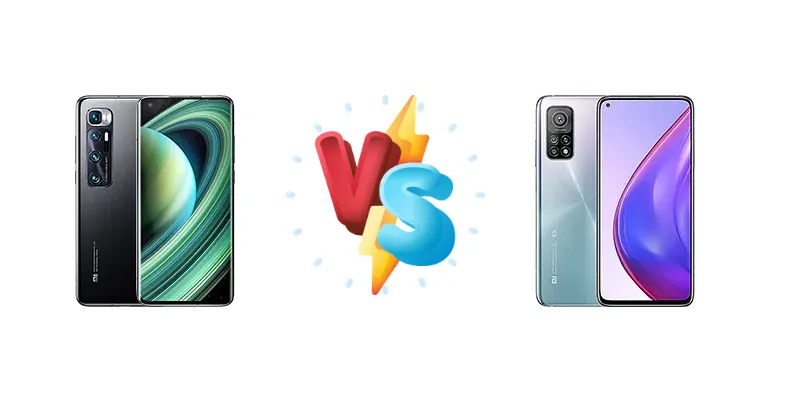
Xiaomi consistently delivers impressive smartphones, and the Mi 10 Ultra and Mi 10T Pro 5G are prime examples. Both pack powerful Snapdragon 865 processors and boast impressive features, but cater to slightly different users. This comprehensive comparison will break down their strengths and weaknesses to help you decide which one is right for you.
🏆 Quick Verdict
The Mi 10T Pro 5G emerges as the more practical choice for most users. While the Mi 10 Ultra boasts faster charging and potentially a slightly better camera in certain scenarios, the Mi 10T Pro’s superior battery life, more reasonable price, and excellent display make it a compelling all-rounder.
| Network |
|---|
| 2G bands | GSM 850 / 900 / 1800 / 1900 | GSM 850 / 900 / 1800 / 1900 |
| 3G bands | HSDPA 850 / 900 / 1700(AWS) / 1900 / 2100 | HSDPA 850 / 900 / 1700(AWS) / 1900 / 2100 |
| 4G bands | 1, 2, 3, 4, 5, 7, 8, 12, 17, 34, 38, 39, 40, 41 | 1, 2, 3, 4, 5, 7, 8, 20, 28, 32, 38, 40, 41 |
| 5G bands | 1, 3, 41, 78, 79 SA/NSA | 1, 3, 7, 8, 20, 28, 38, 41, 77, 78 NSA |
| Speed | HSPA, LTE, 5G | HSPA, LTE, 5G (2+ Gbps DL) |
| Technology | GSM / CDMA / HSPA / EVDO / LTE / 5G | GSM / HSPA / LTE / 5G |
| | CDMA2000 1xEV-DO | - |
| Launch |
|---|
| Announced | 2020, August 11. Released 2020, August 16 | 2020, September 30. Released 2020, October 13 |
| Status | Discontinued | Discontinued |
| Body |
|---|
| Build | Glass front (Gorilla Glass 5), glass back (Gorilla Glass 6), aluminum frame | Glass front (Gorilla Glass 5), glass back (Gorilla Glass 5), aluminum frame |
| Dimensions | 162.4 x 75.1 x 9.5 mm (6.39 x 2.96 x 0.37 in) | 165.1 x 76.4 x 9.3 mm (6.5 x 3.01 x 0.37 in) |
| SIM | Nano-SIM + Nano-SIM | Nano-SIM + Nano-SIM |
| Weight | 221.8 g (7.83 oz) | 218 g (7.69 oz) |
| Display |
|---|
| Protection | Corning Gorilla Glass 5 | Corning Gorilla Glass 5 |
| Resolution | 1080 x 2340 pixels, 19.5:9 ratio (~386 ppi density) | 1080 x 2400 pixels, 20:9 ratio (~395 ppi density) |
| Size | 6.67 inches, 109.2 cm2 (~89.5% screen-to-body ratio) | 6.67 inches, 107.4 cm2 (~85.2% screen-to-body ratio) |
| Type | OLED, 1B colors, 120Hz, HDR10+, 800 nits (HBM), 1120 nits (peak) | IPS LCD, 144Hz, HDR10+, 500 nits (typ), 650 nits (peak) |
| Platform |
|---|
| CPU | Octa-core (1x2.84 GHz Cortex-A77 & 3x2.42 GHz Cortex-A77 & 4x1.80 GHz Cortex-A55) | Octa-core (1x2.84 GHz Cortex-A77 & 3x2.42 GHz Cortex-A77 & 4x1.80 GHz Cortex-A55) |
| Chipset | Qualcomm SM8250 Snapdragon 865 5G (7 nm+) | Qualcomm SM8250 Snapdragon 865 5G (7 nm+) |
| GPU | Adreno 650 | Adreno 650 |
| OS | Android 10, MIUI 12.5 | Android 10, upgradable to Android 11, MIUI 12.5 |
| Memory |
|---|
| Card slot | No | No |
| Internal | 128GB 8GB RAM, 256GB 8GB RAM, 256GB 12GB RAM, 512GB 16GB RAM | 128GB 8GB RAM, 256GB 8GB RAM |
| | UFS 3.1 | UFS 3.1 |
| Main Camera |
|---|
| Features | Laser AF, color spectrum sensor, Dual-LED flash, HDR, panorama | LED flash, HDR, panorama |
| Quad | 48 MP, f/1.9, 25mm (wide), 1/1.32", 1.2µm, PDAF, OIS
48 MP, f/4.1, 120mm (periscope telephoto), 1/2.0", 0.8µm, PDAF, OIS, 5x optical zoom
12 MP, f/2.0, 50mm (telephoto), 1/2.55", 1.4µm, dual pixel PDAF, 2x optical zoom
20 MP, f/2.2, 128˚, 12mm (ultrawide), 1/2.8", 1.0µm, PDAF | - |
| Triple | - | 108 MP, f/1.7, 26mm (wide), 1/1.33", 0.8µm, PDAF, OIS
13 MP, f/2.4, 123˚ (ultrawide), 1.12µm
5 MP (macro), AF |
| Video | 8K@24fps, 4K@30/60fps, 1080p@30/60/120/240/960fps, gyro-EIS, HDR10 rec. | 8K@30fps, 4K@30/60fps, 1080p@30/60/120fps; gyro-EIS |
| Selfie camera |
|---|
| Features | HDR | HDR |
| Single | 20 MP, f/2.3, (wide), 1/3.4", 0.8µm | 20 MP, f/2.2, 27mm (wide), 1/3.4", 0.8µm |
| Video | 1080p@30fps, 720p@120fps, gyro-EIS | 1080p@30fps, 720p@120fps |
| Sound |
|---|
| 3.5mm jack | No | No |
| 35mm jack | No | No |
| Loudspeaker | Yes, with stereo speakers | Yes, with stereo speakers |
| | 24-bit/192kHz audio | 24-bit/192kHz audio |
| Comms |
|---|
| Bluetooth | 5.1, A2DP, LE, aptX HD | 5.1, A2DP, LE, aptX HD, aptX Adaptive |
| Infrared port | Yes | Yes |
| NFC | Yes | Yes |
| Positioning | GPS (L1+L5), GLONASS (G1), BDS (B1I+B2a), GALILEO (E1+E5a), QZSS (L1+L5) | GPS (L1+L5), GLONASS (G1), BDS (B1), GALILEO (E1+E5a) |
| Radio | No | No |
| USB | USB Type-C 2.0, OTG | USB Type-C 2.0, OTG |
| WLAN | Wi-Fi 802.11 a/b/g/n/ac/6, dual-band, Wi-Fi Direct, DLNA | Wi-Fi 802.11 a/b/g/n/ac/6, dual-band, Wi-Fi Direct |
| Features |
|---|
| Sensors | Fingerprint (under display, optical), accelerometer, gyro, proximity, compass, barometer | Fingerprint (side-mounted), accelerometer, gyro, proximity, compass, barometer |
| Battery |
|---|
| Charging | 120W wired, PD3.0, QC5, 41% in 5 min, 100% in 23 min
50W wireless, 100% in 40 min
10W reverse wireless | 33W wired, PD3.0 |
| Type | Li-Ion 4500 mAh, graphene-enhanced | Li-Po 5000 mAh |
| Misc |
|---|
| Colors | Obsidian Black, Mercury Silver, Transparent Edition | Cosmic Black, Lunar Silver, Aurora Blue |
| Models | M2007J1SC | M2007J3SG, M2007J3SP, M2007J3SI, M2007J17C |
| Price | About 650 EUR | € 141.52 / £ 169.99 |
| SAR | - | 0.97 W/kg (head) 0.98 W/kg (body) |
| SAR EU | - | 0.57 W/kg (head) 1.00 W/kg (body) |
| Pricing |
|---|
| 128GB 8GB RAM | - | $ 385.00 |
| 256GB 8GB RAM | - | $ 415.00 |
| RENEWED | - | £ 564.00 |
| Tests |
|---|
| Battery life |
Endurance rating 85h
|
Endurance rating 118h
|
| Camera |
Photo / Video |
Photo / Video |
| Display |
Contrast ratio: Infinite (nominal) |
Contrast ratio: 1185:1 |
| Loudspeaker |
-24.6 LUFS (Very good)
|
-26.4 LUFS (Good)
|
| Performance |
AnTuTu: 638497 (v8)
GeekBench: 3248 (v5.1)
GFXBench: 46fps (ES 3.1 onscreen) |
AnTuTu: 563961 (v8)
GeekBench: 3311 (v5.1)
GFXBench: 46fps (ES 3.1 onscreen) |
Xiaomi Mi 10 Ultra
- Ultra-fast 120W charging
- Potentially superior camera quality (especially zoom)
- Premium build quality
- High-resolution main sensor
- Higher price
- Shorter battery life
- Marketing-heavy 'infinite' contrast ratio claim
- Less practical for average users
Xiaomi Mi 10T Pro 5G
- Excellent battery life
- Bright and vibrant display
- More affordable price
- Good overall performance
- Reliable camera system
- Charging speed slower than Mi 10 Ultra
- Camera not quite as versatile as Mi 10 Ultra
- Build quality slightly less premium
Display Comparison
The Mi 10 Ultra advertises an 'infinite' contrast ratio, which is a marketing term and difficult to quantify. However, the Mi 10T Pro 5G’s measured 1185:1 contrast ratio and 630 nits of brightness offer a more concrete and impressive viewing experience. Both displays are likely excellent, but the Mi 10T Pro has a tangible advantage in brightness.
Camera Comparison
The Mi 10 Ultra's camera system is generally considered superior, particularly its 108MP main sensor and periscope zoom lens. While the Mi 10T Pro’s camera is still very capable, the Ultra offers more versatility and potentially better image quality in challenging lighting conditions. Both record excellent video.
Performance
Both phones share the same Qualcomm Snapdragon 865 5G chipset and CPU configuration, ensuring comparable performance in everyday tasks and demanding games. Real-world performance differences will be minimal, largely dependent on software optimization.
Battery Life
The Mi 10T Pro 5G takes a clear lead in battery life, boasting an endurance rating of 118h compared to the Mi 10 Ultra's 85h. This translates to significantly longer usage between charges, a crucial factor for many users. The Mi 10 Ultra's 120W charging does compensate somewhat, but the Mi 10T Pro's larger battery provides more peace of mind.
Buying Guide
The Xiaomi Mi 10 Ultra is for photography enthusiasts who prioritize camera quality and ultra-fast charging, and are willing to pay a premium. The Xiaomi Mi 10T Pro 5G is ideal for users seeking a high-performance phone with excellent battery life, a vibrant display, and a more accessible price point.
Frequently Asked Questions
❓ Is the Xiaomi Mi 10 Ultra worth the extra money?
Only if you're a serious photography enthusiast who values the best possible camera performance and ultra-fast charging. Otherwise, the Mi 10T Pro offers a better balance of features and price.
❓ Which phone has better software support?
Xiaomi's software support has improved, but it's generally consistent across their devices. Expect regular updates for both phones for a reasonable period.