
Xiaomi Civi 5 Pro vs 13 Lite: A Deep Dive into Performance and Value
| Phones Images | |||||
|---|---|---|---|---|---|
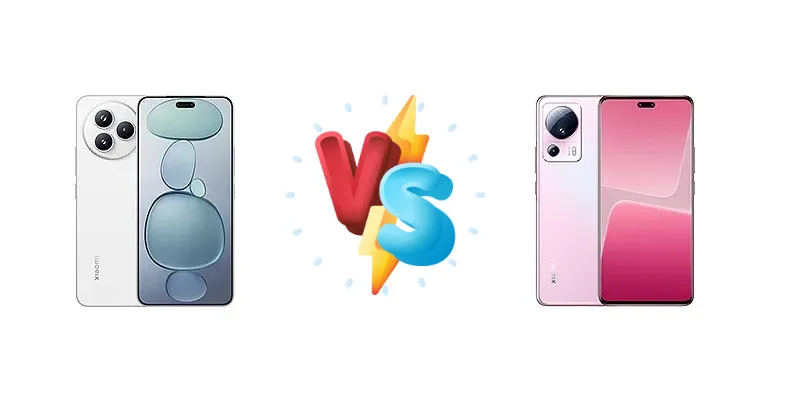
|
🏆 Quick Verdict
For most users prioritizing performance and future-proofing, the Xiaomi Civi 5 Pro is the clear winner. Its Snapdragon 8s Gen 4 chipset delivers a substantial leap in CPU and GPU capabilities compared to the 13 Lite’s Snapdragon 7 Gen 1. While battery life is comparable, the Civi 5 Pro offers a more responsive and capable experience.
| PHONES | ||
|---|---|---|
| Phone Names | Xiaomi Civi 5 Pro | Xiaomi 13 Lite |
| Network | ||
|---|---|---|
| 2G bands | GSM 850 / 900 / 1800 / 1900 | GSM 850 / 900 / 1800 / 1900 |
| 3G bands | HSDPA 800 / 850 / 900 / 1700(AWS) / 1900 / 2100 | HSDPA 800 / 850 / 900 / 1700(AWS) / 1900 / 2100 |
| 4G bands | 1, 3, 4, 5, 8, 19, 28, 34, 38, 39, 40, 41, 42, 48, 66 | 1, 2, 3, 4, 5, 7, 8, 12, 13, 17, 18, 19, 20, 26, 28, 32, 38, 40, 41, 42, 66 |
| 5G bands | 1, 3, 5, 8, 28, 38, 40, 41, 48, 66, 77, 78 SA/NSA | 1, 3, 5, 7, 8, 20, 28, 38, 40, 41, 66, 77, 78 SA/NSA |
| Speed | HSPA, LTE, 5G | HSPA, LTE, 5G |
| Technology | GSM / CDMA / HSPA / CDMA2000 / LTE / 5G | GSM / HSPA / LTE / 5G |
| Launch | ||
|---|---|---|
| Announced | 2025, May 22 | 2023, February 26 |
| Status | Available. Released 2025, May 22 | Available. Released 2023, March 08 |
| Body | ||
|---|---|---|
| Build | - | Glass front (Gorilla Glass 5), glass back, plastic frame |
| Dimensions | 157.1 x 73.2 x 7.5 or 7.7 g | 159.2 x 72.7 x 7.2 mm (6.27 x 2.86 x 0.28 in) |
| SIM | Nano-SIM + Nano-SIM | · Nano-SIM + eSIM· Nano-SIM + Nano-SIM |
| Weight | 181 g or 184 g (6.38 oz) | 171 g (6.03 oz) |
| - | IP53, dust and splash resistant | |
| Display | ||
|---|---|---|
| Protection | - | Corning Gorilla Glass 5 |
| Resolution | 1236 x 2750 pixels, 20:9 ratio (~460 ppi density) | 1080 x 2400 pixels, 20:9 ratio (~402 ppi density) |
| Size | 6.55 inches, 103.5 cm2 (~90.0% screen-to-body ratio) | 6.55 inches, 103.6 cm2 (~89.5% screen-to-body ratio) |
| Type | AMOLED, 68B colors, 120Hz, 2560Hz PWM, Dolby Vision, HDR10+, HDR Vivid, 3200 nits (peak) | AMOLED, 68B colors, Dolby Vision, HDR10+, 120Hz, 500 nits (typ), 1000 nits (peak) |
| Platform | ||
|---|---|---|
| CPU | Octa-core (1x3.21 GHz Cortex-X4 & 3x3.0 GHz Cortex-A720 & 2x2.8 GHz Cortex-A720 & 2x2.0 GHz Cortex-A720) | Octa-core (1x2.4 GHz Cortex-A710 & 3x2.36 GHz Cortex-A710 & 4x1.8 GHz Cortex-A510) |
| Chipset | Qualcomm SM8735 Snapdragon 8s Gen 4 (4 nm) | Qualcomm SM7450-AB Snapdragon 7 Gen 1 (4 nm) |
| GPU | Adreno 825 | Adreno 644 |
| OS | Android 15, HyperOS 2 | Android 12, MIUI 14 |
| Memory | ||
|---|---|---|
| Card slot | No | No |
| Internal | 256GB 12GB RAM, 512GB 12GB RAM, 512GB 16GB RAM | 64GB 8GB RAM, 128GB 8GB RAM, 256GB 8GB RAM |
| - | UFS 2.2 | |
| Main Camera | ||
|---|---|---|
| Features | Color spectrum sensor, Dual-LED flash, HDR, panorama, Leica lenses | Dual-LED dual-tone flash, HDR, panorama |
| Triple | 50 MP, f/1.6, 25mm (wide), 1/1.55", 1.0µm, PDAF, OIS 50 MP, f/2.0, 60mm (telephoto), PDAF (10cm - ∞), 2.5x optical zoom 12 MP, f/2.2, 15mm, 120˚ (ultrawide), 1.12µm, AF | 50 MP, f/1.8, 23mm (wide), 1/1.56", 1.0µm, PDAF 8 MP, f/2.2, 119˚ (ultrawide), 1/4.0", 1.12µm 2 MP (macro) |
| Video | 4K@30/60fps, 1080p@30/60/120/240/960fps, HDR, gyro-EIS | 4K@30fps, 1080p@30/60/120fps, 720p@960fps |
| Selfie camera | ||
|---|---|---|
| Dual | - | 32 MP, f/2.4, 100˚ (ultrawide), 1/2.74", 0.8µm 8 MP, f/2.3, (depth) |
| Features | HDR, panorama | Dual-LED flash, HDR |
| Single | 50 MP, f/2.0, (wide), 0.64µm, PDAF | - |
| Video | 4K@30/60fps, 1080p@30/60fps; gyro-EIS | 1080p@30/60fps |
| Sound | ||
|---|---|---|
| 3.5mm jack | - | No |
| 35mm jack | No | No |
| Loudspeaker | Yes, with stereo speakers | Yes |
| - | 24-bit/192kHz audio | |
| Comms | ||
|---|---|---|
| Bluetooth | 5.4, A2DP, LE, aptX HD, aptX Adaptive, LHDC 5 | 5.2, A2DP, LE |
| Infrared port | Yes | Yes |
| NFC | Yes | Yes (market/region dependent) |
| Positioning | GPS, GALILEO, GLONASS, QZSS, BDS (B1I+B1c) | GPS (L1), GLONASS (G1), BDS (B1I+B1c), GALILEO (E1), QZSS (L1) |
| Radio | No | No |
| USB | USB Type-C 2.0, OTG | USB Type-C 2.0, OTG |
| WLAN | Wi-Fi 802.11 a/b/g/n/ac/6/7, dual-band, Wi-Fi Direct | Wi-Fi 802.11 a/b/g/n/ac/6, dual-band |
| Features | ||
|---|---|---|
| Sensors | Fingerprint (under display, optical), accelerometer, gyro, proximity, compass | Fingerprint (under display, optical), accelerometer, gyro, proximity, compass |
| Battery | ||
|---|---|---|
| Charging | 67W wired, PD3.0, QC3+ | 67W wired, 100% in 40 min |
| Type | Si/C Li-Ion 6000 mAh | Li-Po 4500 mAh |
| Misc | ||
|---|---|---|
| Colors | Gray, Rose Gold, Violet, White, Brown | Black, Lite Blue, Lite Pink |
| Price | About 370 EUR | About 180 EUR |
| Tests | ||
|---|---|---|
| Battery life | - | Endurance rating 93h |
| Camera | - | Photo / Video |
| Display | - | Contrast ratio: Infinite (nominal) |
| Loudspeaker | - | -28.5 LUFS (Average) |
| Performance | - | AnTuTu: 534143 (v9) GeekBench: 2936 (v5.1), 2434 (v6) GFXBench: 33fps (ES 3.1 onscreen) |
Xiaomi Civi 5 Pro
- Significantly faster processor with Snapdragon 8s Gen 4
- Potential for better gaming performance
- Likely improved camera processing due to newer chipset
- Battery capacity is unknown
- Display details are limited
Xiaomi 13 Lite
- Excellent 93-hour battery endurance rating
- Fast 67W charging (40 minutes to full)
- High peak display brightness (938 nits)
- Less powerful Snapdragon 7 Gen 1 chipset
- Standard refresh rate switching (no LTPO)
Display Comparison
Both phones feature displays capable of reaching high brightness, with the Xiaomi 13 Lite measured at 938 nits. While the Civi 5 Pro’s peak brightness isn’t specified, it’s likely comparable. Both boast an 'Infinite' contrast ratio, typical of OLED panels. However, the Civi 5 Pro’s display technology is unknown, and the 13 Lite’s lack of LTPO suggests a standard 60/120Hz refresh rate switching, potentially impacting battery life during dynamic content. The Civi 5 Pro may benefit from a more advanced panel.
Camera Comparison
Both phones are advertised as having capable photo and video capabilities, but detailed sensor information is lacking. Without specifics, it’s difficult to make a definitive judgment. However, Xiaomi typically prioritizes camera performance in its higher-tier devices, suggesting the Civi 5 Pro may benefit from a more advanced image signal processor (ISP) within the Snapdragon 8s Gen 4. The absence of details on OIS or sensor size makes a direct comparison challenging, but the chipset advantage leans towards the Civi 5 Pro.
Performance
The core difference lies in the chipsets. The Xiaomi Civi 5 Pro’s Snapdragon 8s Gen 4 (4nm) is a significant upgrade over the 13 Lite’s Snapdragon 7 Gen 1 (4nm). The 8s Gen 4 features a 1x3.21 GHz Cortex-X4 prime core, alongside 3x3.0 GHz Cortex-A720 cores, and 2x2.8 GHz Cortex-A720 cores, and 2x2.0 GHz Cortex-A720 cores, offering substantially higher peak performance than the 13 Lite’s 1x2.4 GHz Cortex-A710, 3x2.36 GHz Cortex-A710, and 4x1.8 GHz Cortex-A510 configuration. This translates to faster app loading, smoother multitasking, and a more enjoyable gaming experience. While both use a 4nm process, the architectural improvements in the 8s Gen 4 provide a clear advantage.
Battery Life
The Xiaomi 13 Lite boasts an impressive endurance rating of 93 hours, indicating excellent battery optimization. Both phones support 67W wired charging, with the 13 Lite claiming a full charge in 40 minutes. The Civi 5 Pro’s battery capacity is unknown, but the more powerful chipset could offset any potential capacity difference. The 13 Lite’s established endurance rating provides a degree of confidence, but the Civi 5 Pro’s charging speed is comparable, minimizing downtime.
Buying Guide
Buy the Xiaomi Civi 5 Pro if you need a phone capable of handling demanding games, multitasking, and future software updates without slowdown. It’s ideal for power users and mobile gamers. Buy the Xiaomi 13 Lite if you prioritize a well-rounded experience with a proven track record, excellent battery endurance (93h rating), and are less concerned with pushing the absolute limits of mobile performance. It’s a great choice for everyday users and social media enthusiasts.