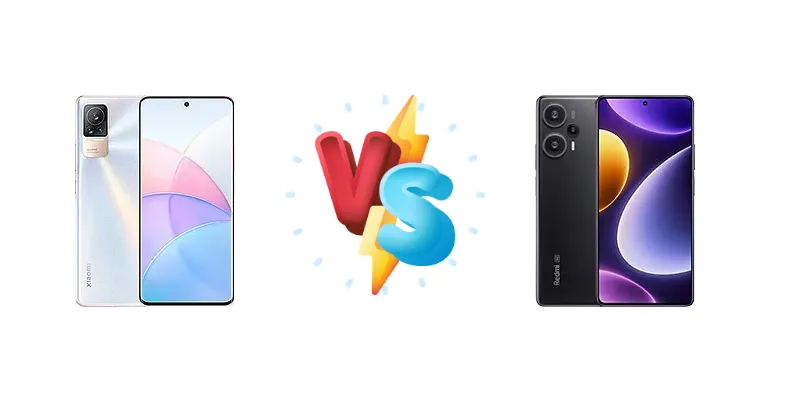
Xiaomi consistently delivers impressive smartphones at competitive prices. The Civi 1S and Redmi Note 12 Turbo are two such contenders, each targeting a slightly different audience. But which one offers the best overall experience? Let's dive into a detailed comparison to help you decide.
🏆 Quick Verdict
The Redmi Note 12 Turbo emerges as the clear winner thanks to its significantly faster Snapdragon 7+ Gen 2 chipset and slightly better charging. While the Civi 1S boasts a stylish design and good camera, the Turbo's performance advantage makes it the more compelling choice for most users.
| Network |
|---|
| 2G bands | GSM 850 / 900 / 1800 / 1900 | GSM 850 / 900 / 1800 / 1900 |
| 3G bands | HSDPA 850 / 900 / 1700(AWS) / 1900 / 2100 | HSDPA 800 / 850 / 900 / 2100 |
| 4G bands | 1, 2, 3, 4, 5, 7, 8, 18, 19, 26, 34, 38, 39, 40, 41, 42 | 1, 3, 5, 8, 19, 34, 38, 39, 40, 41, 42 |
| 5G bands | 1, 3, 5, 8, 28, 38, 41, 77, 78 SA/NSA | 1, 3, 5, 8, 28, 38, 41, 77, 78 SA/NSA |
| Speed | HSPA, LTE, 5G | HSPA, LTE, 5G |
| Technology | GSM / CDMA / HSPA / CDMA2000 / LTE / 5G | GSM / HSPA / CDMA2000 / LTE / 5G |
| | CDMA2000 1x | CDMA2000 1x |
| Launch |
|---|
| Announced | 2022, April 21 | 2023, March 28 |
| Status | Available. Released 2022, April 21 | Available. Released 2023, March 28 |
| Body |
|---|
| Build | Glass front (Gorilla Glass 5), glass back, aluminum frame | Glass front, plastic frame, plastic back |
| Dimensions | 158.3 x 71.5 x 7 mm (6.23 x 2.81 x 0.28 in) | 161.1 x 75 x 7.9 mm (6.34 x 2.95 x 0.31 in) |
| SIM | Nano-SIM + Nano-SIM | Nano-SIM + Nano-SIM |
| Weight | 166 g (5.86 oz) | 181 g (6.38 oz) |
| Display |
|---|
| Protection | Corning Gorilla Glass 5 | - |
| Resolution | 1080 x 2400 pixels, 20:9 ratio (~402 ppi density) | 1080 x 2400 pixels, 20:9 ratio (~395 ppi density) |
| Size | 6.55 inches, 103.6 cm2 (~91.5% screen-to-body ratio) | 6.67 inches, 107.4 cm2 (~88.9% screen-to-body ratio) |
| Type | OLED, 1B colors, Dolby Vision, HDR10+, 120Hz, 950 nits (peak) | OLED, 68B colors, 120Hz, Dolby Vision, HDR10+, 1000 nits (HBM) |
| Platform |
|---|
| CPU | Octa-core (1x2.5 GHz Cortex-A78 & 3x2.4 GHz Cortex-A78 & 4x1.9 GHz Cortex-A55) | Octa-core (1x2.91 GHz Cortex-X2 & 3x2.49 GHz Cortex-A710 & 4x1.8 GHz Cortex-A510) |
| Chipset | Qualcomm SM7325-AE Snapdragon 778G+ 5G (6 nm) | Qualcomm SM7475-AB Snapdragon 7+ Gen 2 (4 nm) |
| GPU | Adreno 642L | Adreno 725 |
| OS | Android 12, MIUI 13 | Android 13, MIUI 14 |
| Memory |
|---|
| Card slot | No | No |
| Internal | 128GB 8GB RAM, 256GB 8GB RAM, 256GB 12GB RAM | 256GB 8GB RAM, 256GB 12GB RAM, 256GB 16GB RAM, 512GB 12GB RAM, 1TB 16GB RAM |
| | UFS 2.2 | UFS 3.1 |
| Main Camera |
|---|
| Features | Color spectrum sensor, LED flash, HDR, panorama | LED flash, HDR, panorama |
| Single | 32 MP, 24mm (wide), 0.8µm, AF | - |
| Triple | 64 MP, f/1.8, 26mm (wide), 1/1.97", 0.7µm, PDAF
8 MP, f/2.2, 120˚ (ultrawide), 1/4.0", 1.12µm
2 MP (macro) | 64 MP, f/1.8, (wide), 1/2.0", 0.7µm, PDAF, OIS
8 MP, f/2.2, 120˚ (ultrawide), 1/4.0", 1.12µm
2 MP (macro) |
| Video | 4K@30fps, 1080p@30/60/120fps, 720p@960fps; gyro-EIS | 4K@30fps, 1080p@30/60/120/240fps |
| Selfie camera |
|---|
| Features | HDR, panorama | - |
| Single | 32 MP, 24mm (wide), 0.8µm, AF | 16 MP, f/2.5, (wide) |
| Video | 1080p@30/60fps | 1080p@30/60fps |
| Sound |
|---|
| 3.5mm jack | No | Yes |
| 35mm jack | No | Yes |
| Loudspeaker | Yes, with stereo speakers | Yes, with stereo speakers |
| | 24-bit/192kHz audio | 24-bit/192kHz audio |
| Comms |
|---|
| Bluetooth | 5.2, A2DP, LE | 5.3, A2DP, LE |
| Infrared port | Yes | Yes |
| NFC | Yes | Yes |
| Positioning | GPS (L1+L5), GLONASS (L1), BDS (B1I+B1c+B2a), GALILEO (E1+E5a), QZSS (L1+L5), NavIC (L5) | GPS (L1), GLONASS (G1), BDS (B1I+B1c), GALILEO (E1), QZSS (L1) |
| Radio | No | No |
| USB | USB Type-C 2.0, OTG | USB Type-C 2.0, OTG |
| WLAN | Wi-Fi 802.11 a/b/g/n/ac/6, dual-band, Wi-Fi Direct | Wi-Fi 802.11 a/b/g/n/ac/6e, dual-band |
| Features |
|---|
| Sensors | Fingerprint (under display, optical), accelerometer, gyro, proximity, compass | Fingerprint (side-mounted), accelerometer, gyro, proximity, compass |
| Battery |
|---|
| Charging | 55W wired, QC4, 100% in 45 min | 67W wired, PD3.0, QC4 |
| Type | Li-Po 4500 mAh | Li-Po 5000 mAh |
| Misc |
|---|
| Colors | Black, Blue, Pink, Silver | Black, Blue, White, Harry Potter Edition |
| Models | - | 23049RAD8C |
| Price | About 330 EUR | About 270 EUR |
Xiaomi Civi 1S
- Stylish Design
- Excellent Selfie Camera
- Compact Size
- Fast Charging (55W)
- Older Chipset
- Less Powerful than Turbo
- No Expandable Storage
Xiaomi Redmi Note 12 Turbo
- Powerful Snapdragon 7+ Gen 2
- Faster Charging (67W)
- Excellent Performance
- Good Value
- Less Distinctive Design
- Potentially Larger Size
- No Expandable Storage
Display Comparison
Both phones feature AMOLED displays with a 120Hz refresh rate, offering smooth visuals. The Note 12 Turbo likely has slightly better peak brightness and color accuracy due to its newer panel, but the difference is subtle. The Civi 1S has a slightly smaller and more compact design, which some may prefer.
Camera Comparison
The Civi 1S is known for its selfie camera capabilities, often praised for its beauty mode and overall quality. Both phones have capable main camera systems, but the Note 12 Turbo's newer chipset may offer slightly better image processing and low-light performance. Expect similar results in most scenarios.
Performance
This is where the Note 12 Turbo truly shines. The Snapdragon 7+ Gen 2 is a substantial upgrade over the Snapdragon 778G+, offering significantly faster CPU and GPU performance. Expect smoother multitasking, faster app loading times, and a much better gaming experience on the Turbo.
Battery Life
The Note 12 Turbo has a slightly larger battery capacity and faster charging (67W vs 55W), allowing for quicker top-ups. Both phones offer all-day battery life with moderate usage, but the Turbo provides a bit more breathing room.
Buying Guide
The Xiaomi Civi 1S is ideal for users prioritizing aesthetics, a compact form factor, and a decent camera experience without needing top-tier performance. The Redmi Note 12 Turbo is perfect for gamers, power users, and anyone who values raw processing power and fast charging above all else.
Frequently Asked Questions
❓ Is the Redmi Note 12 Turbo worth the extra cost?
If performance is a priority, absolutely. The Snapdragon 7+ Gen 2 provides a significant boost over the Civi 1S's chipset.
❓ Does the Civi 1S have expandable storage?
No, neither phone offers expandable storage via microSD card.
❓ Which phone is better for gaming?
The Redmi Note 12 Turbo is significantly better for gaming due to its more powerful chipset and improved thermal management.