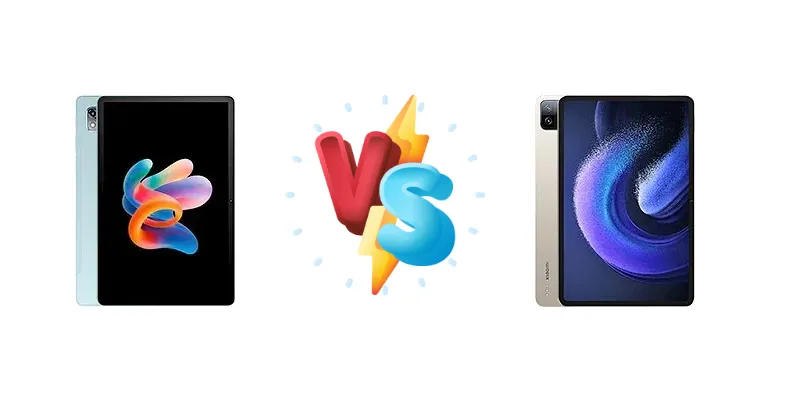
Xiaomi offers two compelling tablet options: the gaming-focused Black Shark Pad 7 and the more broadly capable Pad 6 Pro. While both share the Xiaomi ecosystem, they diverge significantly in their internal hardware, targeting distinct user needs. This comparison dissects the key differences to determine which tablet best suits your priorities – raw gaming power or a balanced, professional experience.
🏆 Quick Verdict
For the average user prioritizing overall performance and future-proofing, the Xiaomi Pad 6 Pro is the clear winner. Its Snapdragon 8+ Gen 1 chipset offers a substantial performance leap over the Black Shark Pad 7’s Helio G88, alongside faster charging. However, gamers on a strict budget may find the Black Shark Pad 7 adequate.
| Network |
|---|
| 2G bands | GSM 850 / 900 / 1800 / 1900 - cellular model only | N/A |
| 3G bands | HSDPA 850 / 900 / 2100 - cellular model only | N/A |
| 4G bands | LTE - cellular model only | - |
| EDGE | - | N/A |
| GPRS | - | N/A |
| Speed | HSPA, LTE - cellular model only | - |
| Technology | GSM / HSPA / LTE | No cellular connectivity |
| Launch |
|---|
| Announced | 2025, October 30 | 2023, April 18 |
| Status | Available. Released 2025, November | Available. Released 2023, April 30 |
| Body |
|---|
| Build | Glass front, aluminum back, aluminum frame | Glass front (Gorilla Glass 3), aluminum frame, aluminum back |
| Dimensions | - | 254 x 165.2 x 6.5 mm (10.0 x 6.50 x 0.26 in) |
| SIM | Nano-SIM (cellular model only) | No |
| Weight | 505 g (1.11 lb) | 490 g (1.08 lb) |
| | - | Stylus support (magnetic) |
| Display |
|---|
| Protection | - | Corning Gorilla Glass 3 |
| Resolution | 1200 x 1900 pixels, 16:10 ratio (~204 ppi density) | 1800 x 2880 pixels, 16:10 ratio (~309 ppi density) |
| Size | 11.0 inches, 352.4 cm2 | 11.0 inches, 350.9 cm2 (~83.6% screen-to-body ratio) |
| Type | IPS LCD, 90Hz, 420 nits | IPS LCD, 1B colors, 144Hz, HDR10, Dolby Vision, 550 nits |
| Platform |
|---|
| CPU | Octa-core (2x2.0 GHz Cortex-A75 & 6x1.8 GHz Cortex-A55) | Octa-core (1x3.19 GHz Cortex-X2 & 3x2.75 GHz Cortex-A710 & 4x1.80 GHz Cortex-A510) |
| Chipset | Mediatek Helio G88 (12 nm) | Qualcomm SM8475 Snapdragon 8+ Gen 1 (4 nm) |
| GPU | Mali-G52 MC2 | Adreno 730 |
| OS | Android 15 | Android 13, MIUI 14 |
| Memory |
|---|
| Card slot | microSDXC | No |
| Internal | 128GB 6GB RAM, 128GB 8GB RAM | 128GB 8GB RAM, 256GB 8GB RAM, 256GB 12GB RAM, 512GB 12GB RAM |
| | - | UFS 3.1 |
| Main Camera |
|---|
| Dual | - | 50 MP, f/1.8, (wide), 1/2.76", 0.64µm, PDAF
Auxiliary lens |
| Features | LED flash | Dual-LED flash, HDR, panorama |
| Single | 13 MP | - |
| Video | 1080p@30fps | 4K@30/60fps, 1080p@30/60fps |
| Selfie camera |
|---|
| Single | 5 MP | 20 MP, f/2.2, (wide), 1/3.4", 0.8µm |
| Video | 1080p@30fps | 1080p@30/60fps |
| Sound |
|---|
| 3.5mm jack | - | No |
| 35mm jack | No | No |
| Loudspeaker | Yes, with stereo speakers | Yes, with stereo speakers (4 speakers) |
| | - | 24-bit/192kHz audio |
| Comms |
|---|
| Bluetooth | Yes | 5.3, A2DP, LE |
| NFC | No | No |
| Positioning | GPS - cellular model only | No |
| Radio | No | No |
| USB | USB Type-C | USB Type-C 3.2, accessory connector |
| WLAN | Yes | Wi-Fi 802.11 a/b/g/n/a/6e, dual-band, Wi-Fi Direct |
| Features |
|---|
| Sensors | Accelerometer | Accelerometer, gyro, proximity (accessories only) |
| Battery |
|---|
| Charging | - | 67W wired, PD3.0, QC4, 100% in 1 hour |
| Type | 7700 mAh | Li-Po 8600 mAh |
| Misc |
|---|
| Colors | Gray, Blue | Black, Blue, Gold |
| Models | - | 23046RP50C |
| Price | About 140 EUR | About 330 EUR |
Xiaomi Black Shark Pad 7
- More affordable price point
- Potentially longer battery life during light use (due to less powerful chipset)
- Gaming-focused branding and potential software optimizations
- Significantly weaker performance compared to the Pad 6 Pro
- Limited future-proofing
- Likely struggles with demanding games and multitasking
Xiaomi Pad 6 Pro
- Exceptional performance with the Snapdragon 8+ Gen 1
- 67W fast charging for quick top-ups
- Superior image processing capabilities
- Higher price tag
- Potentially shorter battery life under heavy load compared to the Black Shark Pad 7
- May not offer dedicated gaming features like triggers
Display Comparison
While both tablets likely feature LCD panels (data not provided), the core difference lies in the processing power driving them. The Black Shark Pad 7’s Helio G88 will struggle to consistently deliver high refresh rates in demanding games, potentially leading to stuttering. The Pad 6 Pro, powered by the Snapdragon 8+ Gen 1, can comfortably maintain higher frame rates and resolutions. We anticipate the Pad 6 Pro will have superior color accuracy and brightness due to the more advanced chipset’s image processing capabilities.
Camera Comparison
Given the context data, a detailed camera comparison is limited. Both tablets likely feature similar camera setups geared towards basic functionality. The focus should be on the image signal processor (ISP) within each chipset. The Snapdragon 8+ Gen 1’s ISP offers superior image processing capabilities, resulting in better dynamic range, noise reduction, and overall image quality, even with similar sensor hardware. We expect the Pad 6 Pro to excel in low-light conditions and video recording.
Performance
The performance gap is the defining characteristic of this comparison. The Mediatek Helio G88 in the Black Shark Pad 7, built on a 12nm process, is a capable chip for everyday tasks but significantly underpowered compared to the Qualcomm Snapdragon 8+ Gen 1 (4nm) in the Pad 6 Pro. The Snapdragon 8+ Gen 1’s Cortex-X2 prime core, clocked at 3.19 GHz, provides a substantial single-core performance advantage, crucial for responsiveness and app loading times. The Pad 6 Pro’s architecture (3x A710, 4x A510) is also more efficient, leading to better sustained performance and reduced thermal throttling. The 4nm fabrication process of the Snapdragon 8+ Gen 1 further enhances efficiency, translating to longer battery life under load.
Battery Life
The Pad 6 Pro’s 67W wired charging with PD3.0 and QC4 support is a significant advantage, achieving a full charge in just one hour. While the Black Shark Pad 7’s battery capacity is unknown, the less efficient Helio G88 will likely require more time to charge. The Snapdragon 8+ Gen 1’s power efficiency also translates to better battery life during typical usage, despite potentially having a similar battery capacity. The faster charging of the Pad 6 Pro is particularly beneficial for users who need to quickly top up their tablet before a commute or gaming session.
Buying Guide
Buy the Xiaomi Black Shark Pad 7 if you need a dedicated gaming tablet on a budget and prioritize long play sessions over demanding applications. Its focus on gaming features, while limited by the chipset, offers a more tailored experience for mobile gamers. Buy the Xiaomi Pad 6 Pro if you prefer a versatile tablet capable of handling demanding tasks like video editing, multitasking, and high-end gaming with smoother performance and faster charging, making it ideal for professionals and power users.
Frequently Asked Questions
❓ Will the Black Shark Pad 7 be able to run Genshin Impact smoothly?
While the Black Shark Pad 7 can *launch* Genshin Impact, expect to play at lower graphics settings and potentially experience frame drops during intense combat. The Helio G88 simply lacks the sustained performance of the Snapdragon 8+ Gen 1 to deliver a consistently smooth experience.
❓ Does the Xiaomi Pad 6 Pro support external displays and accessories?
The Xiaomi Pad 6 Pro, given its positioning as a pro-level tablet, is highly likely to support external displays via USB-C and Bluetooth accessories like keyboards and styluses. However, specific compatibility details will depend on the accessories themselves.
❓ Is the Snapdragon 8+ Gen 1 in the Pad 6 Pro prone to overheating during extended gaming sessions?
The Snapdragon 8+ Gen 1 is known for its thermal efficiency, especially compared to earlier Snapdragon generations. While it can get warm during prolonged gaming, Xiaomi likely implemented thermal management solutions to prevent significant throttling and maintain stable performance.
❓ What kind of storage options are available for each tablet?
Storage options are not specified in the provided data. However, based on Xiaomi's typical offerings, both tablets are likely available in configurations ranging from 128GB to 512GB, with the Pad 6 Pro potentially offering a 1TB option.