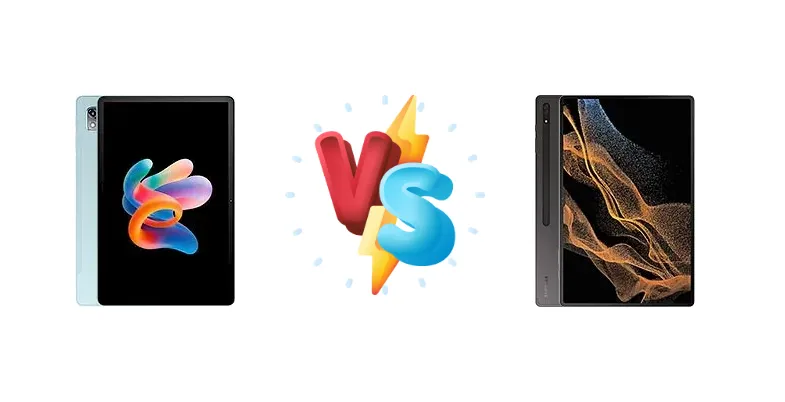
The tablet market is bifurcating: premium productivity devices and dedicated gaming slates. The Samsung Galaxy Tab S8 Ultra represents the pinnacle of Android tablet luxury, boasting a stunning display and flagship power. The Xiaomi Black Shark Pad 7, however, aims to deliver a compelling gaming experience at a significantly lower price point. This comparison dissects the core differences to help you determine which tablet best suits your needs.
🏆 Quick Verdict
For the average user prioritizing all-around performance, display quality, and long-term software support, the Samsung Galaxy Tab S8 Ultra is the clear winner. However, gamers on a budget will find the Black Shark Pad 7 offers a surprisingly capable experience, albeit with compromises in processing power and overall refinement.
| Network |
|---|
| 2G bands | GSM 850 / 900 / 1800 / 1900 - cellular model only | GSM 850 / 900 / 1800 / 1900 |
| 3G bands | HSDPA 850 / 900 / 2100 - cellular model only | HSDPA 850 / 900 / 1700(AWS) / 1900 / 2100 |
| 4G bands | LTE - cellular model only | LTE |
| 5G bands | - | SA/NSA |
| Speed | HSPA, LTE - cellular model only | HSPA, LTE, 5G - cellular model only |
| Technology | GSM / HSPA / LTE | GSM / HSPA / LTE / 5G |
| Launch |
|---|
| Announced | 2025, October 30 | 2022, February 09 |
| Status | Available. Released 2025, November | Available. Released 2022, April 30 |
| Body |
|---|
| Build | Glass front, aluminum back, aluminum frame | - |
| Dimensions | - | 326.4 x 208.6 x 5.5 mm (12.85 x 8.21 x 0.22 in) |
| SIM | Nano-SIM (cellular model only) | Nano-SIM (cellular model only) |
| Weight | 505 g (1.11 lb) | 726 g (Wi-Fi), 728 g (5G) (1.60 lb) |
| | - | Stylus, 2.8ms latency (Bluetooth integration, accelerometer, gyro) |
| Display |
|---|
| Protection | - | Corning Gorilla Glass 5 |
| Resolution | 1200 x 1900 pixels, 16:10 ratio (~204 ppi density) | 1848 x 2960 pixels, 16:10 ratio (~240 ppi density) |
| Size | 11.0 inches, 352.4 cm2 | 14.6 inches, 612.6 cm2 (~90.0% screen-to-body ratio) |
| Type | IPS LCD, 90Hz, 420 nits | Super AMOLED, 120Hz, HDR10+ |
| Platform |
|---|
| CPU | Octa-core (2x2.0 GHz Cortex-A75 & 6x1.8 GHz Cortex-A55) | Octa-core (1x3.00 GHz Cortex-X2 & 3x2.50 GHz Cortex-A710 & 4x1.80 GHz Cortex-A510) |
| Chipset | Mediatek Helio G88 (12 nm) | Qualcomm SM8450 Snapdragon 8 Gen 1 (4 nm) |
| GPU | Mali-G52 MC2 | Adreno 730 |
| OS | Android 15 | Android 12, up to 4 major Android upgrades, One UI 6.1.1 |
| Memory |
|---|
| Card slot | microSDXC | microSDXC (dedicated slot) |
| Internal | 128GB 6GB RAM, 128GB 8GB RAM | 128GB 8GB RAM, 256GB 8GB RAM, 256GB 12GB RAM, 256GB 16GB RAM, 512GB 12GB RAM, 512GB 16GB RAM |
| | - | UFS |
| Main Camera |
|---|
| Dual | - | 13 MP, f/2.0, 26mm (wide), 1/3.4", 1.0µm, AF
6 MP, f/2.2, (ultrawide) |
| Features | LED flash | LED flash, HDR, panorama |
| Single | 13 MP | - |
| Video | 1080p@30fps | 4K@30/60fps, 1080p@30fps |
| Selfie camera |
|---|
| Dual | - | 12 MP, f/2.2, 26mm (wide)
12 MP, f/2.4, 120˚ (ultrawide) |
| Features | - | HDR |
| Single | 5 MP | - |
| Video | 1080p@30fps | 4K@30/60fps, 1080p@30fps |
| Sound |
|---|
| 3.5mm jack | - | No |
| 35mm jack | No | No |
| Loudspeaker | Yes, with stereo speakers | Yes, with stereo speakers (4 speakers) |
| | - | Tuned by AKG |
| Comms |
|---|
| Bluetooth | Yes | 5.2, A2DP, LE |
| NFC | No | No |
| Positioning | GPS - cellular model only | GPS, GLONASS, BDS, GALILEO - cellular model only |
| Radio | No | No |
| USB | USB Type-C | USB Type-C 3.2, magnetic connector |
| WLAN | Yes | Wi-Fi 802.11 a/b/g/n/ac/6e, dual-band, Wi-Fi Direct |
| Features |
|---|
| Sensors | Accelerometer | Fingerprint (under display, optical), accelerometer, gyro, proximity, compass |
| | - | Wireless Samsung DeX |
| Battery |
|---|
| Charging | - | 45W wired, 100% in 82 min |
| Type | 7700 mAh | Li-Po 11200 mAh |
| Misc |
|---|
| Colors | Gray, Blue | Graphite |
| Models | - | SM-X900, SM-X906, SM-X906B, SM-X906U, SM-X906N |
| Price | About 140 EUR | About 1150 EUR |
| SAR EU | - | 0.69 W/kg (body) |
Xiaomi Black Shark Pad 7
- More affordable price point
- Dedicated gaming focus
- Potentially higher refresh rate display
- Significantly weaker processor
- Less refined software experience
- Likely shorter software support
Samsung Galaxy Tab S8 Ultra
- Flagship-level performance with Snapdragon 8 Gen 1
- Stunning Super AMOLED display with LTPO
- Faster charging and potentially better battery efficiency
- Significantly higher price
- Potential for thermal throttling under heavy load
- Larger size may be less portable
Display Comparison
While both tablets offer large displays, the specifics differ significantly. The Galaxy Tab S8 Ultra’s 14.6-inch Super AMOLED panel is expected to deliver vibrant colors and deep blacks, a hallmark of Samsung’s display technology. The Black Shark Pad 7’s display specifications are not provided, but given its gaming focus, a high refresh rate is likely. However, the Tab S8 Ultra’s expected LTPO technology dynamically adjusts the refresh rate, conserving battery life during static content. The Tab S8 Ultra’s larger size and higher resolution will provide a more immersive viewing experience, while the Black Shark Pad 7 likely prioritizes responsiveness for gaming.
Camera Comparison
Camera performance is unlikely to be a primary concern for either tablet, but the Tab S8 Ultra is expected to offer a more versatile system. Details on the Tab S8 Ultra’s camera setup are not provided, but Samsung typically equips its flagship tablets with high-resolution sensors and advanced image processing. The Black Shark Pad 7’s camera specifications are not available, suggesting a focus on cost reduction in this area. Expect the Tab S8 Ultra to excel in image quality and video recording, while the Black Shark Pad 7 will likely suffice for basic video calls and casual snapshots.
Performance
The performance gap is substantial. The Samsung Galaxy Tab S8 Ultra’s Qualcomm Snapdragon 8 Gen 1 (4nm) is a flagship-tier chipset, featuring a Cortex-X2 prime core clocked at 3.00 GHz, alongside Cortex-A710 and A510 cores. This architecture, built on a 4nm process, delivers significantly higher performance and improved power efficiency compared to the Xiaomi Black Shark Pad 7’s MediaTek Helio G88 (12nm). The Helio G88, while capable for casual gaming, is a mid-range chipset. The Snapdragon 8 Gen 1’s superior GPU will translate to higher frame rates and more demanding graphics settings in games. The Tab S8 Ultra’s LPDDR5x RAM further enhances performance, providing faster data access compared to the likely LPDDR4X RAM in the Black Shark Pad 7. Thermal management will be crucial; the Snapdragon 8 Gen 1 is known to generate heat, but the Tab S8 Ultra’s larger chassis should provide better cooling capacity.
Battery Life
Battery life will depend on usage patterns, but the Samsung Galaxy Tab S8 Ultra benefits from 45W wired charging, reaching 100% in 82 minutes. The Black Shark Pad 7’s battery capacity and charging speed are unknown. The Snapdragon 8 Gen 1’s 4nm process offers better power efficiency than the Helio G88’s 12nm node, potentially offsetting the Tab S8 Ultra’s larger display. However, demanding gaming sessions will drain the battery quickly on both devices. The Tab S8 Ultra’s faster charging will minimize downtime.
Buying Guide
Buy the Xiaomi Black Shark Pad 7 if you need a dedicated gaming tablet that won't break the bank, prioritizing frame rates and responsiveness over absolute processing power. You're willing to accept a less refined software experience and potentially shorter software support lifespan. Buy the Samsung Galaxy Tab S8 Ultra if you prefer a premium, versatile tablet for productivity, media consumption, and occasional gaming, demanding the best possible display, performance, and long-term software updates.
Frequently Asked Questions
❓ Is the MediaTek Helio G88 in the Black Shark Pad 7 powerful enough for demanding games like Genshin Impact?
While the Helio G88 can run Genshin Impact, you'll likely need to lower the graphics settings to medium or low to achieve a stable frame rate. It won't deliver the same smooth experience as the Snapdragon 8 Gen 1 in the Tab S8 Ultra, which can handle the game at higher settings.
❓ Does the Samsung Galaxy Tab S8 Ultra's Snapdragon 8 Gen 1 overheat during extended gaming sessions?
The Snapdragon 8 Gen 1 is known to generate heat under sustained load. However, the Tab S8 Ultra’s larger chassis and potential for advanced cooling solutions should mitigate throttling. Expect some performance reduction after prolonged gaming, but it shouldn't be severe enough to render the device unusable.
❓ What kind of software support can I expect from Xiaomi for the Black Shark Pad 7?
Xiaomi's software support for its tablets is generally shorter than Samsung's. Expect fewer major Android updates and security patches compared to the Galaxy Tab S8 Ultra, which benefits from Samsung's commitment to long-term software support.
❓ Is the larger screen size of the Galaxy Tab S8 Ultra unwieldy for everyday use?
The 14.6-inch display is undeniably large, making it less portable than smaller tablets. However, the Tab S8 Ultra’s slim bezels and lightweight design help mitigate this issue. It’s best suited for users who primarily use their tablet at home or in a stationary environment.