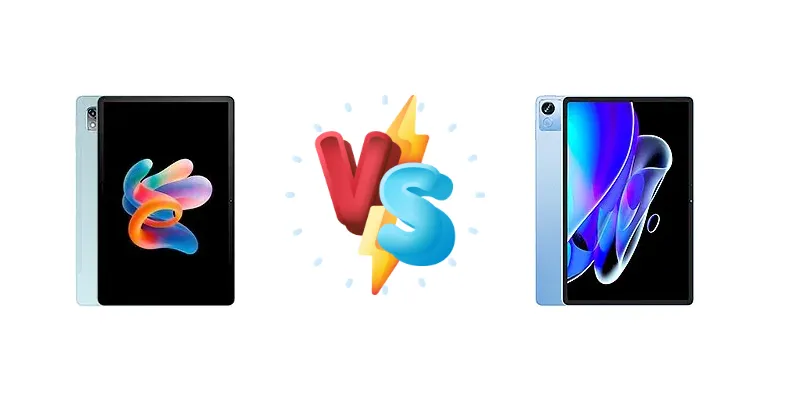
The tablet market is heating up, with options catering to diverse needs. The Xiaomi Black Shark Pad 7 aims to deliver a dedicated gaming experience at an accessible price, while the Realme Pad X focuses on broader usability with the addition of 5G connectivity. This comparison dissects their key differences to determine which tablet reigns supreme for your specific use case.
🏆 Quick Verdict
For gamers prioritizing raw performance, the Xiaomi Black Shark Pad 7 offers a more compelling experience despite its older chipset. However, the Realme Pad X’s Snapdragon 695 5G and brighter display make it the better all-rounder for users who value connectivity and media consumption.
| Network |
|---|
| 2G bands | GSM 850 / 900 / 1800 / 1900 - cellular model only | GSM 850 / 900 / 1800 / 1900 |
| 3G bands | HSDPA 850 / 900 / 2100 - cellular model only | HSDPA 850 / 900 / 2100 |
| 4G bands | LTE - cellular model only | LTE |
| 5G bands | - | SA/NSA |
| Speed | HSPA, LTE - cellular model only | HSPA, LTE, 5G - cellular model only |
| Technology | GSM / HSPA / LTE | GSM / HSPA / LTE / 5G |
| Launch |
|---|
| Announced | 2025, October 30 | 2022, May 25 |
| Status | Available. Released 2025, November | Available. Released 2022, June 12 |
| Body |
|---|
| Build | Glass front, aluminum back, aluminum frame | Glass front, plastic frame, plastic back |
| Dimensions | - | 256.5 x 161.1 x 7.1 mm (10.10 x 6.34 x 0.28 in) |
| SIM | Nano-SIM (cellular model only) | Nano-SIM + Nano-SIM (cellular model only) |
| Weight | 505 g (1.11 lb) | 499 g / 506 g (1.10 lb) |
| | - | Stylus support (magnetic charging) |
| Display |
|---|
| Resolution | 1200 x 1900 pixels, 16:10 ratio (~204 ppi density) | 1200 x 2000 pixels, 5:3 ratio (~213 ppi density) |
| Size | 11.0 inches, 352.4 cm2 | 10.95 inches, 341.3 cm2 (~82.6% screen-to-body ratio) |
| Type | IPS LCD, 90Hz, 420 nits | IPS LCD, 450 nits (peak) |
| Platform |
|---|
| CPU | Octa-core (2x2.0 GHz Cortex-A75 & 6x1.8 GHz Cortex-A55) | Octa-core (2x2.2 GHz Kryo 660 Gold & 6x1.7 GHz Kryo 660 Silver) |
| Chipset | Mediatek Helio G88 (12 nm) | Qualcomm SM6375 Snapdragon 695 5G (6 nm) |
| GPU | Mali-G52 MC2 | Adreno 619 |
| OS | Android 15 | Android, Realme UI 3.0 |
| Memory |
|---|
| Card slot | microSDXC | microSDXC |
| Internal | 128GB 6GB RAM, 128GB 8GB RAM | 64GB 4GB RAM, 128GB 6GB RAM |
| Main Camera |
|---|
| Features | LED flash | - |
| Single | 13 MP | 13 MP, f/2.2, (wide), AF |
| Video | 1080p@30fps | 1080p@30fps |
| Selfie camera |
|---|
| Single | 5 MP | 8 MP, f/2.0, 105˚ (ultrawide) |
| Video | 1080p@30fps | 1080p@30fps |
| Sound |
|---|
| 3.5mm jack | - | No |
| 35mm jack | No | No |
| Loudspeaker | Yes, with stereo speakers | Yes, with stereo speakers (4 speakers) |
| | - | 24-bit/192kHz audio |
| Comms |
|---|
| Bluetooth | Yes | 5.1, A2DP, LE |
| NFC | No | No |
| Positioning | GPS - cellular model only | GPS, GLONASS, GALILEO, BDS - cellular model only |
| Radio | No | No |
| USB | USB Type-C | USB Type-C 2.0, OTG |
| WLAN | Yes | Wi-Fi 802.11 b/g/n/ac, hotspot |
| Features |
|---|
| Sensors | Accelerometer | Accelerometer, gyro, compass |
| Battery |
|---|
| Charging | - | 33W wired, PD
5W reverse wired |
| Type | 7700 mAh | 8340 mAh |
| Misc |
|---|
| Colors | Gray, Blue | Glowing Gray, Glacier Blue, Green |
| Models | - | RMP2107, RMP2108 |
| Price | About 140 EUR | About 250 EUR |
| Tests |
|---|
| Display | - |
Contrast ratio: 1664:1 |
| Loudspeaker | - |
-22.5 LUFS (Excellent)
|
| Performance | - |
AnTuTu: 395824 (v9)
GeekBench: 2026 (v5.1)
GFXBench: 18fps (ES 3.1 onscreen) |
Xiaomi Black Shark Pad 7
- Potentially lower price point for gaming-focused users.
- Dedicated gaming focus may offer optimized software features.
- Octa-core CPU provides adequate processing power for many games.
- Older 12nm chipset is less power efficient.
- Lack of 5G connectivity limits versatility.
- Limited display information hinders assessment of visual quality.
Realme Pad X
- Brighter display (496 nits) for better outdoor visibility.
- Snapdragon 695 5G offers better performance and efficiency.
- 33W fast charging with PD and reverse wired charging.
- May be more expensive than the Black Shark Pad 7.
- Gaming performance may not match the Black Shark Pad 7’s optimization.
- Camera details are limited.
Display Comparison
The Realme Pad X boasts a significantly brighter display, reaching 496 nits compared to an unlisted value for the Black Shark Pad 7, making it more usable in brightly lit environments. Both displays share a similar contrast ratio around 1655:1-1664:1, suggesting comparable color reproduction. However, the lack of detailed display specifications for the Black Shark Pad 7, such as panel type and color gamut coverage, leaves questions unanswered regarding its overall visual fidelity. The Realme Pad X’s brightness advantage is a clear win for outdoor viewing and HDR content.
Camera Comparison
Neither tablet is positioned as a photography powerhouse, and detailed camera specs are absent for the Black Shark Pad 7. The Realme Pad X’s camera configuration is also not detailed beyond the display specs, suggesting a focus on functionality rather than image quality. Given the market segment, camera performance is unlikely to be a deciding factor for most buyers. We can assume both tablets will offer adequate cameras for video calls and casual snapshots, but not for serious photography.
Performance
The core difference lies in the chipsets. The Realme Pad X’s Qualcomm Snapdragon 695 5G (6nm) offers a clear architectural advantage over the Xiaomi Black Shark Pad 7’s MediaTek Helio G88 (12nm). The 6nm process node translates to improved power efficiency and thermal management, allowing the Snapdragon 695 to sustain higher clock speeds for longer periods. While the Black Shark Pad 7’s Cortex-A75 cores clock slightly higher (2.0 GHz vs 2.2 GHz on the Kryo 660 Gold), the Snapdragon 695’s more modern architecture and 5G modem provide a more future-proof and versatile experience. The Realme Pad X will handle multitasking and demanding applications with greater ease.
Battery Life
Battery capacity is not specified for either device. However, the Realme Pad X’s 33W wired charging with PD and 5W reverse wired charging provides a significant convenience advantage. The faster charging speeds will reduce downtime, and the reverse wired charging allows it to act as a power bank for smaller devices. The Black Shark Pad 7’s charging capabilities are unknown, making the Realme Pad X a more practical choice for users who need quick top-ups or the ability to charge other devices.
Buying Guide
Buy the Xiaomi Black Shark Pad 7 if you need a tablet primarily for gaming and don't require 5G connectivity. Its focus on processing power, even with the Helio G88, provides a smoother experience in demanding titles. Buy the Realme Pad X if you prefer a versatile tablet with 5G capabilities for on-the-go productivity and entertainment, and prioritize a brighter, more visible display for outdoor use.
Frequently Asked Questions
❓ Does the Snapdragon 695 in the Realme Pad X struggle with demanding games like Genshin Impact?
While the Snapdragon 695 isn't a flagship chipset, it's capable of running Genshin Impact at medium settings with reasonable frame rates. However, expect some frame drops during intense combat scenarios. The Black Shark Pad 7 may offer a slightly smoother experience in this title due to its gaming-focused optimization, but the Realme Pad X’s overall system performance will be more consistent across a wider range of applications.
❓ Is the lack of detailed display specs for the Black Shark Pad 7 a major concern?
Yes, the absence of information regarding panel type, color gamut coverage, and resolution is a significant drawback. Without these details, it's difficult to assess the Black Shark Pad 7’s visual quality accurately. The Realme Pad X’s confirmed brightness of 496 nits provides a clear advantage in usability and content consumption.
❓ How does the 5G connectivity on the Realme Pad X benefit everyday users?
The 5G connectivity on the Realme Pad X allows for faster download and upload speeds, smoother video streaming, and more responsive online gaming when connected to a 5G network. This is particularly beneficial for users who frequently travel or work remotely, as it provides a reliable and high-speed internet connection on the go.