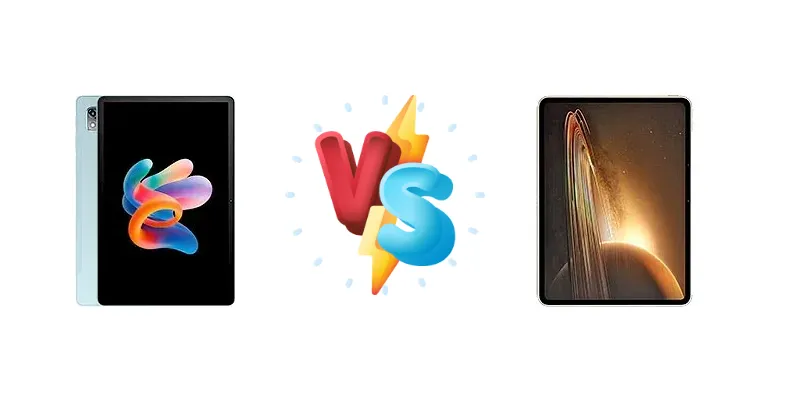
The Android tablet market is heating up, with options ranging from budget-friendly media consumption devices to powerful productivity powerhouses. The Xiaomi Black Shark Pad 7 and Oppo Pad 2 represent distinct approaches: the Black Shark prioritizes gaming on a budget, while the Oppo Pad 2 aims for a more premium experience with flagship-level performance. This comparison dissects their key differences to help you choose the right tablet.
🏆 Quick Verdict
For the average user prioritizing performance and future-proofing, the Oppo Pad 2 is the clear winner. Its Dimensity 9000 chipset offers a substantial leap in processing power and efficiency compared to the Black Shark Pad 7’s Helio G88. However, gamers on a tight budget will find the Black Shark Pad 7 a compelling, if less refined, option.
| Network |
|---|
| 2G bands | GSM 850 / 900 / 1800 / 1900 - cellular model only | N/A |
| 3G bands | HSDPA 850 / 900 / 2100 - cellular model only | N/A |
| 4G bands | LTE - cellular model only | N/A |
| EDGE | - | No |
| GPRS | - | No |
| Speed | HSPA, LTE - cellular model only | - |
| Technology | GSM / HSPA / LTE | No cellular connectivity |
| Launch |
|---|
| Announced | 2025, October 30 | 2023, March 21 |
| Status | Available. Released 2025, November | Available. Released 2023, March 24 |
| Body |
|---|
| Build | Glass front, aluminum back, aluminum frame | Glass front, aluminum frame |
| Dimensions | - | 258 x 189.4 x 6.5 mm (10.16 x 7.46 x 0.26 in) |
| SIM | Nano-SIM (cellular model only) | No |
| Weight | 505 g (1.11 lb) | 552 g (1.22 lb) |
| | - | Stylus support, 2.0ms latency |
| Display |
|---|
| Resolution | 1200 x 1900 pixels, 16:10 ratio (~204 ppi density) | 2000 x 2800 pixels (~296 ppi density) |
| Size | 11.0 inches, 352.4 cm2 | 11.61 inches, 411.3 cm2 (~84.2% screen-to-body ratio) |
| Type | IPS LCD, 90Hz, 420 nits | IPS LCD, 1B colors, Dolby Vision, 144Hz, 500 nits (typ) |
| Platform |
|---|
| CPU | Octa-core (2x2.0 GHz Cortex-A75 & 6x1.8 GHz Cortex-A55) | Octa-core (1x3.05 GHz Cortex-X2 & 3x2.85 GHz Cortex-A710 & 4x1.80 GHz Cortex-A510) |
| Chipset | Mediatek Helio G88 (12 nm) | Mediatek Dimensity 9000 (4 nm) |
| GPU | Mali-G52 MC2 | Mali-G710 MC10 |
| OS | Android 15 | Android 13, ColorOS 13.1 |
| Memory |
|---|
| Card slot | microSDXC | No |
| Internal | 128GB 6GB RAM, 128GB 8GB RAM | 256GB 8GB RAM, 256GB 12GB RAM, 512GB 12GB RAM |
| | - | UFS 3.1 |
| Main Camera |
|---|
| Features | LED flash | Color spectrum sensor, LED flash |
| Single | 13 MP | 13 MP, f/2.2, (wide), AF |
| Video | 1080p@30fps | 4K@30fps, 1080p@30ps, gyro-EIS |
| Selfie camera |
|---|
| Single | 5 MP | 8 MP, f/2.3, 103˚ (ultrawide) |
| Video | 1080p@30fps | 1080p@30fps |
| Sound |
|---|
| 3.5mm jack | - | No |
| 35mm jack | No | No |
| Loudspeaker | Yes, with stereo speakers | Yes, with stereo speakers (4 speakers) |
| Comms |
|---|
| Bluetooth | Yes | 5.3, A2DP, LE, aptX HD |
| NFC | No | No |
| Positioning | GPS - cellular model only | GPS, GLONASS, GALILEO, BDS (B1I+B1c) |
| Radio | No | No |
| USB | USB Type-C | USB Type-C 2.0, OTG, accessory connector |
| WLAN | Yes | Wi-Fi 802.11 a/b/g/n/ac/6, dual-band |
| Features |
|---|
| Sensors | Accelerometer | Accelerometer, gyro, compass |
| Battery |
|---|
| Charging | - | 67W wired, PD, QC 2.0 |
| Type | 7700 mAh | Li-Po 9510 mAh |
| Misc |
|---|
| Colors | Gray, Blue | Gray, Gold |
| Models | - | OPD2201, X22N2 |
| Price | About 140 EUR | About 410 EUR |
Xiaomi Black Shark Pad 7
- More affordable price point
- Gaming-focused design (likely)
- Potentially longer battery life due to efficient chipset (though unconfirmed)
- Significantly weaker performance compared to Oppo Pad 2
- Older chipset architecture
- Likely slower charging speeds
Oppo Pad 2
- Flagship-level performance with Dimensity 9000
- 67W fast charging with PD and QC 2.0
- Superior power efficiency
- Higher price tag
- May not be the best value for casual users
- Potentially shorter battery life if used heavily (though mitigated by efficiency)
Display Comparison
While both tablets likely feature IPS LCD panels (data unavailable), the core difference lies in the processing power driving them. Display specs like resolution and refresh rate are not provided, but the chipset's ability to smoothly render content is paramount. The Oppo Pad 2’s Dimensity 9000 will handle high-resolution video and graphically intensive games with significantly less strain, potentially resulting in a more fluid visual experience. The Black Shark Pad 7’s Helio G88, while capable, will likely struggle with demanding visuals at higher settings.
Camera Comparison
Given the tablet form factor, camera performance is rarely a primary concern. However, the lack of detailed camera specifications for both devices makes a direct comparison difficult. It’s reasonable to assume both tablets feature basic camera setups suitable for casual snapshots and video calls. Without sensor size or aperture information, it’s impossible to determine which tablet offers superior image quality. The focus should be on the processing power of the chipsets; the Oppo Pad 2’s Dimensity 9000 will likely offer better image processing capabilities, potentially resulting in more detailed and vibrant photos.
Performance
The performance gap is the defining characteristic of this comparison. The Oppo Pad 2’s Mediatek Dimensity 9000, built on a 4nm process, is a flagship-tier chipset featuring a Cortex-X2 prime core clocked at 3.05 GHz, alongside three Cortex-A710 performance cores and four Cortex-A510 efficiency cores. This architecture delivers a substantial performance advantage over the Xiaomi Black Shark Pad 7’s Mediatek Helio G88 (12nm). The Helio G88’s octa-core configuration (2x2.0 GHz Cortex-A75 & 6x1.8 GHz Cortex-A55) is geared towards efficiency rather than raw power. This translates to significantly faster app loading times, smoother multitasking, and a more responsive gaming experience on the Oppo Pad 2. The 4nm node also contributes to better thermal efficiency, reducing the likelihood of performance throttling during extended gaming sessions.
Battery Life
Battery capacity data is missing for both devices. However, the Oppo Pad 2’s 67W wired charging with PD and QC 2.0 support is a significant advantage. This allows for incredibly fast charging times, minimizing downtime. While the Black Shark Pad 7’s charging speed is unknown, it’s unlikely to match the Oppo Pad 2’s rapid charging capabilities. The Dimensity 9000’s superior power efficiency also means the Oppo Pad 2 may achieve comparable or even better battery life despite potentially having a similar or smaller battery capacity.
Buying Guide
Buy the Xiaomi Black Shark Pad 7 if you need a dedicated gaming tablet on a strict budget and are willing to compromise on overall performance and long-term software support. Buy the Oppo Pad 2 if you prefer a smoother, more responsive experience for demanding tasks like video editing, multitasking, and gaming, and value faster charging and a more premium build quality.
Frequently Asked Questions
❓ Will the Helio G88 in the Black Shark Pad 7 struggle with demanding games like Genshin Impact?
Yes, the Helio G88 is a mid-range chipset and will likely require significant graphical settings reductions to achieve playable frame rates in demanding titles like Genshin Impact. Expect noticeable frame drops and potential stuttering, especially during intense combat sequences. The Oppo Pad 2’s Dimensity 9000 will handle these games with ease at higher settings.
❓ How much faster is the charging on the Oppo Pad 2 compared to what we might expect on the Black Shark Pad 7?
The Oppo Pad 2’s 67W charging is exceptionally fast, potentially taking a tablet from 0-100% in under an hour. The Black Shark Pad 7 likely supports a significantly slower charging speed, potentially taking over two hours for a full charge. This difference is crucial for users who need to quickly top up their tablet before heading out.
❓ Is the Dimensity 9000 in the Oppo Pad 2 overkill for basic tasks like web browsing and video streaming?
While the Dimensity 9000 is a powerful chipset, it won't be *wasted* on basic tasks. It ensures a consistently smooth and responsive experience, even with multiple apps open. The extra headroom future-proofs the tablet, allowing it to handle more demanding applications and software updates without performance degradation.