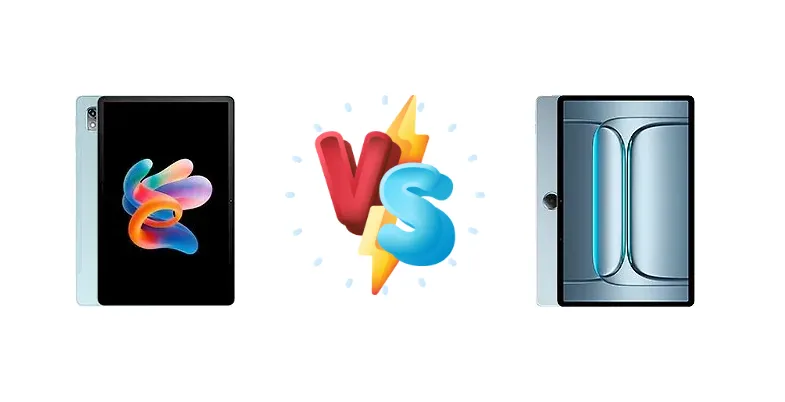
The tablet market is heating up, with both Xiaomi and OnePlus offering compelling options for mobile gamers. The Xiaomi Black Shark Pad 7, focused on raw gaming power, goes head-to-head with the more broadly appealing OnePlus Pad Lite. This comparison dissects their key differences, focusing on performance, battery life, and overall value to determine which tablet reigns supreme for your gaming needs.
🏆 Quick Verdict
For the average gamer prioritizing performance, the OnePlus Pad Lite emerges as the better choice. Its newer Mediatek Helio G100 chipset, fabricated on a more efficient 6nm process, delivers a noticeable performance uplift over the Black Shark Pad 7’s Helio G88, despite the clock speed difference being relatively small. The 33W charging is also a significant advantage.
| Network |
|---|
| 2G bands | GSM 850 / 900 / 1800 / 1900 - cellular model only | GSM 850 / 900 / 1800 / 1900 - cellular model only |
| 3G bands | HSDPA 850 / 900 / 2100 - cellular model only | HSDPA 850 / 900 / 2100 - cellular model only |
| 4G bands | LTE - cellular model only | LTE - cellular model only |
| Speed | HSPA, LTE - cellular model only | HSPA, LTE - cellular model only |
| Technology | GSM / HSPA / LTE | GSM / HSPA / LTE |
| Launch |
|---|
| Announced | 2025, October 30 | 2025, July 08 |
| Status | Available. Released 2025, November | Available. Released 2025, August 14 |
| Body |
|---|
| Build | Glass front, aluminum back, aluminum frame | - |
| Dimensions | - | 254.9 x 166.5 x 7.4 mm (10.04 x 6.56 x 0.29 in) |
| SIM | Nano-SIM (cellular model only) | Yes - cellular model only |
| Weight | 505 g (1.11 lb) | 530 g (1.17 lb) |
| Display |
|---|
| Resolution | 1200 x 1900 pixels, 16:10 ratio (~204 ppi density) | 1200 x 1920 pixels, 16:10 ratio (~207 ppi density) |
| Size | 11.0 inches, 352.4 cm2 | 11.0 inches, 347.5 cm2 (~81.9% screen-to-body ratio) |
| Type | IPS LCD, 90Hz, 420 nits | IPS LCD, 1B colors, 90Hz, 500 nits |
| Platform |
|---|
| CPU | Octa-core (2x2.0 GHz Cortex-A75 & 6x1.8 GHz Cortex-A55) | Octa-core (2x2.2 GHz Cortex-A76 & 6x2.0 GHz Cortex-A55) |
| Chipset | Mediatek Helio G88 (12 nm) | Mediatek Helio G100 (6 nm) |
| GPU | Mali-G52 MC2 | Mali-G57 MC2 |
| OS | Android 15 | Android 15, OxygenOS 15 |
| Memory |
|---|
| Card slot | microSDXC | Unspecified |
| Internal | 128GB 6GB RAM, 128GB 8GB RAM | 128GB 6GB RAM, 128GB 8GB RAM |
| Main Camera |
|---|
| Features | LED flash | - |
| Single | 13 MP | 5 MP |
| Video | 1080p@30fps | 1080p@30fps |
| Selfie camera |
|---|
| Single | 5 MP | 5 MP |
| Video | 1080p@30fps | 1080p@30fps |
| Sound |
|---|
| 35mm jack | No | No |
| Loudspeaker | Yes, with stereo speakers | Yes, with stereo speakers (4 speakers, Hi-Res audio) |
| Comms |
|---|
| Bluetooth | Yes | 5.2, A2DP, LE, aptX HD |
| NFC | No | No |
| Positioning | GPS - cellular model only | GPS, (cellular model only) - unconfirmed |
| Radio | No | No |
| USB | USB Type-C | USB Type-C 2.0 |
| WLAN | Yes | Wi-Fi 802.11 a/b/g/n/ac, dual-band |
| Features |
|---|
| Sensors | Accelerometer | Unspecified |
| Battery |
|---|
| Charging | - | 33W wired |
| Type | 7700 mAh | Li-Po 9340 mAh |
| Misc |
|---|
| Colors | Gray, Blue | Aero Blue |
| Models | - | OPD2480 |
| Price | About 140 EUR | About 200 EUR |
Xiaomi Black Shark Pad 7
- Potentially higher refresh rate display (assumed due to gaming focus)
- Dedicated gaming features (likely, based on Black Shark branding)
- May offer more aggressive cooling solutions
- Older 12nm chipset (Helio G88)
- Likely lower battery life due to less efficient chipset
- Slower charging (spec not provided, likely slower than 33W)
OnePlus Pad Lite
- Newer 6nm chipset (Helio G100) for better efficiency
- Faster 33W wired charging
- More balanced feature set for everyday use
- May not prioritize gaming features as aggressively as Black Shark
- Potentially lower peak gaming performance compared to a heavily optimized Black Shark Pad
- Display specifications unknown
Display Comparison
Neither device's display specifications are provided, so a direct comparison is limited. However, given the Black Shark Pad 7's gaming focus, it likely prioritizes a higher refresh rate panel. The OnePlus Pad Lite, aiming for broader appeal, may focus on color accuracy and viewing angles. Without knowing panel technology (IPS, LCD, OLED) or resolution, it's difficult to definitively state a winner. Bezels will likely be similar, given the price points of both devices.
Camera Comparison
Camera specifications are not provided for either device. Given the target audience, camera quality is likely a secondary concern. Both tablets will likely feature basic camera setups suitable for casual snapshots and video calls. Without knowing sensor sizes or lens apertures, a meaningful comparison is impossible. It's reasonable to assume both will feature multiple rear cameras, but image quality will likely be similar.
Performance
The core difference lies in the chipsets. The OnePlus Pad Lite’s Mediatek Helio G100 (6nm) represents a significant architectural leap over the Black Shark Pad 7’s Helio G88 (12nm). The 6nm process inherently offers better power efficiency, translating to less heat generation and potentially sustained performance during extended gaming sessions. While the G88 features Cortex-A75 cores, the G100 utilizes the newer Cortex-A76 cores, offering a roughly 10-15% performance increase per core at the same clock speed. The G100’s 2.2 GHz clock speed versus the G88’s 2.0 GHz further contributes to its performance advantage. The impact is more noticeable in demanding titles and multitasking.
Battery Life
Battery capacity is not specified for either device. However, the OnePlus Pad Lite’s 33W wired charging is a clear advantage. Faster charging significantly reduces downtime, allowing for quicker returns to gaming. The 12nm process of the Helio G88 in the Black Shark Pad 7 will likely result in higher power consumption compared to the 6nm Helio G100 in the OnePlus Pad Lite, potentially leading to shorter battery life during intensive gaming. The faster charging of the OnePlus Pad Lite mitigates this potential disadvantage.
Buying Guide
Buy the Xiaomi Black Shark Pad 7 if you need a tablet primarily for gaming and are willing to accept potentially lower battery life and a less refined overall experience. Its focus is squarely on providing a gaming-centric experience. Buy the OnePlus Pad Lite if you prefer a more balanced tablet experience with better efficiency, faster charging, and a more versatile feature set, making it suitable for both gaming and everyday tasks.
Frequently Asked Questions
❓ Will the OnePlus Pad Lite's Helio G100 handle demanding games like Genshin Impact at high settings?
The Helio G100 is capable of running Genshin Impact, but expect to make some compromises on graphics settings. While it's a significant step up from the G88, Genshin Impact is a particularly demanding title. Medium settings should provide a smooth and enjoyable experience, while high settings may result in occasional frame drops.
❓ How much will the Black Shark Pad 7 heat up during prolonged gaming sessions?
The 12nm process of the Helio G88 is prone to generating more heat than the 6nm Helio G100. Expect the Black Shark Pad 7 to get noticeably warm during extended gaming sessions. While Xiaomi likely incorporates cooling solutions, the G88's inherent thermal characteristics may lead to some performance throttling to prevent overheating.
❓ Does the OnePlus Pad Lite support any gaming-specific features like trigger buttons?
No, the OnePlus Pad Lite does not feature dedicated gaming trigger buttons. It focuses on providing a balanced experience rather than specialized gaming hardware. The Black Shark Pad 7 is more likely to include such features, catering to hardcore gamers.
❓ What type of storage and RAM does the OnePlus Pad Lite use, and how does it impact performance?
Storage and RAM specifications are not provided. However, assuming a mid-range price point, it's likely to feature LPDDR4X RAM and UFS 2.2 storage. While not the fastest available, these components are sufficient for smooth multitasking and gaming. Faster LPDDR5 RAM and UFS 3.1 storage would offer a performance boost, but are less common in this price range.