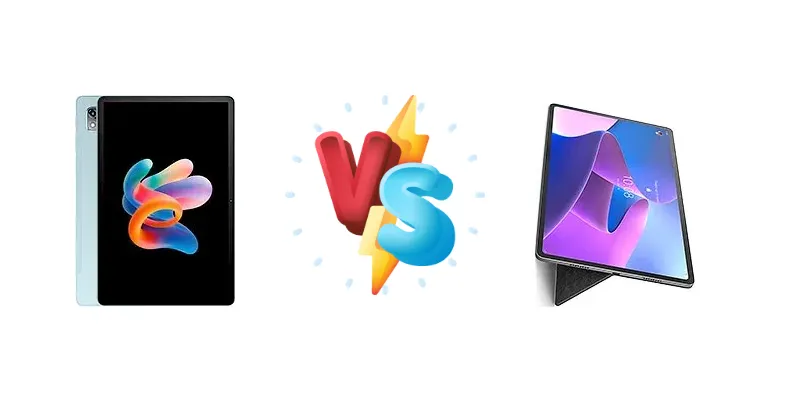
The tablet market offers a diverse range of options, but finding the right balance between performance and features can be challenging. We pit the gaming-focused Xiaomi Black Shark Pad 7 against the premium Lenovo Tab P12 Pro, two tablets targeting distinct user needs. The Black Shark Pad 7 aims for affordability and gaming prowess, while the Tab P12 Pro prioritizes a refined experience with a more powerful chipset and premium build.
🏆 Quick Verdict
For the average user prioritizing overall performance and a more polished experience, the Lenovo Tab P12 Pro is the superior choice. Its Snapdragon 870 chipset delivers significantly faster processing speeds and better multitasking capabilities. However, gamers on a budget will find the Black Shark Pad 7 a compelling option.
| Network |
|---|
| 2G bands | GSM 850 / 900 / 1800 / 1900 - cellular model only | GSM 850 / 900 / 1800 / 1900 |
| 3G bands | HSDPA 850 / 900 / 2100 - cellular model only | HSDPA 850 / 900 / 1900 / 2100 |
| 4G bands | LTE - cellular model only | 1, 2, 3, 4, 5, 7, 8, 19, 20, 26, 28, 34, 38, 39, 40, 41 |
| 5G bands | - | 1, 3, 7, 8, 20, 28, 38, 41, 77, 78 SA/NSA/Sub6 |
| Speed | HSPA, LTE - cellular model only | HSPA, LTE, 5G - cellular model only |
| Technology | GSM / HSPA / LTE | GSM / HSPA / LTE / 5G |
| Launch |
|---|
| Announced | 2025, October 30 | 2021, September 08 |
| Status | Available. Released 2025, November | Available. Released 2021, November 19 |
| Body |
|---|
| Build | Glass front, aluminum back, aluminum frame | - |
| Dimensions | - | 285.6 x 184.5 x 5.6 mm (11.24 x 7.26 x 0.22 in) |
| SIM | Nano-SIM (cellular model only) | Nano-SIM (cellular model only) |
| Weight | 505 g (1.11 lb) | 565 g (1.25 lb) |
| | - | Stylus support |
| Display |
|---|
| Resolution | 1200 x 1900 pixels, 16:10 ratio (~204 ppi density) | 1600 x 2560 pixels, 16:10 ratio (~240 ppi density) |
| Size | 11.0 inches, 352.4 cm2 | 12.6 inches, 460.3 cm2 (~87.4% screen-to-body ratio) |
| Type | IPS LCD, 90Hz, 420 nits | AMOLED, 120Hz, HDR10+, Dolby Vision, 600 nits (HBM) |
| Platform |
|---|
| CPU | Octa-core (2x2.0 GHz Cortex-A75 & 6x1.8 GHz Cortex-A55) | Octa-core (1x3.2 GHz Kryo 585 & 3x2.42 GHz Kryo 585 & 4x1.80 GHz Kryo 585) |
| Chipset | Mediatek Helio G88 (12 nm) | Qualcomm SM8250-AC Snapdragon 870 5G (7 nm) |
| GPU | Mali-G52 MC2 | Adreno 650 |
| OS | Android 15 | Android 11 |
| Memory |
|---|
| Card slot | microSDXC | microSDXC (dedicated slot) |
| Internal | 128GB 6GB RAM, 128GB 8GB RAM | 128GB 6GB RAM, 256GB 8GB RAM |
| Main Camera |
|---|
| Dual | - | 13 MP, (wide), AF
5 MP, (ultrawide) |
| Features | LED flash | - |
| Single | 13 MP | - |
| Video | 1080p@30fps | 4K@30fps, 1080p@30fps |
| Selfie camera |
|---|
| Single | 5 MP | 8 MP, (wide)
8 MP, IR TOF 3D, (biometrics sensor only) |
| Video | 1080p@30fps | 1080p@30fps |
| Sound |
|---|
| 3.5mm jack | - | No |
| 35mm jack | No | No |
| Loudspeaker | Yes, with stereo speakers | Yes, with stereo speakers (4 speakers) |
| | - | JBL speakers |
| Comms |
|---|
| Bluetooth | Yes | 5.2, A2DP, LE |
| NFC | No | Yes (wireless charging and data transfer only) |
| Positioning | GPS - cellular model only | GPS, GLONASS, BDS - cellular model only |
| Radio | No | Unspecified |
| USB | USB Type-C | USB Type-C 3.1 |
| WLAN | Yes | Wi-Fi 802.11 a/b/g/n/ac/6, dual-band, Wi-Fi Direct |
| Features |
|---|
| Sensors | Accelerometer | Fingerprint (side-mounted), accelerometer, gyro, proximity |
| Battery |
|---|
| Charging | - | 45W wired, QC4 |
| Type | 7700 mAh | Li-Po 10200 mAh |
| Misc |
|---|
| Colors | Gray, Blue | Storm Grey |
| Models | - | TB-Q706Z, TB-Q706F |
| Price | About 140 EUR | About 520 EUR |
Xiaomi Black Shark Pad 7
- More affordable price point
- Gaming-focused design
- Potentially larger battery capacity (spec not provided)
- Significantly weaker processor
- Less efficient chipset
- Inferior camera performance
Lenovo Tab P12 Pro
- Powerful Snapdragon 870 processor
- Faster 45W charging with QC4
- Superior image processing capabilities
- Higher price tag
- May not have dedicated gaming features
- Potentially shorter battery life under heavy gaming load (despite efficiency)
Display Comparison
While both tablets likely feature LCD panels (data not provided), the core difference lies in processing power impacting UI responsiveness. The Lenovo Tab P12 Pro, benefiting from the Snapdragon 870, will deliver smoother animations and faster app loading times. The Black Shark Pad 7’s Helio G88, a 12nm chip, will likely exhibit more noticeable lag during demanding tasks. We expect the Tab P12 Pro to have a higher peak brightness, enhancing outdoor visibility, and potentially better color accuracy due to its more advanced image signal processor. Bezels are likely comparable, given both target a similar screen size range.
Camera Comparison
Given the context data, a detailed camera comparison is limited. Both tablets likely feature multi-camera setups, but the focus will be on the primary sensor. The Tab P12 Pro, leveraging the Snapdragon 870’s superior image signal processor, will likely produce more detailed and vibrant photos, especially in challenging lighting conditions. The Black Shark Pad 7’s camera performance will likely be adequate for casual snapshots but won’t compete with the Tab P12 Pro’s image quality. We can assume the Tab P12 Pro will have better video recording capabilities as well.
Performance
The performance gap is substantial. The Lenovo Tab P12 Pro’s Qualcomm Snapdragon 870 5G (7nm) is a significant leap ahead of the Xiaomi Black Shark Pad 7’s MediaTek Helio G88 (12nm). The Snapdragon 870’s Kryo 585 cores, with a peak clock speed of 3.2 GHz, offer considerably more processing power than the Helio G88’s 2.0 GHz Cortex-A75 cores. This translates to faster app launches, smoother multitasking, and a more responsive user experience. The 7nm fabrication process of the Snapdragon 870 also provides better thermal efficiency, reducing the likelihood of performance throttling during extended gaming sessions. The Black Shark Pad 7 will struggle with graphically intensive games at higher settings.
Battery Life
Battery life will depend on usage patterns, but the Lenovo Tab P12 Pro benefits from 45W wired charging with Quick Charge 4 (QC4) support, enabling significantly faster charging times compared to the Black Shark Pad 7 (charging speed data unavailable). While the Black Shark Pad 7 might have a larger battery capacity (spec not provided), the Tab P12 Pro’s efficient Snapdragon 870 and faster charging will likely result in a more convenient user experience. The Snapdragon 870’s power efficiency will also contribute to longer battery life during moderate use.
Buying Guide
Buy the Xiaomi Black Shark Pad 7 if you need a dedicated gaming tablet on a budget and prioritize raw gaming performance over all else. Its focus on gaming features and lower price point make it ideal for casual and mobile gamers. Buy the Lenovo Tab P12 Pro if you prefer a versatile tablet with a premium build, superior processing power for productivity tasks, and faster charging capabilities. It’s the better choice for professionals, content creators, and users who demand a refined tablet experience.
Frequently Asked Questions
❓ Will the Black Shark Pad 7 be able to run demanding games like Genshin Impact?
While the Black Shark Pad 7 can *run* Genshin Impact, expect to play at lower graphics settings and potentially experience frame rate drops. The Helio G88 chipset is not optimized for graphically intensive games like the Snapdragon 870 in the Lenovo Tab P12 Pro.
❓ Is the Snapdragon 870 in the Lenovo Tab P12 Pro still a relevant chipset in 2024?
Absolutely. The Snapdragon 870 remains a highly capable chipset for tablets, offering excellent performance for multitasking, gaming, and content creation. It provides a smooth and responsive experience that surpasses many newer, lower-tier chipsets.
❓ Does the Lenovo Tab P12 Pro support stylus input for note-taking or drawing?
While not explicitly stated in the provided data, Lenovo tablets often support stylus input. Checking the official Lenovo website or product reviews will confirm stylus compatibility and features for the Tab P12 Pro.
❓ How does the thermal management compare between the two tablets during extended gaming sessions?
The Lenovo Tab P12 Pro, with its 7nm Snapdragon 870, is expected to have superior thermal management. The more efficient fabrication process generates less heat, reducing the likelihood of performance throttling during prolonged gaming. The Black Shark Pad 7’s 12nm Helio G88 will likely heat up more quickly, potentially leading to reduced performance.