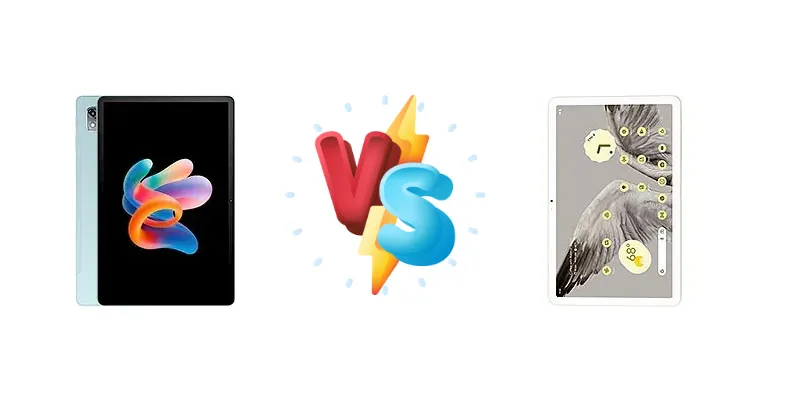
The Android tablet market is heating up, with the Xiaomi Black Shark Pad 7 aiming squarely at gamers and the Google Pixel Tablet offering a unique blend of smart home integration and productivity. This comparison dissects the core differences between these two devices, focusing on their processing power, intended use cases, and overall value proposition.
🏆 Quick Verdict
For users prioritizing raw gaming performance on a budget, the Xiaomi Black Shark Pad 7 is the clear winner. However, the Google Pixel Tablet excels as a smart home hub and offers a more polished, integrated experience for those deeply invested in the Google ecosystem.
| Network |
|---|
| 2G bands | GSM 850 / 900 / 1800 / 1900 - cellular model only | N/A |
| 3G bands | HSDPA 850 / 900 / 2100 - cellular model only | N/A |
| 4G bands | LTE - cellular model only | N/A |
| EDGE | - | No |
| GPRS | - | No |
| Speed | HSPA, LTE - cellular model only | - |
| Technology | GSM / HSPA / LTE | No cellular connectivity |
| Launch |
|---|
| Announced | 2025, October 30 | 2023, May 10 |
| Status | Available. Released 2025, November | Available. Released 2023, June 20 |
| Body |
|---|
| Build | Glass front, aluminum back, aluminum frame | Glass front, aluminum frame, aluminum back |
| Dimensions | - | 258 x 169 x 8.1 mm (10.16 x 6.65 x 0.32 in) |
| SIM | Nano-SIM (cellular model only) | No |
| Weight | 505 g (1.11 lb) | 493 g (1.09 lb) |
| | - | Stylus support |
| Display |
|---|
| Resolution | 1200 x 1900 pixels, 16:10 ratio (~204 ppi density) | 1600 x 2560 pixels, 16:10 ratio (~276 ppi density) |
| Size | 11.0 inches, 352.4 cm2 | 10.95 inches, 347.7 cm2 (~79.7% screen-to-body ratio) |
| Type | IPS LCD, 90Hz, 420 nits | IPS LCD |
| Platform |
|---|
| CPU | Octa-core (2x2.0 GHz Cortex-A75 & 6x1.8 GHz Cortex-A55) | Octa-core (2x2.85 GHz Cortex-X1 & 2x2.35 GHz Cortex-A78 & 4x1.80 GHz Cortex-A55) |
| Chipset | Mediatek Helio G88 (12 nm) | Google Tensor G2 (5 nm) |
| GPU | Mali-G52 MC2 | Mali-G710 MP7 |
| OS | Android 15 | Android 13, upgradable to Android 15 |
| Memory |
|---|
| Card slot | microSDXC | No |
| Internal | 128GB 6GB RAM, 128GB 8GB RAM | 128GB 8GB RAM, 256GB 8GB RAM |
| | - | UFS 3.1 |
| Main Camera |
|---|
| Features | LED flash | HDR, panorama |
| Single | 13 MP | 8 MP, f/2.0, 24mm (wide), 1/4.0", 1.12µm |
| Video | 1080p@30fps | 1080p@30fps |
| Selfie camera |
|---|
| Features | - | HDR, panorama |
| Single | 5 MP | 8 MP, f/2.0, 24mm (wide), 1/4.0", 1.12µm |
| Video | 1080p@30fps | 1080p@30fps |
| Sound |
|---|
| 3.5mm jack | - | No |
| 35mm jack | No | No |
| Loudspeaker | Yes, with stereo speakers | Yes, with stereo speakers (4 speakers) |
| Comms |
|---|
| Bluetooth | Yes | 5.2, A2DP, LE |
| NFC | No | No |
| Positioning | GPS - cellular model only | No |
| Radio | No | No |
| USB | USB Type-C | USB Type-C 3.2 (Gen 1), magnetic connector |
| WLAN | Yes | Wi-Fi 802.11 a/b/g/n/ac/6, dual-band |
| Features |
|---|
| Sensors | Accelerometer | Accelerometer, gyro, compass, proximity (accessories only) |
| | - | Ultra Wideband (UWB) support |
| Battery |
|---|
| Charging | - | 15W wired |
| Type | 7700 mAh | Li-Po 7020 mAh (27 Wh) |
| Misc |
|---|
| Colors | Gray, Blue | Porcelain, Hazel, Rose |
| Models | - | GA06156-EU, GA06157-EU, GA06158-EU |
| Price | About 140 EUR | About 670 EUR |
Xiaomi Black Shark Pad 7
- Potentially lower price point
- Optimized for gaming performance
- Likely larger battery capacity
- Older, less efficient chipset
- Less refined software experience
- Inferior camera performance
Google Pixel Tablet
- Powerful Google Tensor G2 processor
- Seamless Google ecosystem integration
- Superior software and security updates
- Slower 15W charging
- Higher price point
- Less focused on raw gaming performance
Display Comparison
While specific display specs are missing for the Black Shark Pad 7, its target audience suggests a high refresh rate panel is likely. The Pixel Tablet’s display is adequate for media consumption, but neither device is positioned as a display leader. The key difference lies in intended use; the Black Shark Pad 7 likely prioritizes responsiveness for gaming, while the Pixel Tablet focuses on color accuracy for general use. Bezels are likely similar, given both devices aim for a competitive price point.
Camera Comparison
Camera performance is not a primary focus for either device, but the Pixel Tablet benefits from Google’s computational photography expertise. Without specific sensor details for the Black Shark Pad 7, it’s safe to assume a more basic camera setup. The Pixel Tablet’s image processing will likely deliver more consistent and pleasing results, particularly in challenging lighting conditions. The Tensor G2’s ISP (Image Signal Processor) is significantly more advanced than the Helio G88’s, enabling features like HDR+ and Night Sight.
Performance
The core differentiator is the chipset. The Google Pixel Tablet’s Tensor G2, fabricated on a 5nm process, offers a significant architectural advantage over the Black Shark Pad 7’s 12nm Mediatek Helio G88. The Tensor G2’s octa-core configuration, featuring Cortex-X1 performance cores clocked at 2.85 GHz, provides substantially higher single-core and multi-core performance. This translates to faster app loading, smoother multitasking, and a more responsive user experience. The Helio G88, while capable, is geared towards efficiency and budget-conscious devices. The Pixel Tablet’s Tensor G2 also benefits from Google’s dedicated AI/ML processing capabilities, enhancing features like voice recognition and image processing. The Pixel Tablet’s RAM configuration (assumed LPDDR5x) will also contribute to faster performance than the Black Shark Pad 7’s likely LPDDR4X.
Battery Life
The Pixel Tablet’s 15W wired charging is relatively slow compared to many modern tablets. The Black Shark Pad 7’s charging speed is unknown, but gaming tablets often prioritize faster charging to minimize downtime. The actual battery life will depend on usage patterns, but the Tensor G2’s 5nm efficiency could offset a potentially smaller battery capacity compared to the Black Shark Pad 7. The Pixel Tablet’s included charging dock adds convenience, but doesn’t address the slow charging speed.
Buying Guide
Buy the Xiaomi Black Shark Pad 7 if you need a dedicated gaming tablet with a focus on maximizing frame rates and handling demanding titles. It’s ideal for mobile gamers who want a large screen without a flagship price tag. Buy the Google Pixel Tablet if you prefer a tablet that seamlessly integrates with your smart home, offers a refined software experience, and serves as a versatile productivity tool, even if it means sacrificing some raw gaming horsepower.
Frequently Asked Questions
❓ Will the Google Pixel Tablet’s Tensor G2 chip struggle with demanding games like Genshin Impact?
While the Tensor G2 is a powerful chip, it’s optimized for AI tasks and general use, not sustained high-performance gaming. Expect playable frame rates at medium settings, but it won’t match the performance of dedicated gaming tablets like the Black Shark Pad 7, which is designed to prioritize graphics rendering.
❓ How important is the Pixel Tablet’s charging dock, and does the slow charging speed negate its convenience?
The charging dock is a key feature of the Pixel Tablet, transforming it into a smart home hub. However, the 15W charging speed is significantly slower than many competitors. The dock’s convenience is valuable for always-on functionality, but users who frequently game or use power-intensive apps will find the slow charging frustrating.
❓ Is the Mediatek Helio G88 in the Black Shark Pad 7 powerful enough for future Android game releases?
The Helio G88 is a capable chip for current Android games, but its age and limited processing power may struggle with graphically intensive titles released in the next 1-2 years. It will likely require lower graphics settings and may experience occasional frame drops in newer games.