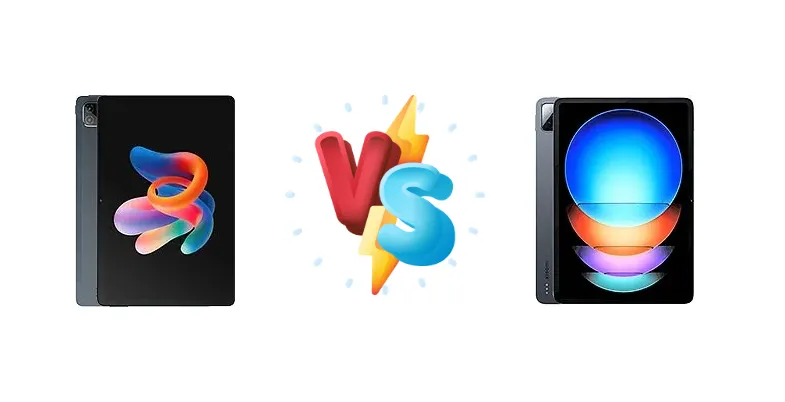
Xiaomi offers a compelling two-pronged tablet strategy: the Black Shark Pad 7 Pro, geared towards mobile gaming enthusiasts, and the Pad 6S Pro 12.4, positioned as a premium productivity and entertainment device. This comparison dissects the core differences between these two tablets, focusing on performance, display quality, and battery life to help you determine which best suits your needs.
🏆 Quick Verdict
For the average user prioritizing all-around performance and a superior display, the Xiaomi Pad 6S Pro 12.4 is the clear winner. Its Snapdragon 8 Gen 2 chipset delivers significantly more processing power and efficiency, complemented by a brighter, higher-contrast display. However, gamers on a tighter budget may find the Black Shark 7 Pro a viable option.
| Network |
|---|
| 2G bands | GSM 850 / 900 / 1800 / 1900 | N/A |
| 3G bands | HSDPA 850 / 900 / 2100 | N/A |
| 4G bands | LTE | - |
| EDGE | - | N/A |
| GPRS | - | N/A |
| Speed | HSPA, LTE | - |
| Technology | GSM / HSPA / LTE | No cellular connectivity |
| Launch |
|---|
| Announced | 2025, October 30 | 2024, February 22 |
| Status | Available. Released 2025, November | Available. Released 2024, February 22 |
| Body |
|---|
| Build | Glass front, aluminum back, aluminum frame | Glass front (Gorilla Glass 5), aluminum frame, aluminum back |
| Dimensions | - | 278.7 x 191.6 x 6.3 mm (10.97 x 7.54 x 0.25 in) |
| SIM | Nano-SIM | No |
| Weight | 513 g (1.13 lb) | 590 g (1.30 lb) |
| Display |
|---|
| Protection | - | Corning Gorilla Glass 5 |
| Resolution | 1200 x 1900 pixels, 16:10 ratio (~204 ppi density) | 2032 x 3048 pixels, 3:2 ratio (~295 ppi density) |
| Size | 11.0 inches, 352.4 cm2 | 12.4 inches, 457.8 cm2 (~85.7% screen-to-body ratio) |
| Type | IPS LCD, 120Hz, 420 nits | IPS LCD, 68B colors, 144Hz, HDR10, Dolby Vision, 900 nits (peak) |
| Platform |
|---|
| CPU | Octa-core (2x2.2 GHz Cortex-A76 & 6x2.0 GHz Cortex-A55) | Octa-core (1x3.2 GHz Cortex-X3 & 2x2.8 GHz Cortex-A715 & 2x2.8 GHz Cortex-A710 & 3x2.0 GHz Cortex-A510) |
| Chipset | Mediatek Helio G100 (6 nm) | Qualcomm SM8550-AB Snapdragon 8 Gen 2 (4 nm) |
| GPU | Mali-G57 MC2 | Adreno 740 |
| OS | Android 15 | Android 14, up to 3 major Android upgrades, HyperOS |
| Memory |
|---|
| Card slot | microSDXC | No |
| Internal | 256GB 8GB RAM | 256GB 8GB RAM, 256GB 12GB RAM, 512GB 12GB RAM, 1TB 16GB RAM |
| Main Camera |
|---|
| Dual | 13 MP
2 MP | 50 MP, f/1.8, (wide), 1/2.76", 0.64µm, PDAF
Auxiliary lens |
| Features | LED flash | LED flash, HDR, panorama |
| Video | 1080p@30fps | 4K@30/60fps, 1080p@30/60fps |
| Selfie camera |
|---|
| Single | 8 MP | 32 MP, f/2.2, (wide), 1/3.6", 0.61µm |
| Video | 1080p@30fps | 1080p@30fps |
| Sound |
|---|
| 35mm jack | No | No |
| Loudspeaker | Yes, with stereo speakers (4 speakers) | Yes, with stereo speakers (6 speakers) |
| Comms |
|---|
| Bluetooth | Yes | 5.3, A2DP, LE, LHDC |
| NFC | No | Yes (file transfer only) |
| Positioning | GPS | No |
| Radio | No | No |
| USB | USB Type-C, magnetic accessory connector pins | USB Type-C 3.2, accessory connector |
| WLAN | Yes | Wi-Fi 802.11 a/b/g/n/a/6/7, dual-band, Wi-Fi Direct |
| Features |
|---|
| Sensors | Accelerometer | Fingerprint (side-mounted), accelerometer, gyro, proximity (accessories only), compass |
| Battery |
|---|
| Charging | - | 120W wired, PD3.0, QC4, 45% in 10 min, 100% in 35 min |
| Type | 8800 mAh | 10000 mAh |
| Misc |
|---|
| Colors | Gray, Blue | Black, Blue, Green |
| Models | - | 24018RPACG |
| Price | About 200 EUR | About 700 EUR |
| SAR EU | - | 0.99 W/kg (body) |
Xiaomi Black Shark Pad 7 Pro
- Potentially more affordable price point
- Gaming-focused design elements
- Dedicated gaming features (if any, not specified)
- Significantly less powerful processor
- Likely lower display quality
- Potentially slower charging and shorter battery life
Xiaomi Pad 6S Pro 12.4
- Flagship Snapdragon 8 Gen 2 performance
- Brighter, higher-contrast display
- Ultra-fast 120W charging
- Excellent battery life (11:14h active use)
- Higher price tag
- Larger size may not be ideal for all users
- May lack dedicated gaming features
Display Comparison
The Xiaomi Pad 6S Pro 12.4 boasts a superior display experience. While both tablets feature large screens, the 6S Pro’s measured 848 nits of peak brightness significantly outshines the Black Shark Pad 7 Pro (brightness data unavailable). Furthermore, the 1378:1 contrast ratio on the 6S Pro delivers deeper blacks and more vibrant colors. The absence of LTPO technology details for the Black Shark Pad 7 Pro suggests a potentially less efficient display, impacting battery life during prolonged use. The larger screen size of the 6S Pro also contributes to a more immersive viewing experience.
Camera Comparison
Camera performance isn't a primary focus for either tablet, but the Pad 6S Pro 12.4 likely holds an advantage due to its more powerful ISP within the Snapdragon 8 Gen 2. While specific camera specs are unavailable for both, the processing capabilities of the Snapdragon chipset will result in better image quality and faster processing times. The Black Shark Pad 7 Pro’s camera is likely optimized for basic functionality, while the 6S Pro can handle more complex scenes and potentially offer better low-light performance.
Performance
The performance gap between these tablets is substantial. The Xiaomi Pad 6S Pro 12.4’s Qualcomm Snapdragon 8 Gen 2 (4nm) is a flagship-level chipset, featuring a Cortex-X3 prime core clocked at 3.2 GHz, alongside Cortex-A715 and A710 performance cores. This architecture provides a significant leap in CPU and GPU performance compared to the Black Shark Pad 7 Pro’s MediaTek Helio G100 (6nm). The Helio G100, while capable, utilizes older Cortex-A76 and A55 cores, resulting in lower single-core and multi-core scores. The 4nm process node of the Snapdragon 8 Gen 2 also offers superior thermal efficiency, minimizing throttling during intensive gaming sessions. The 6S Pro’s LPDDR5x RAM further enhances performance.
Battery Life
The Xiaomi Pad 6S Pro 12.4 demonstrates a clear advantage in battery and charging. The active use score of 11:14h indicates excellent battery life, likely due to the efficiency of the Snapdragon 8 Gen 2. The 120W wired charging is a game-changer, achieving 45% charge in just 10 minutes and a full charge in 35 minutes. The Black Shark Pad 7 Pro’s battery capacity and charging speed are not specified, suggesting a potentially slower charging experience and possibly shorter battery life, especially during demanding tasks.
Buying Guide
Buy the Xiaomi Black Shark Pad 7 Pro if you need a dedicated gaming tablet with a focus on value and are willing to compromise on raw processing power and display quality. Buy the Xiaomi Pad 6S Pro 12.4 if you prefer a premium tablet experience with exceptional performance for demanding tasks, a stunning display for content consumption, and faster charging capabilities.
Frequently Asked Questions
❓ Does the Snapdragon 8 Gen 2 in the Pad 6S Pro 12.4 exhibit thermal throttling during extended gaming sessions?
The Snapdragon 8 Gen 2’s 4nm process and Xiaomi’s thermal management system are designed to minimize throttling. While some heat generation is inevitable during prolonged gaming, the 6S Pro is expected to maintain higher sustained performance levels compared to the Black Shark Pad 7 Pro’s Helio G100.
❓ Is the 120W charging on the Pad 6S Pro 12.4 compatible with all USB-PD chargers?
The Pad 6S Pro 12.4 supports PD3.0 and QC4, ensuring compatibility with a wide range of USB-PD chargers. However, to achieve the full 120W charging speed, a charger specifically rated for that wattage is required. Using a lower-wattage charger will still charge the device, but at a slower rate.
❓ What type of gaming performance can I expect from the Black Shark Pad 7 Pro?
The Black Shark Pad 7 Pro is capable of running most Android games, but at lower graphical settings compared to the Pad 6S Pro 12.4. The Helio G100 chipset is sufficient for casual gaming, but demanding titles may require reduced frame rates and visual fidelity to maintain smooth gameplay.