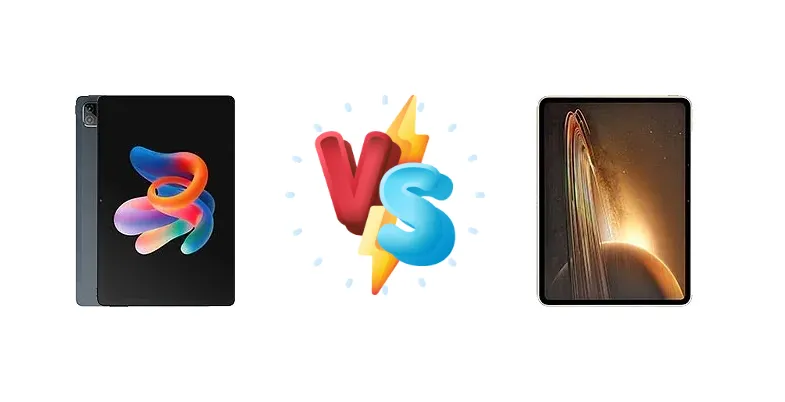
The Android tablet market is heating up, with options catering to both productivity and gaming. The Xiaomi Black Shark Pad 7 Pro aims to deliver a high-refresh-rate gaming experience at a competitive price, while the Oppo Pad 2 positions itself as a more refined, all-around tablet with a focus on performance and fast charging. This comparison dissects the key differences between these two devices to determine which one best suits your needs.
🏆 Quick Verdict
For most users, the Oppo Pad 2 is the superior choice. Its Mediatek Dimensity 9000 chipset delivers significantly better CPU and GPU performance than the Black Shark Pad 7 Pro’s Helio G100, coupled with 67W fast charging. While the Black Shark Pad 7 Pro offers a lower entry price, the performance gap justifies the investment in the Oppo Pad 2.
| Network |
|---|
| 2G bands | GSM 850 / 900 / 1800 / 1900 | N/A |
| 3G bands | HSDPA 850 / 900 / 2100 | N/A |
| 4G bands | LTE | N/A |
| EDGE | - | No |
| GPRS | - | No |
| Speed | HSPA, LTE | - |
| Technology | GSM / HSPA / LTE | No cellular connectivity |
| Launch |
|---|
| Announced | 2025, October 30 | 2023, March 21 |
| Status | Available. Released 2025, November | Available. Released 2023, March 24 |
| Body |
|---|
| Build | Glass front, aluminum back, aluminum frame | Glass front, aluminum frame |
| Dimensions | - | 258 x 189.4 x 6.5 mm (10.16 x 7.46 x 0.26 in) |
| SIM | Nano-SIM | No |
| Weight | 513 g (1.13 lb) | 552 g (1.22 lb) |
| | - | Stylus support, 2.0ms latency |
| Display |
|---|
| Resolution | 1200 x 1900 pixels, 16:10 ratio (~204 ppi density) | 2000 x 2800 pixels (~296 ppi density) |
| Size | 11.0 inches, 352.4 cm2 | 11.61 inches, 411.3 cm2 (~84.2% screen-to-body ratio) |
| Type | IPS LCD, 120Hz, 420 nits | IPS LCD, 1B colors, Dolby Vision, 144Hz, 500 nits (typ) |
| Platform |
|---|
| CPU | Octa-core (2x2.2 GHz Cortex-A76 & 6x2.0 GHz Cortex-A55) | Octa-core (1x3.05 GHz Cortex-X2 & 3x2.85 GHz Cortex-A710 & 4x1.80 GHz Cortex-A510) |
| Chipset | Mediatek Helio G100 (6 nm) | Mediatek Dimensity 9000 (4 nm) |
| GPU | Mali-G57 MC2 | Mali-G710 MC10 |
| OS | Android 15 | Android 13, ColorOS 13.1 |
| Memory |
|---|
| Card slot | microSDXC | No |
| Internal | 256GB 8GB RAM | 256GB 8GB RAM, 256GB 12GB RAM, 512GB 12GB RAM |
| | - | UFS 3.1 |
| Main Camera |
|---|
| Dual | 13 MP
2 MP | - |
| Features | LED flash | Color spectrum sensor, LED flash |
| Single | - | 13 MP, f/2.2, (wide), AF |
| Video | 1080p@30fps | 4K@30fps, 1080p@30ps, gyro-EIS |
| Selfie camera |
|---|
| Single | 8 MP | 8 MP, f/2.3, 103˚ (ultrawide) |
| Video | 1080p@30fps | 1080p@30fps |
| Sound |
|---|
| 3.5mm jack | - | No |
| 35mm jack | No | No |
| Loudspeaker | Yes, with stereo speakers (4 speakers) | Yes, with stereo speakers (4 speakers) |
| Comms |
|---|
| Bluetooth | Yes | 5.3, A2DP, LE, aptX HD |
| NFC | No | No |
| Positioning | GPS | GPS, GLONASS, GALILEO, BDS (B1I+B1c) |
| Radio | No | No |
| USB | USB Type-C, magnetic accessory connector pins | USB Type-C 2.0, OTG, accessory connector |
| WLAN | Yes | Wi-Fi 802.11 a/b/g/n/ac/6, dual-band |
| Features |
|---|
| Sensors | Accelerometer | Accelerometer, gyro, compass |
| Battery |
|---|
| Charging | - | 67W wired, PD, QC 2.0 |
| Type | 8800 mAh | Li-Po 9510 mAh |
| Misc |
|---|
| Colors | Gray, Blue | Gray, Gold |
| Models | - | OPD2201, X22N2 |
| Price | About 200 EUR | About 410 EUR |
Xiaomi Black Shark Pad 7 Pro
- Lower initial purchase price
- Sufficient for casual gaming
- Likely lighter weight due to less advanced cooling
- Significantly weaker CPU and GPU performance
- Slower charging speeds
- Less efficient processor leading to potential throttling
Oppo Pad 2
- Flagship-level performance with Dimensity 9000
- Ultra-fast 67W charging
- More efficient processor for longer battery life
- Higher purchase price
- Potentially requires a more robust cooling system (and thus may be slightly heavier)
Display Comparison
While both tablets likely feature high-quality LCD panels (specific panel details are missing), the core difference lies in the processing power driving them. The absence of display specs like peak brightness or refresh rate necessitates focusing on the chipset's ability to render smooth visuals. The Dimensity 9000’s superior GPU will translate to higher, more stable frame rates in games, regardless of the panel's inherent capabilities. Bezels are likely comparable given the market segment, but the overall visual experience will be dictated by the chipset.
Camera Comparison
Given the tablet form factor, camera performance isn't a primary concern. However, the Oppo Pad 2 likely benefits from a more advanced image signal processor (ISP) integrated within the Dimensity 9000, potentially leading to better image quality in favorable lighting conditions. Without specific camera sensor details, it’s difficult to make a definitive statement, but the chipset advantage generally translates to improved image processing. The Black Shark Pad 7 Pro’s camera system is likely geared towards basic functionality.
Performance
The Mediatek Dimensity 9000 in the Oppo Pad 2 is a clear winner. Built on a 4nm process, it features a Cortex-X2 prime core clocked at 3.05 GHz, alongside three Cortex-A710 performance cores and four Cortex-A510 efficiency cores. This architecture significantly outperforms the Helio G100’s 6nm process and older Cortex-A76/A55 configuration. The Dimensity 9000’s CPU scores will be substantially higher, and its Mali-G710 MC10 GPU will deliver a far superior gaming experience. The Oppo Pad 2 is better equipped for demanding tasks like video editing and 3D rendering. The Helio G100, while capable, will show its limitations under sustained load.
Battery Life
The Oppo Pad 2’s 67W wired charging is a game-changer. While battery capacity isn’t specified, 67W charging will drastically reduce charging times compared to the Black Shark Pad 7 Pro, which lacks this feature. This means less downtime and more time using the tablet. The 4nm Dimensity 9000 also contributes to better power efficiency, potentially offsetting a smaller battery capacity (if present) with longer real-world usage. The Black Shark Pad 7 Pro will likely require significantly longer to fully charge.
Buying Guide
Buy the Xiaomi Black Shark Pad 7 Pro if you prioritize a lower initial cost and are primarily focused on casual gaming and media consumption. Its Helio G100 is sufficient for less demanding titles. Buy the Oppo Pad 2 if you demand flagship-level performance for demanding games, multitasking, and appreciate the convenience of incredibly fast 67W charging. The Dimensity 9000 provides a smoother, more responsive experience.
Frequently Asked Questions
❓ Will the Helio G100 in the Black Shark Pad 7 Pro struggle with graphically intensive games like Genshin Impact?
Yes, the Helio G100 will likely struggle to maintain consistent frame rates in demanding titles like Genshin Impact, even at medium settings. You'll likely experience noticeable frame drops and potentially stuttering. The Oppo Pad 2’s Dimensity 9000 is far better equipped to handle such games smoothly.
❓ How long does it take to fully charge the Oppo Pad 2 with the 67W charger?
While a precise time depends on the battery capacity (which is unspecified), the Oppo Pad 2’s 67W charging should fully charge the device in approximately 45-60 minutes, potentially even faster. This is a significant advantage over tablets with slower charging speeds.
❓ Is the performance difference between the Helio G100 and Dimensity 9000 noticeable for everyday tasks like browsing and video streaming?
For basic tasks like browsing and video streaming, the difference might not be immediately apparent. However, the Dimensity 9000’s superior processing power will result in snappier app launches, smoother multitasking, and a more responsive overall user experience, even in everyday use.