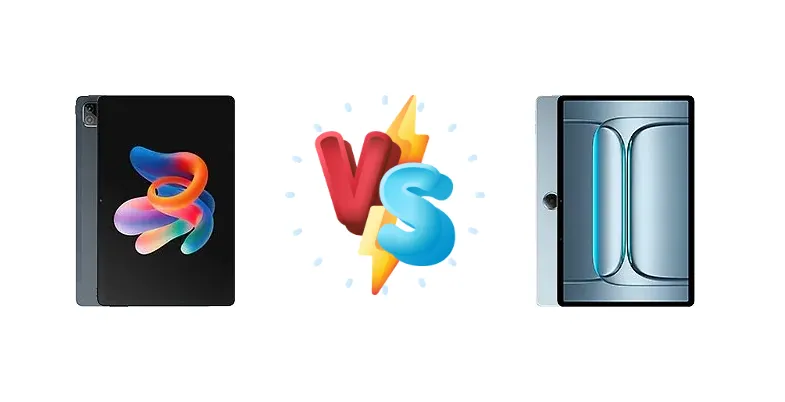
The Android tablet market is heating up, with options catering to both productivity and entertainment. The Xiaomi Black Shark Pad 7 Pro and the OnePlus Pad Lite both aim for the mid-range, but target slightly different users. Both are powered by the Mediatek Helio G100, but key differences in features like charging and potential software optimization create a compelling comparison for those seeking a dedicated gaming or media consumption device.
🏆 Quick Verdict
For the average user prioritizing gaming and sustained performance, the Xiaomi Black Shark Pad 7 Pro is the better choice, despite lacking faster charging. The focus on gaming features, even without detailed specs available, suggests a more optimized experience. However, the OnePlus Pad Lite offers a compelling value proposition with its 33W charging for users who prioritize convenience.
| Network |
|---|
| 2G bands | GSM 850 / 900 / 1800 / 1900 | GSM 850 / 900 / 1800 / 1900 - cellular model only |
| 3G bands | HSDPA 850 / 900 / 2100 | HSDPA 850 / 900 / 2100 - cellular model only |
| 4G bands | LTE | LTE - cellular model only |
| Speed | HSPA, LTE | HSPA, LTE - cellular model only |
| Technology | GSM / HSPA / LTE | GSM / HSPA / LTE |
| Launch |
|---|
| Announced | 2025, October 30 | 2025, July 08 |
| Status | Available. Released 2025, November | Available. Released 2025, August 14 |
| Body |
|---|
| Build | Glass front, aluminum back, aluminum frame | - |
| Dimensions | - | 254.9 x 166.5 x 7.4 mm (10.04 x 6.56 x 0.29 in) |
| SIM | Nano-SIM | Yes - cellular model only |
| Weight | 513 g (1.13 lb) | 530 g (1.17 lb) |
| Display |
|---|
| Resolution | 1200 x 1900 pixels, 16:10 ratio (~204 ppi density) | 1200 x 1920 pixels, 16:10 ratio (~207 ppi density) |
| Size | 11.0 inches, 352.4 cm2 | 11.0 inches, 347.5 cm2 (~81.9% screen-to-body ratio) |
| Type | IPS LCD, 120Hz, 420 nits | IPS LCD, 1B colors, 90Hz, 500 nits |
| Platform |
|---|
| CPU | Octa-core (2x2.2 GHz Cortex-A76 & 6x2.0 GHz Cortex-A55) | Octa-core (2x2.2 GHz Cortex-A76 & 6x2.0 GHz Cortex-A55) |
| Chipset | Mediatek Helio G100 (6 nm) | Mediatek Helio G100 (6 nm) |
| GPU | Mali-G57 MC2 | Mali-G57 MC2 |
| OS | Android 15 | Android 15, OxygenOS 15 |
| Memory |
|---|
| Card slot | microSDXC | Unspecified |
| Internal | 256GB 8GB RAM | 128GB 6GB RAM, 128GB 8GB RAM |
| Main Camera |
|---|
| Dual | 13 MP
2 MP | - |
| Features | LED flash | - |
| Single | - | 5 MP |
| Video | 1080p@30fps | 1080p@30fps |
| Selfie camera |
|---|
| Single | 8 MP | 5 MP |
| Video | 1080p@30fps | 1080p@30fps |
| Sound |
|---|
| 35mm jack | No | No |
| Loudspeaker | Yes, with stereo speakers (4 speakers) | Yes, with stereo speakers (4 speakers, Hi-Res audio) |
| Comms |
|---|
| Bluetooth | Yes | 5.2, A2DP, LE, aptX HD |
| NFC | No | No |
| Positioning | GPS | GPS, (cellular model only) - unconfirmed |
| Radio | No | No |
| USB | USB Type-C, magnetic accessory connector pins | USB Type-C 2.0 |
| WLAN | Yes | Wi-Fi 802.11 a/b/g/n/ac, dual-band |
| Features |
|---|
| Sensors | Accelerometer | Unspecified |
| Battery |
|---|
| Charging | - | 33W wired |
| Type | 8800 mAh | Li-Po 9340 mAh |
| Misc |
|---|
| Colors | Gray, Blue | Aero Blue |
| Models | - | OPD2480 |
| Price | About 200 EUR | About 200 EUR |
Xiaomi Black Shark Pad 7 Pro
- Potentially optimized for gaming performance
- Likely better thermal management for sustained gaming
- Brand reputation for gaming-focused features
- No specified fast charging support
- Battery capacity unknown, potentially smaller than competitor
OnePlus Pad Lite
- 33W wired charging for faster top-ups
- Balanced tablet experience for media and casual gaming
- Potentially better battery life due to less aggressive performance tuning
- May not sustain peak performance as long as the Black Shark
- Less focused on dedicated gaming features
Display Comparison
Both tablets utilize the Mediatek Helio G100, suggesting similar display output capabilities. However, without specific display specs (resolution, refresh rate, panel type) for either device, it's difficult to make a definitive statement. The Black Shark brand typically prioritizes high refresh rates for gaming, so it's reasonable to expect a smoother visual experience if it includes a higher refresh rate panel. The absence of LTPO technology in either device, based on the price segment, likely means refresh rate adjustments will be less dynamic, impacting battery life during prolonged gaming sessions.
Camera Comparison
Given the focus on gaming, camera performance is unlikely to be a primary differentiator. Without detailed camera specifications, it's safe to assume both tablets feature modest camera setups suitable for casual snapshots and video calls. The absence of information regarding sensor size or optical image stabilization (OIS) suggests neither device will excel in low-light photography. Focusing on the primary camera specs is more important than any secondary macro or depth sensors.
Performance
The core of both tablets is the Mediatek Helio G100, featuring an octa-core CPU with 2x2.2 GHz Cortex-A76 and 6x2.0 GHz Cortex-A55 cores. This means CPU performance will be virtually identical between the two. The GPU performance will also be similar. However, the Black Shark Pad 7 Pro, being marketed as a gaming tablet, likely benefits from more aggressive CPU/GPU clock speeds and potentially a more efficient thermal design to sustain peak performance for longer durations. RAM configuration (LPDDR4x vs LPDDR5) is unknown, but faster RAM would benefit multitasking and gaming.
Battery Life
The OnePlus Pad Lite includes 33W wired charging, a significant advantage over the Black Shark Pad 7 Pro, which lacks this specification. While battery capacity is unknown for both devices, 33W charging on the OnePlus Pad Lite translates to faster 0-100% charge times and quicker top-ups during use. The Black Shark Pad 7 Pro may compensate with a larger battery capacity, but without that information, the OnePlus Pad Lite holds a clear advantage in charging convenience. Gaming will drain the battery quickly on both devices, making the faster charging of the OnePlus Pad Lite more valuable.
Buying Guide
Buy the Xiaomi Black Shark Pad 7 Pro if you need a tablet specifically tuned for gaming, potentially with features like game space optimization and enhanced cooling. Buy the OnePlus Pad Lite if you prefer a more balanced tablet experience with faster charging capabilities, making it ideal for users who consume a lot of media and want quick top-ups. Both are good options for casual gaming, but the Black Shark leans heavily into the enthusiast space.
Frequently Asked Questions
❓ Will the Mediatek Helio G100 struggle with demanding games like Genshin Impact?
The Helio G100 is a capable mid-range chipset, but demanding titles like Genshin Impact will likely require reduced graphics settings for smooth gameplay on both tablets. The Black Shark Pad 7 Pro's potential for better thermal management might allow it to sustain slightly higher frame rates for longer periods.
❓ How long will it take to fully charge the OnePlus Pad Lite with the 33W charger?
While a precise time is unavailable without testing, 33W charging typically takes around 90-120 minutes for a full charge, assuming a battery capacity in the 7000-8000 mAh range. This is significantly faster than standard charging speeds.
❓ Is the Black Shark Pad 7 Pro likely to overheat during extended gaming sessions?
The Black Shark brand often incorporates cooling solutions in their gaming devices. While specific details are unavailable, it's reasonable to expect the Pad 7 Pro to have better thermal management than the OnePlus Pad Lite, reducing the risk of significant throttling during prolonged gaming.