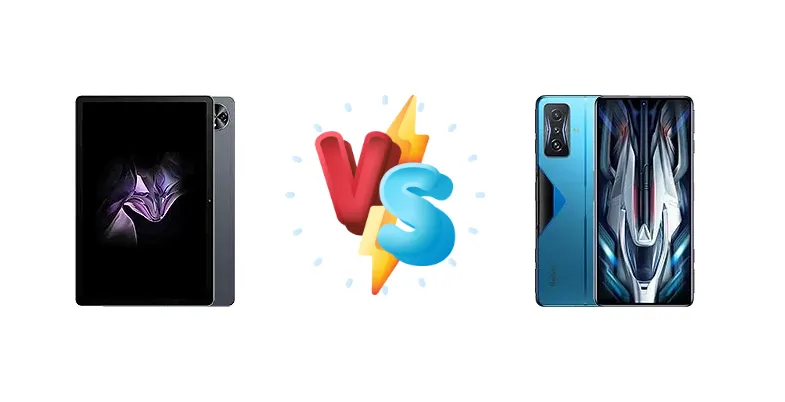
Xiaomi caters to the mobile gaming market with distinct approaches: the large-screen, portable Black Shark Pad 6 and the flagship-level Redmi K50 Gaming. This comparison dissects their core components to determine which device delivers the best gaming experience for your needs and budget, focusing on the significant performance disparity between their chipsets.
🏆 Quick Verdict
For the average gamer prioritizing raw power and speed, the Redmi K50 Gaming is the clear winner. Its Snapdragon 8 Gen 1 chipset offers a substantial performance advantage over the Pad 6’s Unisoc Tiger T616. However, the Pad 6 presents a compelling option for those seeking a dedicated, portable gaming tablet experience at a lower price point.
| Network |
|---|
| 2G bands | GSM 850 / 900 / 1800 / 1900 | GSM 850 / 900 / 1800 / 1900 |
| 3G bands | HSDPA 850 / 900 / 2100 | HSDPA 850 / 900 / 1700(AWS) / 1900 / 2100 |
| 4G bands | LTE | 1, 2, 3, 4, 5, 7, 8, 18, 19, 26, 34, 38, 39, 40, 41, 42 |
| 5G bands | - | 1, 3, 5, 8, 28, 38, 40, 41, 77, 78 SA/NSA/Sub6 |
| Speed | HSPA, LTE - cellular model only | HSPA, LTE, 5G |
| Technology | GSM / HSPA / LTE | GSM / CDMA / HSPA / CDMA2000 / LTE / 5G |
| | - | CDMA2000 1x |
| Launch |
|---|
| Announced | 2024, November 29 | 2022, February 16 |
| Status | Available. Released 2024, December | Available. Released 2022, February 18 |
| Body |
|---|
| Build | - | Glass front (Gorilla Glass Victus), glass back, aluminum frame |
| Dimensions | 265.8 x 168.3 x 7.9 mm (10.46 x 6.63 x 0.31 in) | 162.5 x 76.7 x 8.5 mm (6.40 x 3.02 x 0.33 in) |
| SIM | Nano-SIM + Nano-SIM (cellular model only) | Nano-SIM + Nano-SIM |
| Weight | 523 g (1.15 lb) | 210 g (7.41 oz) |
| | - | Physical magnetic pop-up gaming triggers |
| Display |
|---|
| Protection | - | Corning Gorilla Glass Victus |
| Resolution | 1200 x 1920 pixels, 16:10 ratio (~206 ppi density) | 1080 x 2400 pixels, 20:9 ratio (~395 ppi density) |
| Size | 11.0 inches, 350.9 cm2 (~78.4% screen-to-body ratio) | 6.67 inches, 107.4 cm2 (~86.2% screen-to-body ratio) |
| Type | IPS LCD, 90Hz | OLED, 1B colors, 120Hz, HDR10+, 800 nits (HBM) |
| Platform |
|---|
| CPU | Octa-core (2x2.0 GHz Cortex-A75 & 6x1.8 GHz Cortex-A55) | Octa-core (1x3.00 GHz Cortex-X2 & 3x2.50 GHz Cortex-A710 & 4x1.80 GHz Cortex-A510) |
| Chipset | Unisoc Tiger T616 (12 nm) | Qualcomm SM8450 Snapdragon 8 Gen 1 (4 nm) |
| GPU | Mali-G57 MP1 | Adreno 730 |
| OS | Android 14 | Android 12, MIUI 13 |
| Memory |
|---|
| Card slot | microSDXC (uses shared SIM slot) | No |
| Internal | 256GB 8GB RAM | 128GB 8GB RAM, 128GB 12GB RAM, 256GB 12GB RAM |
| | - | UFS 3.1 |
| Main Camera |
|---|
| Features | LED flash | Color spectrum sensor, Dual-LED flash, HDR, panorama |
| Single | 16 MP, (wide) | 20 MP, f/2.4, (wide), 1/2.0", 0.8µm |
| Triple | - | 64 MP, f/1.9, 26mm (wide), 1/1.73", 0.8µm, PDAF
8 MP, f/2.2, 120˚ (ultrawide)
2 MP (macro) |
| Video | 1080p@30fps | 4K@30/60fps, 1080p@30/60/120fps, 720p@960fps, HDR |
| Selfie camera |
|---|
| Features | - | HDR |
| Single | 8 MP, (wide) | 20 MP, f/2.4, (wide), 1/2.0", 0.8µm |
| Video | 1080p@30fps | 1080p@30/60fps, 720p@120fps, HDR |
| Sound |
|---|
| 3.5mm jack | - | No |
| 35mm jack | No | No |
| Loudspeaker | Yes, with stereo speakers | Yes, with stereo speakers (4 speakers) |
| | - | 24-bit/192kHz audio
Tuned by JBL |
| Comms |
|---|
| Bluetooth | 5.1, A2DP, LE | 5.2, A2DP, LE, aptX HD, aptX Adaptive |
| Infrared port | Yes | Yes |
| NFC | No | Yes |
| Positioning | GPS, GALILEO, GLONASS, BDS - cellular model only | GPS (L1+L5), GLONASS (L1), BDS (B1I+B1c+B2a), GALILEO (E1+E5a), QZSS (L1+L5), NavIC (L5) |
| Radio | Unspecified | No |
| USB | USB Type-C 2.0 | USB Type-C 2.0, OTG |
| WLAN | Wi-Fi 802.11 a/b/g/n/ac, dual-band | Wi-Fi 802.11 a/b/g/n/ac/6e, dual-band, Wi-Fi Direct |
| Features |
|---|
| Sensors | Accelerometer | Fingerprint (side-mounted), accelerometer, gyro, compass |
| | - | Virtual proximity sensing |
| Battery |
|---|
| Charging | 18W wired | 120W wired, PD3.0, QC3, 100% in 17 min |
| Type | 8800 mAh | Li-Po 4700 mAh |
| Misc |
|---|
| Colors | Gray, Green | Black, Gray, Blue, AMG |
| Models | - | 21121210C |
| Price | About 280 EUR | About 460 EUR |
Xiaomi Black Shark Pad 6
- Larger screen for immersive gaming
- More affordable price point
- Dedicated tablet gaming experience
- Significantly weaker chipset performance
- Slow 18W charging
- Lower overall performance ceiling
Xiaomi Redmi K50 Gaming
- Flagship Snapdragon 8 Gen 1 performance
- Ultra-fast 120W charging
- Compact and portable phone form factor
- Smaller screen size compared to the Pad 6
- Potentially higher price
- May experience thermal throttling under sustained load
Display Comparison
The Black Shark Pad 6, being a tablet, inherently offers a larger display, though specific details like screen size and resolution are missing. The Redmi K50 Gaming’s display specs are also unavailable, but given its phone form factor, it will be significantly smaller. The key difference lies in the intended use case; the Pad 6 prioritizes immersion, while the K50 Gaming focuses on portability. Without knowing the panel technology (e.g., IPS, AMOLED) or refresh rates, it’s difficult to assess color accuracy or responsiveness, but the larger canvas of the Pad 6 is a significant advantage for certain game types.
Camera Comparison
Camera performance isn’t a primary focus for gaming devices, but it’s worth noting. Specific camera specs for both devices are unavailable. However, given the Redmi K50 Gaming’s flagship positioning, it likely features a more capable camera system than the Black Shark Pad 6. The Pad 6 likely prioritizes cost savings in this area. Without detailed sensor information, it’s impossible to assess image quality or low-light performance.
Performance
This is where the chasm between these devices becomes apparent. The Redmi K50 Gaming’s Qualcomm Snapdragon 8 Gen 1 (4nm) is a flagship-level chipset built for demanding tasks. Its octa-core configuration, featuring a Cortex-X2 prime core clocked at 3.00 GHz, delivers significantly higher CPU and GPU performance than the Unisoc Tiger T616 (12nm) found in the Black Shark Pad 6. The Snapdragon 8 Gen 1’s Adreno 730 GPU will handle graphically intensive games at higher settings and frame rates. The 4nm process node of the Snapdragon 8 Gen 1 also contributes to better thermal efficiency, potentially mitigating throttling during extended gaming sessions, a concern that may be more prevalent with the 12nm Unisoc chip. The Pad 6’s CPU, with its Cortex-A75 and A55 cores, is geared towards efficiency rather than raw power.
Battery Life
The Redmi K50 Gaming boasts a significant advantage in charging speed with its 120W wired charging, capable of a full charge in just 17 minutes. This is a game-changer for gamers who need to quickly get back into the action. The Black Shark Pad 6’s 18W charging is comparatively slow. While battery capacity is unknown for both devices, the faster charging of the K50 Gaming effectively mitigates any potential capacity disadvantage. The K50 Gaming also supports PD3.0 and QC3 standards, offering broader compatibility with chargers.
Buying Guide
Buy the Xiaomi Black Shark Pad 6 if you need a larger screen for immersive gaming, prioritize portability over absolute performance, and are on a tighter budget. It’s ideal for casual gamers and those who enjoy tablet-based gaming experiences. Buy the Xiaomi Redmi K50 Gaming if you prefer a phone-form factor, demand top-tier performance for demanding games, and value incredibly fast 120W charging for minimal downtime. This is the choice for competitive mobile gamers.
Frequently Asked Questions
❓ Will the Unisoc Tiger T616 in the Black Shark Pad 6 struggle with demanding games like Genshin Impact?
Yes, the Unisoc Tiger T616 is a mid-range chipset and will likely require significant graphical settings reductions to achieve playable frame rates in demanding titles like Genshin Impact. Expect lower detail levels and potentially noticeable frame drops compared to the Snapdragon 8 Gen 1.
❓ Does the Redmi K50 Gaming's Snapdragon 8 Gen 1 overheat during prolonged gaming sessions?
The Snapdragon 8 Gen 1 is known to generate heat under sustained load. While the Redmi K50 Gaming likely incorporates cooling solutions, some thermal throttling is possible during extended gaming sessions. However, the K50 Gaming's superior performance still makes it the better choice for demanding gamers, even with some throttling.
❓ Is the 120W charging on the Redmi K50 Gaming safe for the battery's long-term health?
Xiaomi employs battery protection technologies to mitigate the impact of fast charging on long-term battery health. While fast charging generates more heat, the K50 Gaming's charging system is designed to optimize the process and minimize degradation.