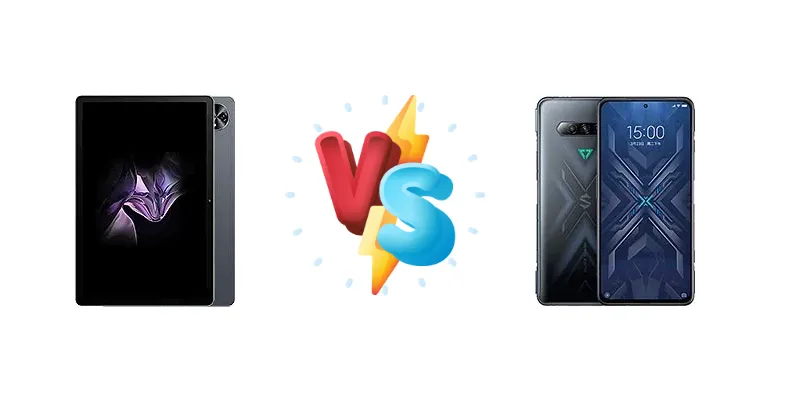
Xiaomi's Black Shark line has consistently delivered gaming-focused devices, but the product stack is now diverse. We're pitting the recently released Black Shark Pad 6, aimed at a more accessible price point, against the older but still potent Black Shark 4 Pro, a former flagship, to determine which offers the best gaming experience for your money.
🏆 Quick Verdict
For most gamers, the Xiaomi Black Shark 4 Pro remains the superior choice. Its Snapdragon 888 5G chipset delivers significantly higher performance than the Pad 6’s Unisoc Tiger T616, justifying the price difference despite the Pad 6’s newer design and potentially better software support. However, the Pad 6 is a compelling option for casual gamers on a tight budget.
| Network |
|---|
| 2G bands | GSM 850 / 900 / 1800 / 1900 | GSM 850 / 900 / 1800 / 1900 |
| 3G bands | HSDPA 850 / 900 / 2100 | HSDPA 800 / 850 / 900 / 1700(AWS) / 1900 / 2100 |
| 4G bands | LTE | 1, 2, 3, 4, 5, 7, 8, 18, 19, 20, 26, 28, 34, 38, 39, 40, 41 |
| 5G bands | - | 1, 3, 8, 28, 41, 77, 78, 79 SA/NSA |
| Speed | HSPA, LTE - cellular model only | HSPA, LTE, 5G |
| Technology | GSM / HSPA / LTE | GSM / CDMA / HSPA / EVDO / LTE / 5G |
| | - | CDMA2000 1xEV-DO |
| Launch |
|---|
| Announced | 2024, November 29 | 2021, March 23 |
| Status | Available. Released 2024, December | Available. Released 2021, March 30 |
| Body |
|---|
| Dimensions | 265.8 x 168.3 x 7.9 mm (10.46 x 6.63 x 0.31 in) | 163.8 x 76.4 x 9.9 mm (6.45 x 3.01 x 0.39 in) |
| SIM | Nano-SIM + Nano-SIM (cellular model only) | Nano-SIM + Nano-SIM |
| Weight | 523 g (1.15 lb) | 220 g (7.76 oz) |
| | - | Physical pop-up gaming triggers |
| Display |
|---|
| Resolution | 1200 x 1920 pixels, 16:10 ratio (~206 ppi density) | 1080 x 2400 pixels, 20:9 ratio (~395 ppi density) |
| Size | 11.0 inches, 350.9 cm2 (~78.4% screen-to-body ratio) | 6.67 inches, 107.4 cm2 (~85.8% screen-to-body ratio) |
| Type | IPS LCD, 90Hz | Super AMOLED, 144Hz, HDR10+, 1300 nits (peak) |
| | - | Always-on display |
| Platform |
|---|
| CPU | Octa-core (2x2.0 GHz Cortex-A75 & 6x1.8 GHz Cortex-A55) | Octa-core (1x2.84 GHz Cortex-X1 & 3x2.42 GHz Cortex-A78 & 4x1.80 GHz Cortex-A55) |
| Chipset | Unisoc Tiger T616 (12 nm) | Qualcomm SM8350 Snapdragon 888 5G (5 nm) |
| GPU | Mali-G57 MP1 | Adreno 660 |
| OS | Android 14 | Android 11, Joy UI 12.5 |
| Memory |
|---|
| Card slot | microSDXC (uses shared SIM slot) | No |
| Internal | 256GB 8GB RAM | 128GB 8GB RAM, 256GB 8GB RAM, 256GB 12GB RAM, 512GB 16GB RAM |
| | - | UFS 3.1 |
| Main Camera |
|---|
| Features | LED flash | LED flash, HDR, panorama |
| Single | 16 MP, (wide) | 20 MP, f/2.5, (wide), 0.8µm |
| Triple | - | 64 MP, f/1.8, (wide), 1/1.97", 0.7µm, PDAF
8 MP, f/2.2, 120˚ (ultrawide), 1/4.0", 1.12µm
5 MP (macro), AF |
| Video | 1080p@30fps | 4K@30/60fps, 1080p@30/60/240fps, 1080p@960fps; HDR10+ |
| Selfie camera |
|---|
| Features | - | HDR |
| Single | 8 MP, (wide) | 20 MP, f/2.5, (wide), 0.8µm |
| Video | 1080p@30fps | 1080p@30fps |
| Sound |
|---|
| 3.5mm jack | - | Yes |
| 35mm jack | No | Yes |
| Loudspeaker | Yes, with stereo speakers | Yes, with stereo speakers |
| | - | 24-bit/192kHz audio |
| Comms |
|---|
| Bluetooth | 5.1, A2DP, LE | 5.2 (China), 5.0 (Global), A2DP, LE, aptX HD, aptX Adaptive |
| Infrared port | Yes | - |
| NFC | No | Yes |
| Positioning | GPS, GALILEO, GLONASS, BDS - cellular model only | GPS, GLONASS, GALILEO, QZSS, BDS |
| Radio | Unspecified | No |
| USB | USB Type-C 2.0 | USB Type-C 2.0 |
| WLAN | Wi-Fi 802.11 a/b/g/n/ac, dual-band | Wi-Fi 802.11 a/b/g/n/ac/6, dual-band, Wi-Fi Direct |
| Features |
|---|
| Sensors | Accelerometer | Fingerprint (side-mounted), accelerometer, gyro, proximity, compass, barometer (China only) |
| Battery |
|---|
| Charging | 18W wired | 120W wired, 50% in 5 min, 100% in 15 min |
| Type | 8800 mAh | Li-Po 4500 mAh |
| Misc |
|---|
| Colors | Gray, Green | Shadow Black, Misty Grey, Cosmos Black, Dark Blue, Silver |
| Models | - | SHARK PAR-H0 |
| Price | About 280 EUR | About 500 EUR |
Xiaomi Black Shark Pad 6
- More affordable price point
- Potentially longer software support (newer device)
- Larger screen size (assumed)
- Significantly weaker performance due to Unisoc chipset
- Slow 18W charging
- Likely lower display quality
Xiaomi Black Shark 4 Pro
- Superior gaming performance with Snapdragon 888
- Ultra-fast 120W charging
- Likely better display quality
- Higher price
- Older device, potentially shorter software support
- May throttle under sustained heavy load
Display Comparison
While both devices are designed for immersive gaming, details on the Pad 6’s display are limited. The Black Shark 4 Pro likely boasts a higher peak brightness and potentially better color accuracy due to its flagship status. The Pad 6’s larger screen size (assumed, based on 'Pad' designation) will be beneficial for media consumption, but the 4 Pro’s display quality is likely superior. We expect the 4 Pro to have a higher refresh rate as well, contributing to smoother gameplay.
Camera Comparison
Neither device is known for its camera prowess, but the 4 Pro likely has a more capable main sensor. Given Black Shark’s focus on gaming, camera quality is secondary. Details on the Pad 6’s camera are scarce, but we can assume it’s a budget-oriented setup. The 4 Pro’s image processing, while not exceptional, will likely produce more detailed and vibrant photos in good lighting conditions. We'll disregard any 2MP macro or depth sensors on both devices as they offer minimal practical benefit.
Performance
The core difference lies in the chipsets. The Black Shark 4 Pro’s Snapdragon 888 5G (5nm) is a substantial leap ahead of the Pad 6’s Unisoc Tiger T616 (12nm). The Snapdragon 888’s Cortex-X1 prime core, clocked at 2.84 GHz, provides significantly more single-core performance, crucial for responsiveness and UI fluidity. The 5nm process node also translates to better thermal efficiency, meaning the 4 Pro can sustain peak performance for longer periods before throttling. The Pad 6’s Cortex-A75 cores, while capable, simply can’t compete with the Snapdragon 888’s architecture. Gamers prioritizing demanding titles will find the 4 Pro’s performance far more satisfying.
Battery Life
The Black Shark 4 Pro’s 120W wired charging is a game-changer, capable of charging the device from 0-100% in just 15 minutes. This is a massive advantage for gamers who need to quickly top up their battery between sessions. The Pad 6’s 18W charging is comparatively slow. While the Pad 6 may have a larger battery capacity (speculation based on 'Pad' designation), the 4 Pro’s charging speed mitigates any potential capacity disadvantage. The 4 Pro’s faster charging allows for more uninterrupted gaming.
Buying Guide
Buy the Xiaomi Black Shark Pad 6 if you prioritize a larger screen for media consumption and light gaming, and need a more affordable entry point into the Black Shark ecosystem. You'll benefit from a newer device with potentially longer software support. Buy the Xiaomi Black Shark 4 Pro if you demand uncompromising gaming performance, need the fastest possible charging speeds, and are willing to pay a premium for a flagship-level experience. The Snapdragon 888 will handle demanding titles with ease.
Frequently Asked Questions
❓ Will the Unisoc Tiger T616 in the Black Shark Pad 6 struggle with graphically demanding games like Genshin Impact?
Yes, the Unisoc Tiger T616 is a mid-range chipset and will likely require significant graphical settings reductions to achieve playable frame rates in demanding titles like Genshin Impact. Expect noticeable frame drops and potentially stuttering, especially during intense combat sequences. The Snapdragon 888 in the 4 Pro handles these games with ease at higher settings.
❓ How much of a difference will the 120W charging make in real-world gaming scenarios on the Black Shark 4 Pro?
The 120W charging is a massive benefit. A quick 5-minute charge can provide enough power for a substantial gaming session, and a full charge takes only 15 minutes. This minimizes downtime and allows you to jump back into your games quickly. The Pad 6’s 18W charging will take significantly longer, potentially disrupting your gaming flow.
❓ Is the Black Shark Pad 6 a good choice for emulating older consoles?
The Pad 6's Unisoc chipset *may* be sufficient for emulating older consoles like the SNES or Game Boy Advance, but more demanding emulators (N64, PlayStation) will likely experience performance issues. The Snapdragon 888 in the 4 Pro offers a much smoother experience for a wider range of emulators.