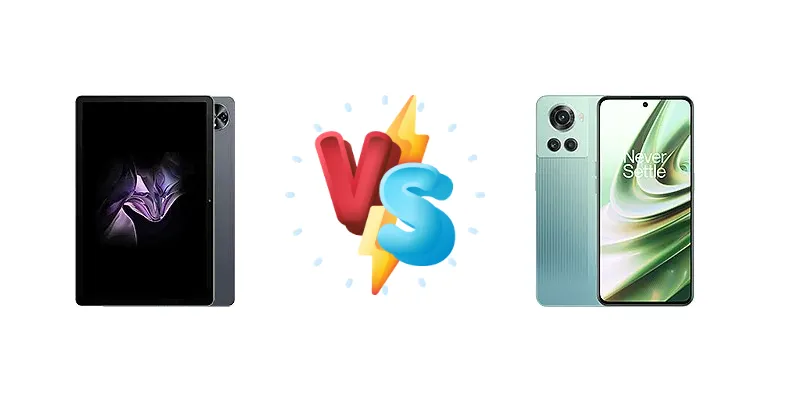
The Xiaomi Black Shark Pad 6 and OnePlus 10R 150W represent distinct approaches to mobile performance. The Pad 6 targets gamers with a larger form factor, while the 10R prioritizes raw speed and incredibly fast charging. This comparison dissects their core components to determine which device delivers the best experience for your needs.
🏆 Quick Verdict
For the average user prioritizing everyday tasks and rapid power-ups, the OnePlus 10R 150W is the clear winner. Its Dimensity 8100 Max chipset offers significantly superior processing power, and the 150W charging is a game-changer. However, gamers seeking a dedicated, larger-screen experience will find value in the Black Shark Pad 6.
| Network |
|---|
| 2G bands | GSM 850 / 900 / 1800 / 1900 | GSM 850 / 900 / 1800 / 1900 |
| 3G bands | HSDPA 850 / 900 / 2100 | HSDPA 800 / 850 / 900 / 1700(AWS) / 1900 / 2100 |
| 4G bands | LTE | 1, 2, 3, 4, 5, 7, 8, 18, 19, 26, 28, 34, 38, 39, 40, 41 |
| 5G bands | - | 1, 3, 5, 8, 28, 40, 41, 77, 78 SA/NSA |
| Speed | HSPA, LTE - cellular model only | HSPA 42.2/5.76 Mbps, LTE (4CA), Cat12 600/150 Mbps, 5G |
| Technology | GSM / HSPA / LTE | GSM / HSPA / LTE / 5G |
| Launch |
|---|
| Announced | 2024, November 29 | 2022, April 28 |
| Status | Available. Released 2024, December | Available. Released 2022, May 04 |
| Body |
|---|
| Build | - | Glass front (Gorilla Glass 5), plastic frame, plastic back |
| Dimensions | 265.8 x 168.3 x 7.9 mm (10.46 x 6.63 x 0.31 in) | 163.3 x 75.5 x 8.2 mm (6.43 x 2.97 x 0.32 in) |
| SIM | Nano-SIM + Nano-SIM (cellular model only) | Nano-SIM + Nano-SIM |
| Weight | 523 g (1.15 lb) | 186 g (6.56 oz) |
| Display |
|---|
| Protection | - | Corning Gorilla Glass 5 |
| Resolution | 1200 x 1920 pixels, 16:10 ratio (~206 ppi density) | 1080 x 2412 pixels, 20:9 ratio (~394 ppi density) |
| Size | 11.0 inches, 350.9 cm2 (~78.4% screen-to-body ratio) | 6.7 inches, 108.0 cm2 (~87.6% screen-to-body ratio) |
| Type | IPS LCD, 90Hz | Fluid AMOLED, 1B colors, 120Hz, HDR10+ |
| Platform |
|---|
| CPU | Octa-core (2x2.0 GHz Cortex-A75 & 6x1.8 GHz Cortex-A55) | Octa-core (4x2.85 GHz Cortex-A78 & 4x2.0 GHz Cortex-A55) |
| Chipset | Unisoc Tiger T616 (12 nm) | Mediatek Dimensity 8100 Max (5 nm) |
| GPU | Mali-G57 MP1 | Mali-G610 MC6 |
| OS | Android 14 | Android 12, upgradable to Android 13, OxygenOS 13 |
| Memory |
|---|
| Card slot | microSDXC (uses shared SIM slot) | No |
| Internal | 256GB 8GB RAM | 256GB 12GB RAM |
| | - | UFS 3.1 |
| Main Camera |
|---|
| Features | LED flash | Color spectrum sensor, LED flash, HDR, panorama |
| Single | 16 MP, (wide) | 16 MP, f/2.4, 26mm (wide), 1/3.09", 1.0µm |
| Triple | - | 50 MP, f/1.8, 24mm (wide), 1/1.56", 1.0µm, PDAF, OIS
8 MP, f/2.2, 15mm, 120˚ (ultrawide), 1/4.0", 1.12µm
2 MP (macro) |
| Video | 1080p@30fps | 4K@30fps, 1080p@30/60/120fps, gyro-EIS |
| Selfie camera |
|---|
| Features | - | HDR |
| Single | 8 MP, (wide) | 16 MP, f/2.4, 26mm (wide), 1/3.09", 1.0µm |
| Video | 1080p@30fps | 1080p@30fps, gyro-EIS |
| Sound |
|---|
| 3.5mm jack | - | No |
| 35mm jack | No | No |
| Loudspeaker | Yes, with stereo speakers | Yes, with stereo speakers |
| | - | 24-bit/192kHz audio |
| Comms |
|---|
| Bluetooth | 5.1, A2DP, LE | 5.2, A2DP, LE |
| Infrared port | Yes | - |
| NFC | No | Yes |
| Positioning | GPS, GALILEO, GLONASS, BDS - cellular model only | GPS (L1+L5), GLONASS (G1), BDS (B1), GALILEO (E1+E5a) |
| Radio | Unspecified | No |
| USB | USB Type-C 2.0 | USB Type-C 2.0 |
| WLAN | Wi-Fi 802.11 a/b/g/n/ac, dual-band | Wi-Fi 802.11 a/b/g/n/ac/6, dual-band, Wi-Fi Direct |
| Features |
|---|
| Sensors | Accelerometer | Fingerprint (under display, optical), accelerometer, gyro, proximity, compass |
| Battery |
|---|
| Charging | 18W wired | 150W wired, 30% in 3 min, 100% in 17 min |
| Type | 8800 mAh | Li-Po 4500 mAh |
| Misc |
|---|
| Colors | Gray, Green | Sierra Black, Forest Green |
| Price | About 280 EUR | About 340 EUR |
| SAR | - | 0.95 W/kg (head) 0.96 W/kg (body) |
Xiaomi Black Shark Pad 6
- Larger screen size ideal for gaming and media consumption
- Dedicated gaming focus with potential software optimizations
- Potentially longer battery life due to tablet form factor
- Significantly weaker processor compared to the OnePlus 10R
- Slow 18W charging
- Limited camera capabilities likely
OnePlus 10R 150W
- Powerful Mediatek Dimensity 8100 Max chipset
- Blazing-fast 150W charging
- More versatile smartphone functionality
- Smaller screen size compared to the Black Shark Pad 6
- May experience more thermal throttling under sustained load (though 5nm helps)
- Potentially less optimized for gaming specifically
Display Comparison
The Black Shark Pad 6, being a tablet, inherently offers a larger display, though specific details like screen size and resolution are missing. The OnePlus 10R’s display specs are also unavailable, but its smartphone form factor implies a smaller, likely AMOLED panel. The key difference lies in the intended use case; the Pad 6 prioritizes immersion, while the 10R focuses on portability. Without knowing the nits or color accuracy of either display, it's difficult to assess visual quality beyond size.
Camera Comparison
Camera details for both devices are limited. However, given the focus of the Black Shark Pad 6 on gaming, its camera system is likely a secondary consideration. The OnePlus 10R, as a smartphone, will likely have a more robust camera setup, though specific sensor sizes and apertures are unknown. Without further information, it’s difficult to make a meaningful comparison beyond assuming the 10R will offer a more versatile photographic experience.
Performance
The OnePlus 10R 150W boasts a significant performance advantage thanks to its Mediatek Dimensity 8100 Max (5 nm) chipset. Its octa-core CPU, featuring 4x2.85 GHz Cortex-A78 cores, delivers substantially more processing power than the Black Shark Pad 6’s Unisoc Tiger T616 (12 nm) with its 2x2.0 GHz Cortex-A75 and 6x1.8 GHz Cortex-A55 configuration. The 5nm fabrication process of the Dimensity 8100 Max also translates to improved thermal efficiency, reducing throttling during sustained workloads. This means the 10R will handle demanding games and applications with greater ease and consistency.
Battery Life
The OnePlus 10R 150W’s standout feature is its 150W wired charging, capable of reaching 30% charge in just 3 minutes and 100% in 17 minutes. This is a massive advantage over the Black Shark Pad 6’s comparatively slow 18W wired charging. While the Pad 6 may have a larger battery capacity (details unavailable), the 10R’s charging speed drastically reduces downtime. The faster charging is particularly beneficial for users who frequently find themselves needing a quick power boost.
Buying Guide
Buy the Xiaomi Black Shark Pad 6 if you need a dedicated gaming tablet with a larger display and are willing to compromise on processing power and charging speed. Buy the OnePlus 10R 150W if you prefer a powerful smartphone with exceptional charging capabilities and a focus on general performance, even if it means sacrificing the larger screen real estate.
Frequently Asked Questions
❓ Is the Unisoc Tiger T616 in the Black Shark Pad 6 powerful enough for demanding games like Genshin Impact?
While the Unisoc Tiger T616 can run Genshin Impact, expect to play at lower graphics settings and potentially experience frame rate drops. The chipset is geared towards efficiency rather than raw performance, making it less suitable for graphically intensive titles compared to the Dimensity 8100 Max in the OnePlus 10R.
❓ How does the 150W charging on the OnePlus 10R affect battery health over the long term?
OnePlus employs charging algorithms designed to mitigate the potential impact of fast charging on battery health. While all batteries degrade over time, the 10R’s charging system prioritizes safety and aims to minimize long-term degradation. However, consistent use of extremely fast charging *may* contribute to slightly faster degradation compared to slower charging methods.
❓ Does the OnePlus 10R 150W get excessively hot during prolonged gaming sessions?
The Dimensity 8100 Max's 5nm process helps with thermal efficiency, but sustained gaming will inevitably generate heat. The OnePlus 10R incorporates cooling solutions to manage temperatures, but some throttling may occur during extended, demanding gameplay. It's unlikely to reach dangerously high temperatures, but performance may be slightly reduced.