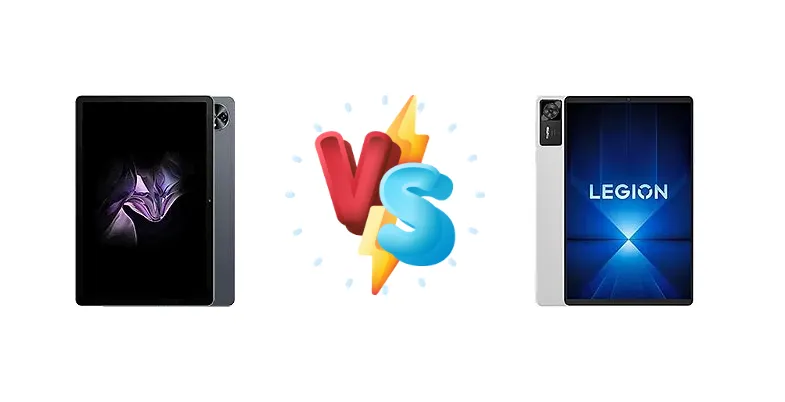
The Android gaming tablet market is heating up, with options ranging from budget-friendly to uncompromising flagships. We're putting the Xiaomi Black Shark Pad 6, a value-oriented contender, head-to-head with the Lenovo Legion Y700 (Gen 4), a performance-focused device boasting the latest Snapdragon 8 Elite chipset. This comparison will dissect their strengths and weaknesses to help you choose the right tablet for your gaming needs.
🏆 Quick Verdict
For the average gamer prioritizing raw performance and future-proofing, the Lenovo Legion Y700 (Gen 4) is the clear winner. Its Snapdragon 8 Elite chipset and 68W charging significantly outperform the Black Shark Pad 6. However, the Black Shark Pad 6 remains a compelling option for budget-conscious gamers who don't demand the absolute highest frame rates.
| Network |
|---|
| 2G bands | GSM 850 / 900 / 1800 / 1900 | N/A |
| 3G bands | HSDPA 850 / 900 / 2100 | N/A |
| 4G bands | LTE | N/A |
| EDGE | - | No |
| GPRS | - | No |
| Speed | HSPA, LTE - cellular model only | - |
| Technology | GSM / HSPA / LTE | No cellular connectivity |
| Launch |
|---|
| Announced | 2024, November 29 | 2025, May 08 |
| Status | Available. Released 2024, December | Available. Released 2025, May |
| Body |
|---|
| Build | - | Glass front, aluminum frame, aluminum back |
| Dimensions | 265.8 x 168.3 x 7.9 mm (10.46 x 6.63 x 0.31 in) | 7 mm thickness |
| SIM | Nano-SIM + Nano-SIM (cellular model only) | No |
| Weight | 523 g (1.15 lb) | 340 g (11.99 oz) |
| Display |
|---|
| Resolution | 1200 x 1920 pixels, 16:10 ratio (~206 ppi density) | 1904 x 3040 pixels, 16:10 ratio (~408 ppi density) |
| Size | 11.0 inches, 350.9 cm2 (~78.4% screen-to-body ratio) | 8.8 inches, 224.8 cm2 |
| Type | IPS LCD, 90Hz | IPS LCD, 68B colors, 165Hz, HDR, 600 nits (typ) |
| Platform |
|---|
| CPU | Octa-core (2x2.0 GHz Cortex-A75 & 6x1.8 GHz Cortex-A55) | Octa-core (2x4.32 GHz Oryon V2 Phoenix L + 6x3.53 GHz Oryon V2 Phoenix M) |
| Chipset | Unisoc Tiger T616 (12 nm) | Qualcomm SM8750-AB Snapdragon 8 Elite (3 nm) |
| GPU | Mali-G57 MP1 | Adreno 830 |
| OS | Android 14 | Android 15 |
| Memory |
|---|
| Card slot | microSDXC (uses shared SIM slot) | microSDXC |
| Internal | 256GB 8GB RAM | 256GB 12GB RAM, 512GB 16GB RAM, 1TB 16GB RAM |
| Main Camera |
|---|
| Features | LED flash | LED flash |
| Single | 16 MP, (wide) | 50 MP, (wide), PDAF |
| Video | 1080p@30fps | Yes |
| Selfie camera |
|---|
| Single | 8 MP, (wide) | 8 MP |
| Video | 1080p@30fps | 1080p@30fps |
| Sound |
|---|
| 35mm jack | No | No |
| Loudspeaker | Yes, with stereo speakers | Yes, with stereo speakers |
| Comms |
|---|
| Bluetooth | 5.1, A2DP, LE | Yes |
| Infrared port | Yes | - |
| NFC | No | No |
| Positioning | GPS, GALILEO, GLONASS, BDS - cellular model only | No |
| Radio | Unspecified | Unspecified |
| USB | USB Type-C 2.0 | 1x USB Type-C 2.0 & 1x USB Type-C 3.2 Gen2, DisplayPort 1.4 |
| WLAN | Wi-Fi 802.11 a/b/g/n/ac, dual-band | Yes |
| Features |
|---|
| Sensors | Accelerometer | Unspecified |
| Battery |
|---|
| Charging | 18W wired | 68W wired
Bypass charging |
| Type | 8800 mAh | Li-Po 7600 mAh |
| Misc |
|---|
| Colors | Gray, Green | Black, White |
| Models | - | TB322FC, ZAG40002CN |
| Price | About 280 EUR | About 400 EUR |
Xiaomi Black Shark Pad 6
- More affordable price point
- Decent performance for casual gaming
- Potentially lighter and more portable
- Significantly weaker chipset compared to the competition
- Slow 18W charging
- Likely to experience throttling during demanding games
Lenovo Legion Y700 (Gen 4)
- Exceptional performance with Snapdragon 8 Elite
- Fast 68W charging with bypass charging
- Superior thermal management for sustained gaming
- Higher price tag
- Potentially heavier and bulkier
- May require more frequent charging with intensive use
Display Comparison
While both tablets likely feature LCD panels (data not provided), the core difference lies in the processing power driving them. The Black Shark Pad 6's Unisoc Tiger T616 will struggle to consistently deliver high refresh rates in demanding titles, whereas the Legion Y700's Snapdragon 8 Elite is designed to push high-resolution, high-refresh-rate gaming. The Legion Y700's chipset allows for more advanced display features like variable refresh rate (VRR) support, which the Black Shark Pad 6 likely lacks. Bezels and color accuracy are unknown, but the Legion Y700, being a flagship, is expected to have tighter tolerances.
Camera Comparison
Given the focus on gaming, camera performance is likely secondary on both devices. Without specific sensor details, it's difficult to make a direct comparison. However, the Legion Y700, as a higher-end device, is expected to have a more refined camera system with better image processing. The Black Shark Pad 6 will likely offer a basic camera setup sufficient for casual snapshots. We anticipate both tablets will prioritize front-facing cameras for video calls and streaming.
Performance
The performance gap is substantial. The Lenovo Legion Y700 (Gen 4) utilizes the Qualcomm SM8750-AB Snapdragon 8 Elite (3nm), featuring Oryon V2 Phoenix cores clocked up to 4.32 GHz. This represents a massive leap in CPU and GPU performance compared to the Xiaomi Black Shark Pad 6's Unisoc Tiger T616 (12nm) with its Cortex-A75/A55 cores peaking at 2.0 GHz. The 3nm process node of the Snapdragon 8 Elite translates to significantly improved thermal efficiency, reducing throttling during extended gaming sessions. The Legion Y700 will also benefit from faster LPDDR5x RAM, further enhancing performance. The Black Shark Pad 6 will be suitable for less demanding titles and casual gaming, but will struggle with graphically intensive games at high settings.
Battery Life
The Lenovo Legion Y700 (Gen 4) boasts a significant advantage in charging speed with its 68W wired charging and bypass charging capability (allowing gaming while charging without overheating). The Black Shark Pad 6 is limited to 18W wired charging, resulting in considerably longer charge times. While battery capacity isn't specified, the Snapdragon 8 Elite's superior power efficiency may offset a potentially smaller battery in the Legion Y700, providing comparable or even better real-world battery life during gaming.
Buying Guide
Buy the Xiaomi Black Shark Pad 6 if you need a capable gaming tablet without breaking the bank, prioritizing affordability and decent performance for casual gaming. Buy the Lenovo Legion Y700 (Gen 4) if you demand the highest possible frame rates, sustained performance during long gaming sessions, and the fastest charging speeds, and are willing to pay a premium for it.
Frequently Asked Questions
❓ Will the Black Shark Pad 6 be able to run Genshin Impact smoothly?
The Black Shark Pad 6 can likely run Genshin Impact, but you'll need to lower the graphics settings significantly and expect frame rate drops during intense combat. The Unisoc Tiger T616 simply doesn't have the graphical horsepower to handle the game at high settings consistently.
❓ Does the Lenovo Legion Y700 (Gen 4) support external controllers?
Yes, the Lenovo Legion Y700 (Gen 4) is expected to support Bluetooth controllers, enhancing the gaming experience. Lenovo often prioritizes gaming features, and controller compatibility is a standard expectation for a device in this category.
❓ How long does it take to fully charge the Black Shark Pad 6?
With its 18W charging, the Black Shark Pad 6 will likely take over 3 hours to fully charge from 0%. This is a significant drawback compared to the Legion Y700's 68W fast charging.
❓ Will the Snapdragon 8 Elite in the Legion Y700 overheat during prolonged gaming sessions?
The Snapdragon 8 Elite's 3nm process and Lenovo's likely implementation of advanced cooling solutions (details not provided) are designed to mitigate overheating. While some heat is inevitable, the Legion Y700 should maintain stable performance for longer periods than the Black Shark Pad 6.