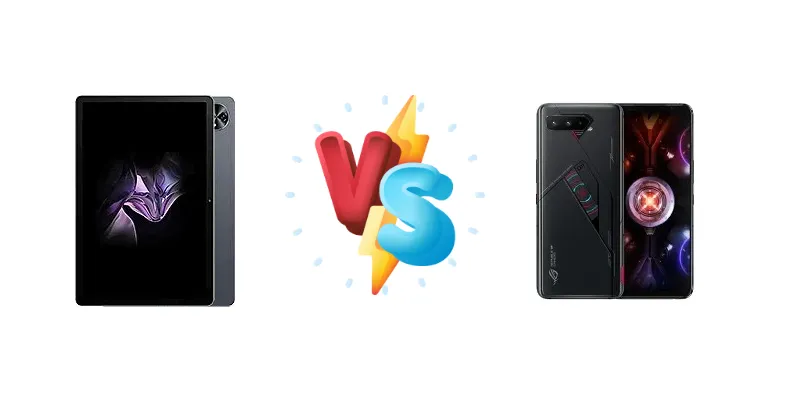
The mobile gaming landscape offers diverse form factors, and the Xiaomi Black Shark Pad 6 and Asus ROG Phone 5s Pro represent two compelling options: a dedicated gaming tablet aiming for affordability, and a flagship gaming phone prioritizing raw power. This comparison dissects their key differences to determine which device best suits your gaming needs and budget.
🏆 Quick Verdict
For the average gamer prioritizing performance and fast charging, the Asus ROG Phone 5s Pro is the clear winner. Its Snapdragon 888+ chipset offers significantly higher processing power than the Black Shark Pad 6’s Unisoc Tiger T616, and its 65W charging drastically reduces downtime. However, the Pad 6 offers a larger screen at a lower price point.
| Network |
|---|
| 2G bands | GSM 850 / 900 / 1800 / 1900 | GSM 850 / 900 / 1800 / 1900 |
| 3G bands | HSDPA 850 / 900 / 2100 | HSDPA 800 / 850 / 900 / 1700(AWS) / 1800 / 1900 / 2100 |
| 4G bands | LTE | 1, 2, 3, 4, 5, 7, 8, 12, 13, 17, 18, 19, 20, 25, 26, 28, 29, 30, 32, 34, 38, 39, 40, 41, 42, 48, 66, 71 |
| 5G bands | - | 1, 2, 3, 5, 7, 8, 12, 20, 25, 28, 38, 40, 41, 66, 71, 77, 78, 79 SA/NSA |
| Speed | HSPA, LTE - cellular model only | HSPA 42.2/5.76 Mbps, LTE (7CA) Cat20 1400/150 Mbps, 5G 4 Gbps DL |
| Technology | GSM / HSPA / LTE | GSM / HSPA / LTE / 5G |
| Launch |
|---|
| Announced | 2024, November 29 | 2021, August 16 |
| Status | Available. Released 2024, December | Available. Released 2021, August 24 |
| Body |
|---|
| Build | - | Glass front (Gorilla Glass Victus), glass back (Gorilla Glass 3), aluminum frame |
| Dimensions | 265.8 x 168.3 x 7.9 mm (10.46 x 6.63 x 0.31 in) | 172.8 x 77.3 x 9.9 mm (6.80 x 3.04 x 0.39 in) |
| SIM | Nano-SIM + Nano-SIM (cellular model only) | Nano-SIM + Nano-SIM |
| Weight | 523 g (1.15 lb) | 238 g (8.40 oz) |
| | - | Pressure sensitive zones (Gaming triggers)
Touch sensor; ROG Vision monochrome PMOLED display (on the back) |
| Display |
|---|
| Protection | - | Corning Gorilla Glass Victus |
| Resolution | 1200 x 1920 pixels, 16:10 ratio (~206 ppi density) | 1080 x 2448 pixels (~395 ppi density) |
| Size | 11.0 inches, 350.9 cm2 (~78.4% screen-to-body ratio) | 6.78 inches, 109.5 cm2 (~82.0% screen-to-body ratio) |
| Type | IPS LCD, 90Hz | AMOLED, 1B colors, 144Hz, HDR10+, 800 nits (typ), 1200 nits (peak) |
| Platform |
|---|
| CPU | Octa-core (2x2.0 GHz Cortex-A75 & 6x1.8 GHz Cortex-A55) | Octa-core (1x2.99 GHz Cortex-X1 & 3x2.42 GHz Cortex-A78 & 4x1.80 GHz Cortex-A55) |
| Chipset | Unisoc Tiger T616 (12 nm) | Qualcomm SM8350 Snapdragon 888+ 5G (5 nm) |
| GPU | Mali-G57 MP1 | Adreno 660 |
| OS | Android 14 | Android 11, upgradable to Android 13, ROG UI |
| Memory |
|---|
| Card slot | microSDXC (uses shared SIM slot) | No |
| Internal | 256GB 8GB RAM | 512GB 18GB RAM |
| | - | UFS 3.1 |
| Main Camera |
|---|
| Features | LED flash | LED flash, HDR, panorama |
| Single | 16 MP, (wide) | - |
| Triple | - | 64 MP, f/1.8, 26mm (wide), 1/1.73", 0.8µm, PDAF
13 MP, f/2.4, 11mm, 125˚ (ultrawide)
5 MP (macro) |
| Video | 1080p@30fps | 8K@30fps, 4K@30/60/120fps, 1080p@30/60/120/240fps, 720p@480fps; gyro-EIS |
| Selfie camera |
|---|
| Features | - | Panorama, HDR |
| Single | 8 MP, (wide) | 24 MP, f/2.5, 27mm (wide), 0.9µm |
| Video | 1080p@30fps | 1080p@30fps |
| Sound |
|---|
| 3.5mm jack | - | Yes |
| 35mm jack | No | Yes |
| Loudspeaker | Yes, with stereo speakers | Yes, with stereo speakers (2 amplifiers) |
| | - | 24-bit/192kHz audio |
| Comms |
|---|
| Bluetooth | 5.1, A2DP, LE | 5.2, A2DP, LE, aptX HD, aptX Adaptive |
| Infrared port | Yes | - |
| NFC | No | Yes |
| Positioning | GPS, GALILEO, GLONASS, BDS - cellular model only | GPS (L1+L5), GLONASS (L1), BDS (B1I+B1c+B2a), GALILEO (E1+E5a), QZSS (L1+L5), NavIC (L5) |
| Radio | Unspecified | No |
| USB | USB Type-C 2.0 | USB Type-C 3.1 (side), USB Type-C 2.0 (bottom), OTG, accessory connector |
| WLAN | Wi-Fi 802.11 a/b/g/n/ac, dual-band | Wi-Fi 802.11 a/b/g/n/ac/6e, dual-band, Wi-Fi Direct |
| Features |
|---|
| Sensors | Accelerometer | Fingerprint (under display, optical), accelerometer, gyro, proximity, compass |
| Battery |
|---|
| Charging | 18W wired | 65W wired, PD3.0, QC5, 70% in 30 min, 100% in 52 min
10W reverse wired |
| Type | 8800 mAh | Li-Po 6000 mAh |
| Misc |
|---|
| Colors | Gray, Green | Matte White |
| Models | - | ZS676KS |
| Price | About 280 EUR | About 2000 EUR |
| Tests |
|---|
| Battery life | - |
Endurance rating 110h
|
| Loudspeaker | - |
-24.0 LUFS (Very good)
|
| Performance | - |
AnTuTu: 743021 (v8), 844901 (v9)
GeekBench: 14278 (v4.4), 3672 (v5.1)
GFXBench: 58fps (ES 3.1 onscreen) |
Xiaomi Black Shark Pad 6
- Larger screen size for immersive gaming
- Potentially more affordable price point
- Good battery endurance (110h)
- Significantly weaker processor (Unisoc T616)
- Slow 18W charging
- Likely lower display brightness and refresh rate
Asus ROG Phone 5s Pro
- Flagship Snapdragon 888+ processor for superior performance
- Ultra-fast 65W charging with multiple protocols
- High display brightness (840 nits)
- Smaller screen size compared to the Pad 6
- Higher price point
- Potentially more prone to thermal throttling under extreme load
Display Comparison
The Asus ROG Phone 5s Pro boasts a measured peak brightness of 840 nits, providing excellent visibility even in bright conditions. While the Black Shark Pad 6’s display specifications are not provided, tablets generally prioritize screen real estate over peak brightness. The ROG Phone’s smaller, higher-brightness display is likely more comfortable for extended outdoor use. The ROG Phone’s display technology is also likely to have a higher refresh rate, contributing to smoother gameplay, a detail absent from the Pad 6’s specs.
Camera Comparison
Camera performance isn’t a primary focus for gaming devices, but the ROG Phone 5s Pro likely benefits from a more sophisticated image signal processor (ISP) integrated within the Snapdragon 888+. Without detailed camera specs for the Black Shark Pad 6, it’s difficult to make a direct comparison. However, the ROG Phone’s flagship status suggests a more capable camera system overall, even if not its primary selling point.
Performance
The core difference lies in the chipsets. The Asus ROG Phone 5s Pro’s Snapdragon 888+ (5nm) is a flagship-level processor with a Cortex-X1 prime core clocked at 2.99 GHz, offering a substantial performance advantage over the Xiaomi Black Shark Pad 6’s Unisoc Tiger T616 (12nm). The Snapdragon 888+’s architecture – 1x Cortex-X1, 3x Cortex-A78, and 4x Cortex-A55 – is significantly more advanced than the Pad 6’s 2x Cortex-A75 & 6x Cortex-A55 configuration. This translates to faster frame rates, smoother multitasking, and better handling of demanding games. The 5nm fabrication process of the Snapdragon also contributes to better thermal efficiency, reducing throttling during prolonged gaming sessions.
Battery Life
Both devices achieve an endurance rating of 110 hours, suggesting similar overall battery life despite differing capacities. However, the Asus ROG Phone 5s Pro’s 65W wired charging with PD3.0 and QC5 support is a game-changer. It can reach 70% charge in just 30 minutes and 100% in 52 minutes, minimizing downtime. The Black Shark Pad 6’s 18W charging is considerably slower, requiring significantly more time to fully recharge, impacting usability for gamers who need quick top-ups.
Buying Guide
Buy the Xiaomi Black Shark Pad 6 if you need a large-screen gaming experience on a tighter budget and prioritize portability over peak performance. It’s ideal for casual gamers and those who enjoy mobile games primarily at home. Buy the Asus ROG Phone 5s Pro if you demand the highest possible Android gaming performance, require rapid charging, and value a more compact form factor for on-the-go gaming.
Frequently Asked Questions
❓ Will the Unisoc Tiger T616 in the Black Shark Pad 6 struggle with demanding games like Genshin Impact?
Yes, the Unisoc Tiger T616 is a mid-range chipset and will likely require significant graphics settings reductions to achieve playable frame rates in graphically intensive games like Genshin Impact. The Snapdragon 888+ in the ROG Phone 5s Pro will handle these titles with ease at higher settings.
❓ How much does the faster charging of the ROG Phone 5s Pro actually improve the gaming experience?
The 65W charging on the ROG Phone 5s Pro is a substantial benefit for gamers. Being able to go from near-empty to 70% charge in 30 minutes means less downtime between gaming sessions, allowing for more uninterrupted play. The Pad 6’s 18W charging will take considerably longer, potentially disrupting your gaming flow.
❓ Is the ROG Phone 5s Pro likely to overheat during extended gaming sessions?
While the Snapdragon 888+ is a powerful chip, it is known to generate heat under sustained load. Asus incorporates advanced cooling solutions in the ROG Phone 5s Pro, including vapor chambers and heat spreaders, to mitigate throttling. However, some performance reduction may still occur during very long gaming sessions.