
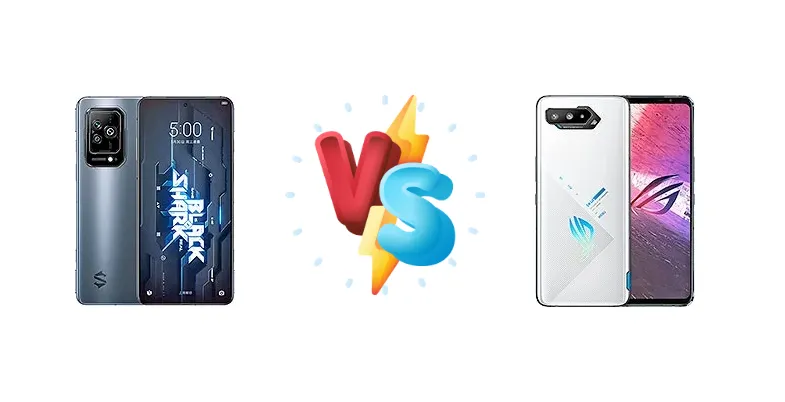
Black Shark 5 vs Asus ROG Phone 5s: A Deep Dive into Gaming Performance and Value
| Phones Images | |||||
|---|---|---|---|---|---|
|
🏆 Quick Verdict
For the average gamer prioritizing value, the Xiaomi Black Shark 5 offers a compelling package. Its 120W charging is significantly faster than the ROG Phone 5s’s 65W, and the Snapdragon 870 provides excellent performance at a lower cost. However, the ROG Phone 5s’s Snapdragon 888+ offers a performance edge for demanding titles and sustained workloads.
| PHONES | ||
|---|---|---|
| Phone Names | Xiaomi Black Shark 5 | Asus ROG Phone 5s |
| Network | ||
|---|---|---|
| 2G bands | GSM 850 / 900 / 1800 / 1900 | GSM 850 / 900 / 1800 / 1900 |
| 3G bands | HSDPA 800 / 850 / 900 / 1700(AWS) / 1900 / 2100 | HSDPA 800 / 850 / 900 / 1700(AWS) / 1800 / 1900 / 2100 - Version 1 |
| 4G bands | 1, 2, 3, 4, 5, 8, 18, 19, 26, 28, 34, 38, 39, 40, 41 | 1, 2, 3, 4, 5, 7, 8, 12, 13, 17, 18, 19, 20, 25, 26, 28, 29, 30, 32, 34, 38, 39, 40, 41, 42, 48, 66, 71 - Version 1 |
| 5G bands | 1, 3, 5, 8, 28, 41, 77, 78 SA/NSA | 1, 2, 3, 5, 7, 8, 12, 20, 25, 28, 38, 40, 41, 66, 71, 77, 78, 79 SA/NSA - Version 1 |
| Speed | HSPA, LTE, 5G | HSPA 42.2/5.76 Mbps, LTE (7CA) Cat20 1400/150 Mbps, 5G 4 Gbps DL |
| Technology | GSM / CDMA / HSPA / LTE / 5G | GSM / HSPA / LTE / 5G |
| CDMA 800 & TD-SCDMA | 2, 3, 5, 7, 12, 20, 25, 28, 38, 40, 66, 71, 77, 78, 79 SA/NSA - Version 4 | |
| Launch | ||
|---|---|---|
| Announced | 2022, March 30 | 2021, August 16 |
| Status | Available. Released 2022, April 04 | Available. Released 2021, August 26 |
| Body | ||
|---|---|---|
| Build | - | Glass front (Gorilla Glass Victus), glass back (Gorilla Glass 3), aluminum frame |
| Dimensions | 163.8 x 76.3 x 10 mm (6.45 x 3.00 x 0.39 in) | 172.8 x 77.3 x 9.9 mm (6.80 x 3.04 x 0.39 in) |
| SIM | Nano-SIM + Nano-SIM | Nano-SIM + Nano-SIM |
| Weight | 218 g (7.69 oz) | 238 g (8.40 oz) |
| Physical pop-up gaming triggers | RGB light panel (on the back) Pressure sensitive zones (Gaming triggers) | |
| Display | ||
|---|---|---|
| Protection | - | Corning Gorilla Glass Victus |
| Resolution | 1080 x 2400 pixels, 20:9 ratio (~395 ppi density) | 1080 x 2448 pixels (~395 ppi density) |
| Size | 6.67 inches, 107.4 cm2 (~85.9% screen-to-body ratio) | 6.78 inches, 109.5 cm2 (~82.0% screen-to-body ratio) |
| Type | AMOLED, 144Hz, 1300 nits (peak) | AMOLED, 1B colors, 144Hz, HDR10+, 800 nits (typ), 1200 nits (peak) |
| Always-on display | - | |
| Platform | ||
|---|---|---|
| CPU | Octa-core (1x3.2 GHz Kryo 585 & 3x2.42 GHz Kryo 585 & 4x1.80 GHz Kryo 585) | Octa-core (1x2.99 GHz Cortex-X1 & 3x2.42 GHz Cortex-A78 & 4x1.80 GHz Cortex-A55) |
| Chipset | Qualcomm SM8250-AC Snapdragon 870 5G (7 nm) | Qualcomm SM8350 Snapdragon 888+ 5G (5 nm) |
| GPU | Adreno 650 | Adreno 660 |
| OS | Android 12, Joy UI 13 | Android 11, upgradable to Android 13, ROG UI |
| Memory | ||
|---|---|---|
| Card slot | No | No |
| Internal | 128GB 8GB RAM, 128GB 12GB RAM, 256GB 12GB RAM | 128GB 8GB RAM, 128GB 12GB RAM, 256GB 12GB RAM, 256GB 16GB RAM, 512GB 16GB RAM, 512GB 18GB RAM |
| UFS 3.1 | UFS 3.1 | |
| Main Camera | ||
|---|---|---|
| Features | LED flash, HDR, panorama | LED flash, HDR, panorama |
| Triple | 64 MP, f/1.8, (wide), PDAF 13 MP, f/2.4, 120˚ (ultrawide) 2 MP (macro) | 64 MP, f/1.8, 26mm (wide), 1/1.73", 0.8µm, PDAF 13 MP, f/2.4, 11mm, 125˚ (ultrawide) 5 MP (macro) |
| Video | 4K@30/60fps, 1080p@30/60/240fps, 1080p@960fps | 8K@30fps, 4K@30/60/120fps, 1080p@30/60/120/240fps, 720p@480fps; gyro-EIS |
| Selfie camera | ||
|---|---|---|
| Features | HDR | Panorama, HDR |
| Single | 16 MP, (wide) | 24 MP, f/2.5, 27mm (wide), 0.9µm |
| Video | 1080p@30fps | 1080p@30fps |
| Sound | ||
|---|---|---|
| 3.5mm jack | No | Yes |
| 35mm jack | No | Yes |
| Loudspeaker | Yes, with stereo speakers | Yes, with stereo speakers (2 amplifiers) |
| 24-bit/192kHz audio | 24-bit/192kHz audio | |
| Comms | ||
|---|---|---|
| Bluetooth | 5.2, A2DP, LE, aptX HD, aptX Adaptive | 5.2, A2DP, LE, aptX HD, aptX Adaptive |
| NFC | Yes | Yes |
| Positioning | GPS, GLONASS, GALILEO, QZSS, BDS | GPS (L1+L5), GLONASS (L1), BDS (B1I+B1c+B2a), GALILEO (E1+E5a), QZSS (L1+L5), NavIC (L5) |
| Radio | No | No |
| USB | USB Type-C 2.0 | USB Type-C 3.1 (side), USB Type-C 2.0 (bottom), OTG, accessory connector |
| WLAN | Wi-Fi 802.11 a/b/g/n/ac/6, dual-band, Wi-Fi Direct | Wi-Fi 802.11 a/b/g/n/ac/6e, dual-band, Wi-Fi Direct |
| Features | ||
|---|---|---|
| Sensors | Fingerprint (side-mounted), accelerometer, gyro, proximity, compass, barometer | Fingerprint (under display, optical), accelerometer, gyro, proximity, compass |
| Battery | ||
|---|---|---|
| Charging | 120W wired, 100% in 15 min | 65W wired, PD3.0, QC5, 70% in 30 min, 100% in 52 min 10W reverse wired |
| Type | Li-Po 4650 mAh | Li-Po 6000 mAh |
| Misc | ||
|---|---|---|
| Colors | Black, White, Gray | Phantom Black, Storm White |
| Models | SHARK PAR-A0 | ZS676KS |
| Price | About 600 EUR | About 1030 EUR |
Xiaomi Black Shark 5
- Incredibly fast 120W charging
- More affordable price point
- Excellent performance for the price
- Snapdragon 870 is less powerful than 888+
- Potentially less refined software experience
Asus ROG Phone 5s
- More powerful Snapdragon 888+ processor
- Potentially better camera performance
- Refined software experience
- Slower 65W charging
- Higher price tag
Display Comparison
While both phones likely feature high refresh rate AMOLED displays (data not provided), the core difference lies in the underlying processing power impacting game rendering. The Snapdragon 888+ in the ROG Phone 5s will push higher frame rates in graphically intensive games, assuming the display supports it. The Black Shark 5’s Snapdragon 870, while capable, will require some graphical settings adjustments to maintain consistent performance. The 5nm process of the 888+ also suggests better power efficiency during display-heavy tasks.
Camera Comparison
Neither phone is primarily marketed for its camera capabilities, but the ROG Phone 5s likely has a more versatile camera system due to Asus’s broader imaging expertise. While specific sensor details are missing, the Snapdragon 888+’s image signal processor (ISP) offers more advanced features and processing capabilities compared to the 870’s ISP. Expect better dynamic range and low-light performance from the ROG Phone 5s. The Black Shark 5 will likely suffice for casual photography, but serious photographers will lean towards the ROG Phone 5s.
Performance
The Asus ROG Phone 5s boasts the Qualcomm SM8350 Snapdragon 888+ 5G (5 nm), a clear upgrade over the Xiaomi Black Shark 5’s SM8250 Snapdragon 870 5G (7 nm). The 888+ features a Cortex-X1 prime core clocked at 2.99 GHz, offering a performance advantage over the 870’s Kryo 585 prime core at 3.2 GHz. While the 870’s clock speed is higher, the 888+’s architectural improvements and smaller node size translate to superior sustained performance and efficiency. This means the ROG Phone 5s is better equipped to handle demanding games and multitasking without significant throttling. The ROG Phone 5s also benefits from potentially faster LPDDR5 RAM, further enhancing performance.
Battery Life
The Black Shark 5’s 120W wired charging is a game-changer, achieving a full charge in just 15 minutes. This is significantly faster than the ROG Phone 5s’s 65W charging, which takes 52 minutes for a full charge. While the ROG Phone 5s offers 10W reverse wired charging, a feature absent in the Black Shark 5, the speed advantage of the Black Shark 5’s charging is substantial. The actual battery capacity (mAh) is unknown for both, but the faster charging of the Black Shark 5 mitigates any potential disadvantage from a slightly smaller battery.
Buying Guide
Buy the Xiaomi Black Shark 5 if you need blazing-fast charging, a more affordable price point, and excellent performance for most mobile games. It’s ideal for gamers who want a powerful experience without breaking the bank. Buy the Asus ROG Phone 5s if you prioritize raw processing power for the most demanding games, appreciate a more polished software experience, and are willing to pay a premium for the Snapdragon 888+ and its associated benefits.