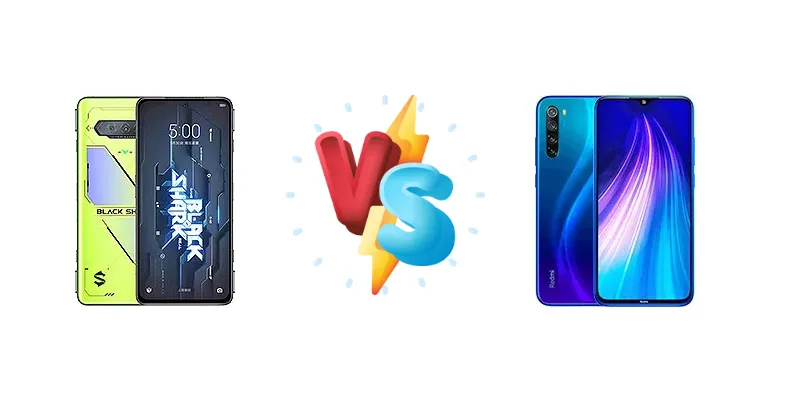
The Xiaomi Black Shark 5 RS is a dedicated gaming phone boasting flagship-level power, while the Redmi Note 8 is a long-standing budget champion known for its impressive battery life. This comparison dives deep into their strengths and weaknesses to help you choose the perfect device for your needs.
🏆 Quick Verdict
The Black Shark 5 RS utterly dominates in performance thanks to its Snapdragon 888. However, the Redmi Note 8 offers exceptional battery life and a surprisingly good display for its price. If gaming is your priority, the Black Shark wins; for budget-conscious users needing longevity, the Redmi Note 8 is a strong contender.
| Network |
|---|
| 2G bands | GSM 850 / 900 / 1800 / 1900 | GSM 850 / 900 / 1800 / 1900 |
| 3G bands | HSDPA 800 / 850 / 900 / 1700(AWS) / 1900 / 2100 | HSDPA 850 / 900 / 1700(AWS) / 1900 / 2100 |
| 4G bands | 1, 2, 3, 4, 5, 8, 18, 19, 26, 28, 34, 38, 39, 40, 41 | 1, 2, 3, 4, 5, 7, 8, 20, 38, 40 |
| 5G bands | 1, 3, 5, 8, 28, 41, 77, 78 SA/NSA | - |
| Speed | HSPA, LTE, 5G | HSPA 42.2/5.76 Mbps, LTE (4CA) Cat12 600/50 Mbps |
| Technology | GSM / CDMA / HSPA / EVDO / LTE / 5G | GSM / HSPA / LTE |
| | CDMA2000 1xEV-DO | - |
| Launch |
|---|
| Announced | 2022, March 30 | 2019, August 29. Released 2019, October 16 |
| Status | Available. Released 2022, April 04 | Discontinued |
| Body |
|---|
| Build | - | Glass front (Gorilla Glass 5), glass back (Gorilla Glass 5), plastic frame |
| Dimensions | 163.7 x 76.2 x 9.9 mm (6.44 x 3.00 x 0.39 in) | 158.3 x 75.3 x 8.4 mm (6.23 x 2.96 x 0.33 in) |
| SIM | Nano-SIM + Nano-SIM | Nano-SIM + Nano-SIM |
| Weight | 220 g (7.76 oz) | 190 (6.70 oz) |
| | Physical pop-up gaming triggers | - |
| Display |
|---|
| Protection | - | Corning Gorilla Glass 5 |
| Resolution | 1080 x 2400 pixels, 20:9 ratio (~395 ppi density) | 1080 x 2340 pixels, 19.5:9 ratio (~409 ppi density) |
| Size | 6.67 inches, 107.4 cm2 (~86.1% screen-to-body ratio) | 6.3 inches, 97.4 cm2 (~81.7% screen-to-body ratio) |
| Type | AMOLED, 144Hz, 1300 nits (peak) | IPS LCD |
| | Always-on display | - |
| Platform |
|---|
| CPU | Octa-core (1x2.84/3.0 GHz Cortex-X1 & 3x2.42 GHz Cortex-A78 & 4x1.80 GHz Cortex-A55) | Octa-core (4x2.0 GHz Kryo 260 Gold & 4x1.8 GHz Kryo 260 Silver) |
| Chipset | Qualcomm SM8350 Snapdragon 888/888+ 5G (5 nm) | Qualcomm SDM665 Snapdragon 665 (11 nm) |
| GPU | Adreno 660 | Adreno 610 |
| OS | Android 12, Joy UI 12.8 | Android 9.0 (Pie), upgradable to Android 11, MIUI 12.5 |
| Memory |
|---|
| Card slot | No | microSDXC (dedicated slot) |
| Internal | 256GB 8GB RAM, 256GB 12GB RAM | 32GB 3GB RAM, 64GB 4GB RAM, 64GB 6GB RAM, 128GB 4GB RAM, 128GB 6GB RAM |
| | UFS 3.1/SSD
256GB 8GB RAM - Snapdragon 888
256GB 12GB RAM - Snapdragon 888+ | - |
| Main Camera |
|---|
| Features | LED flash, HDR, panorama | LED flash, HDR, panorama |
| Quad | - | 48 MP, f/1.8, 26mm (wide), 1/2.0", 0.8µm, PDAF
8 MP, f/2.2, 120˚ (ultrawide), 1/4.0", 1.12µm
2 MP (macro)
Auxiliary lens |
| Single | 20 MP, (wide) | - |
| Triple | 64 MP, f/1.8, (wide), 1/1.97", 0.7µm, PDAF
8 MP, 120˚ (ultrawide)
5 MP, f/2.4, (telephoto macro) | - |
| Video | 4K@30/60fps, 1080p@30/60/240fps, 1080p@960fps; HDR10+ | 4K@30fps, 1080p@30/60/120fps; gyro-EIS |
| Selfie camera |
|---|
| Features | HDR | HDR, panorama |
| Single | 20 MP, (wide) | 13 MP, f/2.0, (wide), 1/3.1", 1.12µm |
| Video | 1080p@30fps | 1080p@30fps |
| Sound |
|---|
| 3.5mm jack | Yes | Yes |
| 35mm jack | Yes | Yes |
| Loudspeaker | Yes, with stereo speakers | Yes |
| | 24-bit/192kHz audio | - |
| Comms |
|---|
| Bluetooth | 5.2, A2DP, LE, aptX HD, aptX Adaptive | 4.2, A2DP, LE |
| Infrared port | - | Yes |
| NFC | Yes | No |
| Positioning | GPS, GLONASS, GALILEO, QZSS, BDS | GPS, GLONASS, BDS |
| Radio | No | FM radio |
| USB | USB Type-C 2.0 | USB Type-C 2.0, OTG |
| WLAN | Wi-Fi 802.11 a/b/g/n/ac/6, dual-band, Wi-Fi Direct | Wi-Fi 802.11 a/b/g/n/ac, dual-band, Wi-Fi Direct |
| Features |
|---|
| Sensors | Fingerprint (side-mounted), accelerometer, gyro, proximity, compass, barometer | Fingerprint (rear-mounted), accelerometer, gyro, proximity, compass |
| Battery |
|---|
| Charging | 120W wired, 100% in 15 min | 18W wired |
| Type | Li-Po 4500 mAh | Li-Po 4000 mAh, non-removable |
| Misc |
|---|
| Colors | Black, Yellow | Neptune Blue, Moonlight White, Space Black, Nebula Purple, Cosmic Purple |
| Models | - | M1908C3JH, M1908C3JG, M1908C3JI |
| Price | About 470 EUR | About 220 EUR |
| SAR | - | 0.26 W/kg (head) 1.00 W/kg (body) |
| SAR EU | - | 0.19 W/kg (head) 1.09 W/kg (body) |
| Tests |
|---|
| Audio quality | - |
Noise -94.0dB / Crosstalk -93.3dB |
| Battery life | - |
Endurance rating 108h
|
| Camera | - |
Photo / Video |
| Display | - |
Contrast ratio: 1521:1 (nominal) |
| Loudspeaker | - |
Voice 78dB / Noise 72dB / Ring 81dB
|
| Performance | - |
AnTuTu: 141915 (v7), 161572 (v8)
GeekBench: 5590 (v4.4), 1339 (v5.1)
GFXBench: 5.9fps (ES 3.1 onscreen) |
Xiaomi Black Shark 5 RS
- Flagship Performance (Snapdragon 888)
- 120W Fast Charging
- High Refresh Rate Display (assumed)
- Dedicated Gaming Features (triggers, cooling)
- Potentially Better Camera
- Higher Price
- Likely Shorter Battery Life than Redmi Note 8
- Potentially Bulky Design
Xiaomi Redmi Note 8
- Exceptional Battery Life (108h Endurance)
- Affordable Price
- Good Contrast Ratio Display
- Reliable Performance for Everyday Tasks
- Outdated Chipset (Snapdragon 665)
- Slower Charging (18W)
- Lower Performance for Demanding Games
- Potentially Lower Camera Quality
Display Comparison
The Redmi Note 8 boasts a respectable 1521:1 contrast ratio, offering decent image quality for its class. The Black Shark 5 RS likely features a higher refresh rate (assumed 120Hz or higher) and potentially better color accuracy, providing a smoother and more vibrant visual experience, especially beneficial for gaming. Screen size and resolution are likely different, with the Black Shark potentially having a larger display.
Camera Comparison
While both offer 'Photo / Video' capabilities, the Black Shark 5 RS's Snapdragon 888 likely provides better image processing and potentially higher resolution sensors. The Redmi Note 8's camera is adequate for everyday use, but the Black Shark should deliver superior image quality, especially in low light. Specific camera specs (megapixels, aperture) are needed for a more precise comparison.
Performance
This is where the Black Shark 5 RS truly shines. The Snapdragon 888 is a significant leap over the Redmi Note 8's Snapdragon 665. Expect drastically faster app loading, smoother multitasking, and significantly better gaming performance on the Black Shark. The Black Shark's cooling system will also be a major advantage during extended gaming sessions.
Battery Life
The Redmi Note 8's endurance rating of 108 hours is remarkable. The Black Shark 5 RS, while featuring a 120W fast charger (charging to 100% in 15 minutes), likely has a smaller battery capacity and will not match the Redmi Note 8's sheer battery longevity. However, the fast charging compensates for this.
Buying Guide
The Xiaomi Black Shark 5 RS is ideal for mobile gamers, content creators, and anyone demanding top-tier performance. The Xiaomi Redmi Note 8 is perfect for students, casual users, and those seeking a reliable, long-lasting phone on a tight budget.
Frequently Asked Questions
❓ Is the Black Shark 5 RS worth the extra money for gaming?
Absolutely, if gaming is your primary use case. The Snapdragon 888 provides a massive performance boost over the Redmi Note 8, resulting in smoother gameplay and better graphics.
❓ How long will the Redmi Note 8's battery last?
The Redmi Note 8 is known for its exceptional battery life, often lasting over two days with moderate usage thanks to its endurance rating of 108 hours.