
Xiaomi Black Shark 5 RS vs Sony Xperia 1 III: A Clash of Titans
| Phones Images | |||||
|---|---|---|---|---|---|
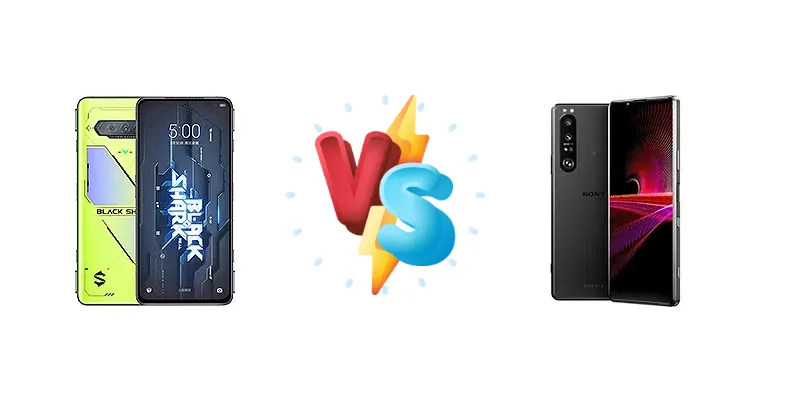
|
🏆 Quick Verdict
The Black Shark 5 RS is the clear winner for gamers, boasting blistering 120W charging and optimized cooling. However, the Xperia 1 III shines for photography enthusiasts and those seeking a refined, high-quality display and longer battery life, despite slower charging.
| PHONES | ||
|---|---|---|
| Phone Names | Xiaomi Black Shark 5 RS | Sony Xperia 1 III |
| Network | ||
|---|---|---|
| 2G bands | GSM 850 / 900 / 1800 / 1900 | GSM 850 / 900 / 1800 / 1900 |
| 3G bands | HSDPA 800 / 850 / 900 / 1700(AWS) / 1900 / 2100 | HSDPA 800 / 850 / 900 / 1700(AWS) / 1900 / 2100 |
| 4G bands | 1, 2, 3, 4, 5, 8, 18, 19, 26, 28, 34, 38, 39, 40, 41 | 1, 2, 3, 4, 5, 7, 8, 12, 13, 17, 19, 20, 25, 26, 28, 29, 32, 34, 38, 39, 40, 41, 46, 66 - Europe |
| 5G bands | 1, 3, 5, 8, 28, 41, 77, 78 SA/NSA | 1, 3, 5, 7, 8, 20, 28, 38, 40, 41, 77, 78 SA/NSA/Sub6 - Europe |
| Speed | HSPA, LTE, 5G | HSPA, LTE, 5G |
| Technology | GSM / CDMA / HSPA / EVDO / LTE / 5G | GSM / HSPA / LTE / 5G |
| CDMA2000 1xEV-DO | SA/NSA/Sub6/mmWave - USA (specific) | |
| Launch | ||
|---|---|---|
| Announced | 2022, March 30 | 2021, April 14 |
| Status | Available. Released 2022, April 04 | Available. Released 2021, August 25 |
| Body | ||
|---|---|---|
| Build | - | Glass front (Gorilla Glass Victus), glass back (Gorilla Glass 6), aluminum frame |
| Dimensions | 163.7 x 76.2 x 9.9 mm (6.44 x 3.00 x 0.39 in) | 165 x 71 x 8.2 mm (6.50 x 2.80 x 0.32 in) |
| SIM | Nano-SIM + Nano-SIM | Nano-SIM + Nano-SIM |
| Weight | 220 g (7.76 oz) | 186 g / 187.1 g (mmWave) (6.56 oz) |
| Physical pop-up gaming triggers | IP65/IP68 dust/water resistant (up to 1.5m for 30 min) | |
| Display | ||
|---|---|---|
| Protection | - | Corning Gorilla Glass Victus |
| Resolution | 1080 x 2400 pixels, 20:9 ratio (~395 ppi density) | 1644 x 3840 pixels, 21:9 ratio (~643 ppi density) |
| Size | 6.67 inches, 107.4 cm2 (~86.1% screen-to-body ratio) | 6.5 inches, 98.6 cm2 (~84.2% screen-to-body ratio) |
| Type | AMOLED, 144Hz, 1300 nits (peak) | OLED, 1B colors, 120Hz, HDR BT.2020 |
| Always-on display | Runs at 1096 x 2560 pixels except for select use cases | |
| Platform | ||
|---|---|---|
| CPU | Octa-core (1x2.84/3.0 GHz Cortex-X1 & 3x2.42 GHz Cortex-A78 & 4x1.80 GHz Cortex-A55) | Octa-core (1x2.84 GHz Cortex-X1 & 3x2.42 GHz Cortex-A78 & 4x1.80 GHz Cortex-A55) |
| Chipset | Qualcomm SM8350 Snapdragon 888/888+ 5G (5 nm) | Qualcomm SM8350 Snapdragon 888 5G (5 nm) |
| GPU | Adreno 660 | Adreno 660 |
| OS | Android 12, Joy UI 12.8 | Android 11, upgradable to Android 13 |
| Memory | ||
|---|---|---|
| Card slot | No | microSDXC (uses shared SIM slot) |
| Internal | 256GB 8GB RAM, 256GB 12GB RAM | 256GB 12GB RAM, 512GB 12GB RAM |
| UFS 3.1/SSD 256GB 8GB RAM - Snapdragon 888 256GB 12GB RAM - Snapdragon 888+ | UFS 3.X | |
| Main Camera | ||
|---|---|---|
| Features | LED flash, HDR, panorama | Zeiss optics, Zeiss T* lens coating, color spectrum sensor, LED flash, panorama, HDR, eye tracking |
| Single | 20 MP, (wide) | 8 MP, f/2.0, 24mm (wide), 1/4", 1.12µm |
| Triple | 64 MP, f/1.8, (wide), 1/1.97", 0.7µm, PDAF 8 MP, 120˚ (ultrawide) 5 MP, f/2.4, (telephoto macro) | 12 MP, f/1.7, 24mm (wide), 1/1.7", 1.8µm, dual pixel PDAF, OIS 12 MP, f/2.3, 70mm (telephoto), f/2.8, 105mm (telephoto), 1/2.9", dual pixel PDAF, 3x/4.4x optical zoom, OIS 12 MP, f/2.2, 124˚, 16mm (ultrawide), 1/2.6", dual pixel PDAF 0.3 MP, TOF 3D, (depth) |
| Video | 4K@30/60fps, 1080p@30/60/240fps, 1080p@960fps; HDR10+ | 4K@24/25/30/60/120fps HDR, 1080p@30/60/120fps; 5-axis gyro-EIS, OIS |
| Selfie camera | ||
|---|---|---|
| Features | HDR | HDR |
| Single | 20 MP, (wide) | 8 MP, f/2.0, 24mm (wide), 1/4.0", 1.12µm |
| Video | 1080p@30fps | 1080p@30fps, 5-axis gyro-EIS |
| Sound | ||
|---|---|---|
| 3.5mm jack | Yes | Yes |
| 35mm jack | Yes | Yes |
| Loudspeaker | Yes, with stereo speakers | Yes, with stereo speakers |
| 24-bit/192kHz audio | 24-bit/192kHz audio Dynamic vibration system | |
| Comms | ||
|---|---|---|
| Bluetooth | 5.2, A2DP, LE, aptX HD, aptX Adaptive | 5.2, A2DP, LE, aptX HD, aptX Adaptive |
| NFC | Yes | Yes |
| Positioning | GPS, GLONASS, GALILEO, QZSS, BDS | GPS, GLONASS, BDS, GALILEO, QZSS |
| Radio | No | No |
| USB | USB Type-C 2.0 | USB Type-C 3.1, OTG, video output |
| WLAN | Wi-Fi 802.11 a/b/g/n/ac/6, dual-band, Wi-Fi Direct | Wi-Fi 802.11 a/b/g/n/ac/6, dual-band, Wi-Fi Direct, DLNA |
| Features | ||
|---|---|---|
| Sensors | Fingerprint (side-mounted), accelerometer, gyro, proximity, compass, barometer | Fingerprint (side-mounted), accelerometer, gyro, proximity, barometer, compass |
| - | Native Sony Alpha camera support | |
| Battery | ||
|---|---|---|
| Charging | 120W wired, 100% in 15 min | 30W wired, PD, 50% in 30 min Wireless Reverse wireless |
| Type | Li-Po 4500 mAh | Li-Po 4500 mAh |
| Misc | ||
|---|---|---|
| Colors | Black, Yellow | Frosted Black, Frosted Gray, Frosted Purple |
| Models | - | XQBC62/V, XQBC52V.UKCX, SO-51B, SOG03, A101SO, XQ-BC62, XQ-BC72, XQ-BC52, XQ-BC01, XQ-BC11, XQ-BC21, XQ-BC72 |
| Price | About 470 EUR | € 505.26 / $ 903.43 |
| Tests | ||
|---|---|---|
| Battery life | - | Endurance rating 82h |
| Camera | - | Photo / Video |
| Display | - | Contrast ratio: Infinite (nominal) |
| Loudspeaker | - | -26.5 LUFS (Good) |
| Performance | - | AnTuTu: 607423 (v8) GeekBench: 3515 (v5.1) GFXBench: 54fps (ES 3.1 onscreen) |
Xiaomi Black Shark 5 RS
- Blazing-fast 120W charging
- Excellent cooling system for sustained gaming
- High 144Hz refresh rate display
- Aggressive gaming design
- Camera performance is not a priority
- Design may not appeal to everyone
- Battery life is average
Sony Xperia 1 III
- Exceptional 4K OLED display
- Outstanding camera system
- Long-lasting battery life
- Premium design and build quality
- Slower 30W charging
- Thermal throttling under heavy load
- Higher price point
Display Comparison
The Xperia 1 III boasts a stunning 6.5-inch 4K OLED display with a 120Hz refresh rate and a 21:9 aspect ratio, offering exceptional contrast and color accuracy. Its 620 nits brightness is respectable. The Black Shark 5 RS features a 6.67-inch AMOLED display with a 144Hz refresh rate, prioritizing smoothness for gaming. While vibrant, it may not match the Xperia's color accuracy and contrast. The Xperia's infinite contrast ratio (nominal) suggests deep blacks.
Camera Comparison
The Xperia 1 III excels in camera performance, featuring a versatile triple-lens setup with excellent image quality and video recording capabilities. Its computational photography is refined. The Black Shark 5 RS offers a decent camera system, but it's not the primary focus, and image quality is generally inferior to the Xperia 1 III, especially in low light. The Xperia's video recording capabilities are also superior.
Performance
Both phones utilize the Snapdragon 888, ensuring flagship-level performance. However, the Black Shark 5 RS's cooling system is significantly more robust, allowing it to sustain peak performance for longer gaming sessions. The Xperia 1 III, while capable, may experience thermal throttling under extended load. Both offer smooth multitasking and app loading.
Battery Life
The Xperia 1 III's battery life is a major advantage, offering an impressive endurance rating of 82 hours. The Black Shark 5 RS, while having a smaller battery, compensates with incredibly fast 120W charging, reaching 100% in just 15 minutes. However, the faster charging may impact long-term battery health.
Buying Guide
Buy the Xiaomi Black Shark 5 RS if you're a serious mobile gamer who values performance and rapid charging. Buy the Sony Xperia 1 III if you're a photography lover, content creator, or appreciate a premium design and excellent display quality with extended battery life.