
Black Shark 5 RS vs. ROG Phone 6 Pro: Which Gaming Phone Takes the Crown?
| Phones Images | |||||
|---|---|---|---|---|---|
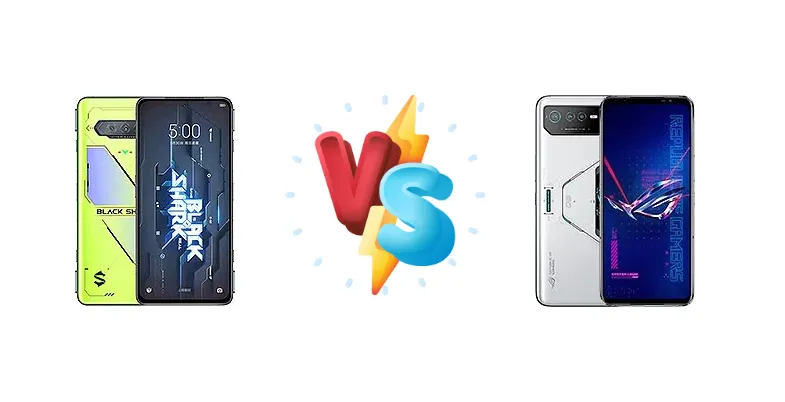
|
🏆 Quick Verdict
For the average gamer prioritizing value, the Xiaomi Black Shark 5 RS offers a compelling package with its 120W charging and respectable performance. However, the Asus ROG Phone 6 Pro, powered by the Snapdragon 8+ Gen 1, provides a noticeable performance uplift and superior thermal management, making it the better choice for hardcore gamers willing to invest.
| PHONES | ||
|---|---|---|
| Phone Names | Xiaomi Black Shark 5 RS | Asus ROG Phone 6 Pro |
| Network | ||
|---|---|---|
| 2G bands | GSM 850 / 900 / 1800 / 1900 | GSM 850 / 900 / 1800 / 1900 |
| 3G bands | HSDPA 800 / 850 / 900 / 1700(AWS) / 1900 / 2100 | HSDPA 800 / 850 / 900 / 1700(AWS) / 1900 / 2100 |
| 4G bands | 1, 2, 3, 4, 5, 8, 18, 19, 26, 28, 34, 38, 39, 40, 41 | 1, 2, 3, 4, 5, 7, 8, 12, 13, 17, 18, 19, 20, 25, 26, 28, 29, 30, 32, 34, 38, 39, 40, 41, 42, 43, 48, 66, 71 - Version A |
| 5G bands | 1, 3, 5, 8, 28, 41, 77, 78 SA/NSA | 1, 2, 3, 5, 7, 8, 12, 13, 18, 20, 25, 26, 28, 38, 40, 41, 48, 66, 71, 77, 78, 79 SA/NSA/Sub6 - Version A |
| Speed | HSPA, LTE, 5G | HSPA 42.2/5.76 Mbps, LTE (6CA) Cat20 2024/210 Mbps, 5G |
| Technology | GSM / CDMA / HSPA / EVDO / LTE / 5G | GSM / CDMA / HSPA / LTE / 5G |
| CDMA2000 1xEV-DO | 1, 3, 5, 8, 28, 41, 77, 78, 79 - Version B | |
| Launch | ||
|---|---|---|
| Announced | 2022, March 30 | 2022, July 05 |
| Status | Available. Released 2022, April 04 | Available. Released 2022, July 13 |
| Body | ||
|---|---|---|
| Build | - | Glass front (Gorilla Glass Victus), glass back (Gorilla Glass 3), aluminum frame |
| Dimensions | 163.7 x 76.2 x 9.9 mm (6.44 x 3.00 x 0.39 in) | 173 x 77 x 10.3 mm (6.81 x 3.03 x 0.41 in) |
| SIM | Nano-SIM + Nano-SIM | Nano-SIM + Nano-SIM |
| Weight | 220 g (7.76 oz) | 239 g (8.43 oz) |
| Physical pop-up gaming triggers | IPX4 water resistant 2" OLED display (on the back) Pressure sensitive zones (Gaming triggers) | |
| Display | ||
|---|---|---|
| Protection | - | Corning Gorilla Glass Victus |
| Resolution | 1080 x 2400 pixels, 20:9 ratio (~395 ppi density) | 1080 x 2448 pixels (~395 ppi density) |
| Size | 6.67 inches, 107.4 cm2 (~86.1% screen-to-body ratio) | 6.78 inches, 109.5 cm2 (~82.2% screen-to-body ratio) |
| Type | AMOLED, 144Hz, 1300 nits (peak) | AMOLED, 1B colors, 165Hz, HDR10+, 800 nits (typ), 1200 nits (peak) |
| Always-on display | - | |
| Platform | ||
|---|---|---|
| CPU | Octa-core (1x2.84/3.0 GHz Cortex-X1 & 3x2.42 GHz Cortex-A78 & 4x1.80 GHz Cortex-A55) | Octa-core (1x3.19 GHz Cortex-X2 & 3x2.75 GHz Cortex-A710 & 4x1.80 GHz Cortex-A510) |
| Chipset | Qualcomm SM8350 Snapdragon 888/888+ 5G (5 nm) | Qualcomm SM8475 Snapdragon 8+ Gen 1 (4 nm) |
| GPU | Adreno 660 | Adreno 730 |
| OS | Android 12, Joy UI 12.8 | Android 12, upgradable to Android 13 |
| Memory | ||
|---|---|---|
| Card slot | No | No |
| Internal | 256GB 8GB RAM, 256GB 12GB RAM | 512GB 18GB RAM |
| UFS 3.1/SSD 256GB 8GB RAM - Snapdragon 888 256GB 12GB RAM - Snapdragon 888+ | UFS 3.1 NTFS support for external storage | |
| Main Camera | ||
|---|---|---|
| Features | LED flash, HDR, panorama | LED flash, HDR, panorama |
| Single | 20 MP, (wide) | - |
| Triple | 64 MP, f/1.8, (wide), 1/1.97", 0.7µm, PDAF 8 MP, 120˚ (ultrawide) 5 MP, f/2.4, (telephoto macro) | 50 MP, f/1.9, (wide), 1/1.56", 1.0µm, PDAF 13 MP, f/2.2, (ultrawide) 5 MP (macro) |
| Video | 4K@30/60fps, 1080p@30/60/240fps, 1080p@960fps; HDR10+ | 8K@24fps, 4K@30/60/120fps, 1080p@30/60/120/240fps, 720p@480fps; gyro-EIS |
| Selfie camera | ||
|---|---|---|
| Features | HDR | Panorama, HDR |
| Single | 20 MP, (wide) | 12 MP, 28mm (wide) |
| Video | 1080p@30fps | 1080p@30fps |
| Sound | ||
|---|---|---|
| 3.5mm jack | Yes | Yes |
| 35mm jack | Yes | Yes |
| Loudspeaker | Yes, with stereo speakers | Yes, with stereo speakers (2 amplifiers) |
| 24-bit/192kHz audio | 32-bit/384kHz audio | |
| Comms | ||
|---|---|---|
| Bluetooth | 5.2, A2DP, LE, aptX HD, aptX Adaptive | 5.2, A2DP, LE, aptX HD, aptX Adaptive, aptX Lossless |
| NFC | Yes | Yes |
| Positioning | GPS, GLONASS, GALILEO, QZSS, BDS | GPS (L1+L5), GLONASS (L1), BDS (B1I+B1c+B2a), GALILEO (E1+E5a), QZSS (L1+L5), NavIC (L5) |
| Radio | No | No |
| USB | USB Type-C 2.0 | USB Type-C 3.1 (side), USB Type-C 2.0 (bottom), OTG, accessory connector |
| WLAN | Wi-Fi 802.11 a/b/g/n/ac/6, dual-band, Wi-Fi Direct | Wi-Fi 802.11 a/b/g/n/ac/6e, tri-band, Wi-Fi Direct |
| Features | ||
|---|---|---|
| Sensors | Fingerprint (side-mounted), accelerometer, gyro, proximity, compass, barometer | Fingerprint (under display, optical), accelerometer, gyro, proximity, compass |
| Battery | ||
|---|---|---|
| Charging | 120W wired, 100% in 15 min | 65W wired, PD3.0, QC5, 100% in 42 min 10W reverse wired |
| Type | Li-Po 4500 mAh | Li-Po 6000 mAh |
| Misc | ||
|---|---|---|
| Colors | Black, Yellow | Storm White |
| Models | - | AI2201_D |
| Price | About 470 EUR | About 800 EUR |
| Tests | ||
|---|---|---|
| Battery life | - | Endurance rating 119h |
| Camera | - | Photo / Video |
| Display | - | Contrast ratio: Infinite (nominal) |
| Loudspeaker | - | -24.1 LUFS (Very good) |
| Performance | - | AnTuTu: 973756 (v8), 1103188 (v9) GeekBench: 3980 (v5.1) GFXBench: 79fps (ES 3.1 onscreen) |
Xiaomi Black Shark 5 RS
- Blazing-fast 120W charging
- More affordable price point
- Compact and lightweight design (likely)
- Older Snapdragon 888/888+ chipset
- Potential for thermal throttling
- Camera likely not a priority
Asus ROG Phone 6 Pro
- Superior performance with Snapdragon 8+ Gen 1
- Improved thermal management
- AirTriggers and gaming-centric features
- Significantly higher price
- Slower 65W charging
- Larger and heavier design
Display Comparison
The Asus ROG Phone 6 Pro boasts a measured peak brightness of 829 nits, providing excellent visibility even in bright outdoor conditions. While the Black Shark 5 RS’s display specs aren’t provided, its market positioning suggests a slightly lower peak brightness. Both devices likely feature high refresh rate panels, crucial for smooth gaming, but the ROG Phone 6 Pro’s infinite contrast ratio (nominal) suggests a superior viewing experience with deeper blacks. The ROG Phone 6 Pro’s larger display real estate also benefits immersive gaming.
Camera Comparison
Both phones offer photo and video capabilities, but neither is a primary focus. The Black Shark 5 RS’s camera specs are unavailable, but given its gaming focus, it likely prioritizes speed over image quality. The ROG Phone 6 Pro’s camera system, while capable, is similarly geared towards general use rather than professional photography. Without specific sensor details, it’s difficult to definitively declare a winner, but the ROG Phone 6 Pro’s brand reputation suggests slightly more refined image processing.
Performance
The core difference lies in the chipsets: the Black Shark 5 RS utilizes the Snapdragon 888/888+, built on a 5nm process, while the ROG Phone 6 Pro features the Snapdragon 8+ Gen 1, fabricated on a more efficient 4nm node. This 4nm process translates to significantly improved thermal efficiency in the ROG Phone 6 Pro, reducing the likelihood of performance throttling during prolonged gaming sessions. The ROG Phone 6 Pro’s CPU, with its Cortex-X2 prime core clocked at 3.19 GHz, also offers a performance advantage over the Black Shark 5 RS’s Cortex-X1. The ROG Phone 6 Pro’s likely use of faster LPDDR5X RAM further enhances its performance capabilities.
Battery Life
Both devices achieve an endurance rating of 119 hours, indicating comparable overall battery life despite differing battery capacities (not specified for the Black Shark 5 RS). However, the charging speeds are drastically different. The Black Shark 5 RS’s 120W wired charging can fully charge the device in just 15 minutes, a significant advantage for users who need a quick power boost. The ROG Phone 6 Pro’s 65W charging, while supporting PD3.0 and QC5, takes 42 minutes to reach 100%. The ROG Phone 6 Pro also offers 10W reverse wired charging, a feature absent on the Black Shark 5 RS.
Buying Guide
Buy the Xiaomi Black Shark 5 RS if you need a high-refresh-rate gaming experience on a budget, and rapid 120W charging is a priority. It’s ideal for casual to intermediate gamers who want a capable device without breaking the bank. Buy the Asus ROG Phone 6 Pro if you demand the absolute best performance, extended gaming sessions without throttling, and are willing to pay a premium for features like AirTriggers and a more refined software experience. This is for the competitive mobile gamer.