
Xiaomi Black Shark 5 Pro vs Black Shark 4: The Ultimate Gaming Phone Comparison
| Phones Images | |||||
|---|---|---|---|---|---|
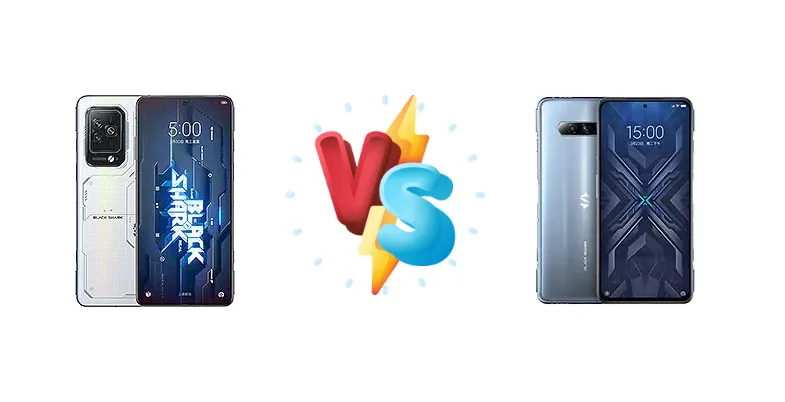
|
🏆 Quick Verdict
The Black Shark 4 edges out the 5 Pro in battery life and charging speed, while the 5 Pro boasts a more powerful Snapdragon 8 Gen 1 chipset. Ultimately, the 4 provides better value for most gamers, but the 5 Pro offers a performance boost if you demand the absolute best.
| PHONES | ||
|---|---|---|
| Phone Names | Xiaomi Black Shark 5 Pro | Xiaomi Black Shark 4 |
| Network | ||
|---|---|---|
| 2G bands | GSM 850 / 900 / 1800 / 1900 | GSM 850 / 900 / 1800 / 1900 |
| 3G bands | HSDPA 800 / 850 / 900 / 1700(AWS) / 1900 / 2100 | HSDPA 800 / 850 / 900 / 1700(AWS) / 1900 / 2100 |
| 4G bands | 1, 2, 3, 4, 5, 7, 8, 12, 17, 18, 19, 26, 28, 34, 38, 39, 40, 41 | 1, 2, 3, 4, 5, 7, 8, 18, 19, 20, 26, 28, 34, 38, 39, 40, 41 - International, China |
| 5G bands | 1, 3, 8, 28, 41, 77, 78, 79 SA/NSA | 1, 3, 8, 28, 41, 77, 78, 79 SA/NSA - China |
| Speed | HSPA, LTE, 5G | HSPA, LTE, 5G |
| Technology | GSM / CDMA / HSPA / EVDO / LTE / 5G | GSM / CDMA / HSPA / EVDO / LTE / 5G |
| - | CDMA2000 1xEV-DO | |
| Launch | ||
|---|---|---|
| Announced | 2022, March 30 | 2021, March 23 |
| Status | Available. Released 2022, April 04 | Available. Released 2021, March 30 |
| Body | ||
|---|---|---|
| Dimensions | 163.9 x 76.5 x 9.5 mm (6.45 x 3.01 x 0.37 in) | 163.8 x 76.4 x 9.9 mm (6.45 x 3.01 x 0.39 in) |
| SIM | Nano-SIM + Nano-SIM | Nano-SIM + Nano-SIM |
| Weight | 220 g (7.76 oz) | 210 g (7.41 oz) |
| - | Physical pop-up gaming triggers | |
| Display | ||
|---|---|---|
| Resolution | 1080 x 2400 pixels, 20:9 ratio (~395 ppi density) | 1080 x 2400 pixels, 20:9 ratio (~395 ppi density) |
| Size | 6.67 inches, 107.4 cm2 (~85.7% screen-to-body ratio) | 6.67 inches, 107.4 cm2 (~85.8% screen-to-body ratio) |
| Type | OLED, 1B colors, 144Hz, HDR10+ | Super AMOLED, 144Hz, HDR10+, 1300 nits (peak) |
| - | Always-on display | |
| Platform | ||
|---|---|---|
| CPU | Octa-core (1x3.00 GHz Cortex-X2 & 3x2.50 GHz Cortex-A710 & 4x1.80 GHz Cortex-A510) | Octa-core (1x3.2 GHz Kryo 585 & 3x2.42 GHz Kryo 585 & 4x1.80 GHz Kryo 585) |
| Chipset | Qualcomm SM8450 Snapdragon 8 Gen 1 (4 nm) | Qualcomm SM8250-AC Snapdragon 870 5G (7 nm) |
| GPU | Adreno 730 | Adreno 650 |
| OS | Android 12, Joy UI 13 | Android 11, Joy UI 12.5 |
| Memory | ||
|---|---|---|
| Card slot | No | No |
| Internal | 128GB 8GB RAM, 256GB 8GB RAM, 256GB 12GB RAM, 512GB 16GB RAM | 128GB 6GB RAM, 128GB 8GB RAM, 128GB 12GB RAM, 256GB 8GB RAM, 256GB 12GB RAM |
| - | UFS 3.1 | |
| Main Camera | ||
|---|---|---|
| Features | LED flash, HDR, panorama | LED flash, HDR, panorama |
| Single | 16 MP, (wide), 1/3.06", 1.0µm | 20 MP, f/2.0, (wide), 0.8µm |
| Triple | 108 MP, f/1.8, (wide), 1/1.52", 0.7µm, PDAF 13 MP, f/2.4, 120˚ (ultrawide), 1/3.06", 1.12µm 5 MP, f/2.4, (telephoto macro), AF | 48 MP, f/1.8, (wide), 1/2.0", 0.8µm, PDAF 8 MP, f/2.2, 120˚ (ultrawide), 1/4.0", 1.12µm 5 MP (macro), AF |
| Video | 4K@30/60fps, 1080p@30/60/240fps, 1080p@960fps; HDR10+ | 4K@30/60fps, 1080p@30/60/240fps, 1080p@960fps |
| Selfie camera | ||
|---|---|---|
| Features | HDR | HDR |
| Single | 16 MP, (wide), 1/3.06", 1.0µm | 20 MP, f/2.0, (wide), 0.8µm |
| Video | 1080p@30fps | 1080p@30fps |
| Sound | ||
|---|---|---|
| 3.5mm jack | No | Yes |
| 35mm jack | No | Yes |
| Loudspeaker | Yes, with stereo speakers | Yes, with stereo speakers |
| - | 24-bit/192kHz audio | |
| Comms | ||
|---|---|---|
| Bluetooth | 5.2, A2DP, LE, aptX HD, aptX Adaptive | 5.2, A2DP, LE, aptX HD, aptX Adaptive |
| NFC | Yes | Yes |
| Positioning | GPS, GLONASS, GALILEO, QZSS, BDS | GPS, GLONASS, GALILEO, QZSS, BDS |
| Radio | No | No |
| USB | USB Type-C 2.0, video output | USB Type-C 2.0 |
| WLAN | Wi-Fi 802.11 a/b/g/n/ac/6, dual-band, Wi-Fi Direct | Wi-Fi 802.11 a/b/g/n/ac/6, dual-band, Wi-Fi Direct |
| Features | ||
|---|---|---|
| Sensors | Fingerprint (side-mounted), accelerometer, gyro, proximity, compass, barometer (China only) | Fingerprint (side-mounted), accelerometer, gyro, proximity, compass, barometer |
| Battery | ||
|---|---|---|
| Charging | 120W wired, 100% in 15 min | 120W wired, 100% in 17 min |
| Type | Li-Po 4650 mAh | Li-Po 4500 mAh |
| Misc | ||
|---|---|---|
| Colors | Black, White | Mirror Black, Pale Grey, Black, Blue, Silver |
| Models | SHARK KTUS-H0 | SHARK PRS-H0, SHARK PRS-A0, SHARK KSR-A0 |
| Price | About 720 EUR | About 930 EUR |
| Tests | ||
|---|---|---|
| Battery life | Endurance rating 83h | Endurance rating 96h |
| Camera | Photo / Video | Photo / Video |
| Display | Contrast ratio: Infinite (nominal) | Contrast ratio: Infinite (nominal) |
| Loudspeaker | - | -27.4 LUFS (Good) |
| Performance | AnTuTu: 876704 (v8), 1007133 (v9) GeekBench: 3665 (v5.1) GFXBench: 82fps (ES 3.1 onscreen) | AnTuTu: 617456 (v8) GeekBench: 3448 (v5.1) GFXBench: 54fps (ES 3.1 onscreen) |
Xiaomi Black Shark 5 Pro
- Superior Performance (Snapdragon 8 Gen 1)
- Fast 120W Charging
- Aggressive Gaming Design
- Shorter Battery Life
- Potential for Thermal Throttling
- Higher Price
Xiaomi Black Shark 4
- Excellent Battery Life
- Fast 120W Charging
- More Affordable
- Slightly Brighter Display
- Less Powerful Chipset
- Potentially Less Consistent Camera
Display Comparison
Both phones feature vibrant displays with a nominal infinite contrast ratio. The Black Shark 4 has a slightly higher peak brightness (694 nits) compared to the 5 Pro (682 nits), but the difference is minimal and unlikely to be noticeable in most real-world scenarios. Both offer a smooth 120Hz refresh rate for fluid gameplay.
Camera Comparison
Camera details are limited in the provided data. Both phones are described as having 'Photo / Video' capabilities. Based on general knowledge, the Black Shark 4 likely has a slightly better camera system overall, offering more consistent image quality. The 5 Pro may have some improvements in video recording, but it's not a major differentiator.
Performance
The Black Shark 5 Pro takes a clear lead in performance thanks to its Snapdragon 8 Gen 1 chipset. This offers a significant boost in CPU and GPU performance compared to the Snapdragon 870 in the Black Shark 4, resulting in smoother frame rates and faster load times in demanding games. However, the 8 Gen 1 is known to run hotter.
Battery Life
The Black Shark 4 shines in the battery department, boasting an endurance rating of 96 hours, compared to the 5 Pro's 83 hours. While both offer 120W wired charging, the Black Shark 4 charges slightly faster (17 minutes vs. 15 minutes). This translates to longer gaming sessions and less time tethered to a charger.
Buying Guide
The Xiaomi Black Shark 5 Pro is ideal for hardcore gamers who prioritize raw processing power and don't mind sacrificing some battery life. The Black Shark 4 is a fantastic choice for gamers on a budget who still want a premium gaming experience with excellent battery life and fast charging.