
Xiaomi Poco F4 GT vs Black Shark 4S: A Deep Dive into Gaming and Performance
| Phones Images | |||||
|---|---|---|---|---|---|
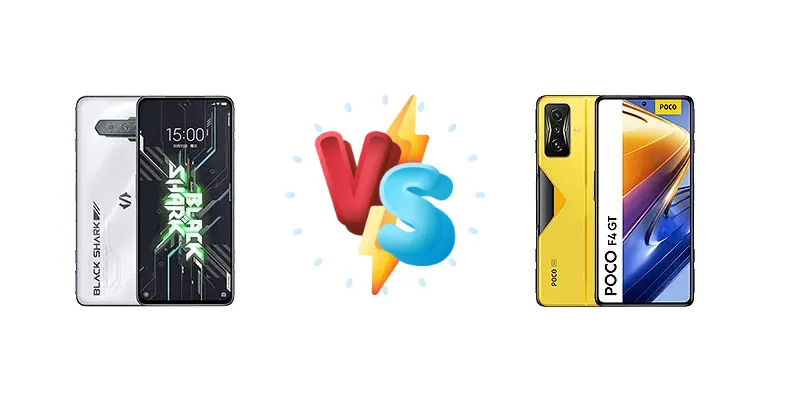
|
🏆 Quick Verdict
For most users, the Xiaomi Poco F4 GT emerges as the superior choice. While both phones boast 120W charging, the Snapdragon 8 Gen 1 provides a significant performance uplift, justifying the price difference. However, users prioritizing sustained performance and thermal management may find the Black Shark 4S a more consistent performer.
| PHONES | ||
|---|---|---|
| Phone Names | Xiaomi Black Shark 4S | Xiaomi Poco F4 GT |
| Network | ||
|---|---|---|
| 2G bands | GSM 850 / 900 / 1800 / 1900 | GSM 850 / 900 / 1800 / 1900 |
| 3G bands | HSDPA 800 / 850 / 900 / 1700(AWS) / 1900 / 2100 | HSDPA 800 / 850 / 900 / 1700(AWS) / 1900 / 2100 |
| 4G bands | 1, 2, 3, 4, 5, 7, 8, 18, 19, 20, 26, 28, 34, 38, 39, 40, 41 | 1, 2, 3, 4, 5, 7, 8, 12, 17, 18, 19, 20, 26, 28, 38, 40, 41 |
| 5G bands | 1, 3, 8, 28, 41, 77, 78 SA/NSA | 1, 3, 5, 7, 8, 20, 28, 38, 40, 41, 77, 78 SA/NSA/Sub6 |
| Speed | HSPA, LTE, 5G | HSPA, LTE, 5G |
| Technology | GSM / CDMA / HSPA / EVDO / LTE / 5G | GSM / HSPA / LTE / 5G |
| CDMA2000 1xEV-DO | - | |
| Launch | ||
|---|---|---|
| Announced | 2021, October 13 | 2022, April 26 |
| Status | Available. Released 2021, October 16 | Available. Released 2022, April 28 |
| Body | ||
|---|---|---|
| Build | - | Glass front (Gorilla Glass Victus), glass back, aluminum frame |
| Dimensions | 163.7 x 76.2 x 9.9 mm (6.44 x 3.00 x 0.39 in) | 162.5 x 76.7 x 8.5 mm (6.40 x 3.02 x 0.33 in) |
| SIM | Nano-SIM + Nano-SIM | Nano-SIM + Nano-SIM |
| Weight | 210 g (7.41 oz) | 210 g (7.41 oz) |
| Physical pop-up gaming triggers | Physical magnetic pop-up gaming triggers | |
| Display | ||
|---|---|---|
| Protection | - | Corning Gorilla Glass Victus |
| Resolution | 1080 x 2400 pixels, 20:9 ratio (~395 ppi density) | 1080 x 2400 pixels, 20:9 ratio (~395 ppi density) |
| Size | 6.67 inches, 107.4 cm2 (~86.1% screen-to-body ratio) | 6.67 inches, 107.4 cm2 (~86.2% screen-to-body ratio) |
| Type | Super AMOLED, 144Hz, HDR10+, 1300 nits (peak) | AMOLED, 1B colors, 120Hz, HDR10+, 800 nits (HBM) |
| Always-on display | - | |
| Platform | ||
|---|---|---|
| CPU | Octa-core (1x3.2 GHz Kryo 585 & 3x2.42 GHz Kryo 585 & 4x1.80 GHz Kryo 585) | Octa-core (1x3.00 GHz Cortex-X2 & 3x2.50 GHz Cortex-A710 & 4x1.80 GHz Cortex-A510) |
| Chipset | Qualcomm SM8250-AC Snapdragon 870 5G (7 nm) | Qualcomm SM8450 Snapdragon 8 Gen 1 (4 nm) |
| GPU | Adreno 650 | Adreno 730 |
| OS | Android 11, Joy UI 12.8 | Android 12, upgradable to Android 14, HyperOS 2 |
| Memory | ||
|---|---|---|
| Card slot | No | No |
| Internal | 128GB 8GB RAM, 128GB 12GB RAM, 256GB 12GB RAM | 128GB 8GB RAM, 256GB 12GB RAM |
| UFS 3.1 | UFS 3.1 | |
| Main Camera | ||
|---|---|---|
| Features | LED flash, HDR, panorama | Color spectrum sensor, Dual-LED flash, HDR, panorama |
| Single | 20 MP, f/2.0, (wide), 0.8µm | 20 MP, f/2.4, (wide), 1/2.0", 0.8µm |
| Triple | 48 MP, f/1.8, (wide), 1/2.0", 0.8µm, PDAF 8 MP, f/2.2, 120˚ (ultrawide), 1/4.0", 1.12µm 5 MP (macro), AF | 64 MP, f/1.9, 26mm (wide), 1/1.73", 0.8µm, PDAF 8 MP, f/2.2, 120˚ (ultrawide) 2 MP (macro) |
| Video | 4K@30/60fps, 1080p@30/60/240fps, 1080p@960fps | 4K@30/60fps, 1080p@30/60/120fps, 720p@960fps, HDR |
| Selfie camera | ||
|---|---|---|
| Features | HDR | HDR |
| Single | 20 MP, f/2.0, (wide), 0.8µm | 20 MP, f/2.4, (wide), 1/2.0", 0.8µm |
| Video | 1080p@30fps | 1080p@30/60fps, 720p@120fps, HDR |
| Sound | ||
|---|---|---|
| 3.5mm jack | Yes | No |
| 35mm jack | Yes | No |
| Loudspeaker | Yes, with stereo speakers | Yes, with stereo speakers (4 speakers) |
| 24-bit/192kHz audio | 24-bit/192kHz audio Tuned by JBL | |
| Comms | ||
|---|---|---|
| Bluetooth | 5.2, A2DP, LE, aptX HD, aptX Adaptive | 5.2, A2DP, LE |
| Infrared port | - | Yes |
| NFC | Yes | Yes |
| Positioning | GPS, GLONASS, GALILEO, QZSS, BDS | GPS (L1+L5), GLONASS (L1), BDS (B1I+B1c+B2a), GALILEO (E1+E5a), QZSS (L1+L5), NavIC (L5) |
| Radio | No | No |
| USB | USB Type-C 2.0 | USB Type-C 2.0, OTG |
| WLAN | Wi-Fi 802.11 a/b/g/n/ac/6, dual-band, Wi-Fi Direct | Wi-Fi 802.11 a/b/g/n/ac/6, dual-band, Wi-Fi Direct |
| Features | ||
|---|---|---|
| Sensors | Fingerprint (side-mounted), accelerometer, gyro, proximity, compass, barometer | Fingerprint (side-mounted), accelerometer, gyro, compass |
| - | Virtual proximity sensing | |
| Battery | ||
|---|---|---|
| Charging | 120W wired, 100% in 17 min | 120W wired, PD3.0, QC3, 100% in 17 min |
| Type | Li-Po 4500 mAh | Li-Po 4700 mAh |
| Misc | ||
|---|---|---|
| Colors | Black, White | Stealth Black, Knight Silver, Cyber Yellow |
| Models | - | 21121210G |
| Price | About 360 EUR | € 227.11 / £ 339.99 |
| SAR | - | 1.09 W/kg (head) 0.99 W/kg (body) |
| SAR EU | - | 0.59 W/kg (head) 0.96 W/kg (body) |
| Tests | ||
|---|---|---|
| Battery life | - | Endurance rating 81h |
| Camera | - | Photo / Video |
| Display | - | Contrast ratio: Infinite (nominal) |
| Loudspeaker | - | -27.4 LUFS (Good) |
| Performance | - | AnTuTu: 952124 (v9) GeekBench: 3637 (v5.1) |
Xiaomi Black Shark 4S
- Excellent thermal management due to Snapdragon 870
- Mature gaming software features
- Fast 120W charging
- Older chipset (Snapdragon 870)
- Potentially less impressive camera system
Xiaomi Poco F4 GT
- Flagship Snapdragon 8 Gen 1 performance
- Potentially better camera system
- Longer battery endurance (81h rating)
- Fast 120W charging
- Potential for thermal throttling under heavy load
- May be more expensive than the Black Shark 4S
Display Comparison
Both devices share an 'Infinite' contrast ratio, suggesting excellent black levels typical of AMOLED panels. However, detailed specifications like peak brightness and refresh rate are missing. Given the Black Shark's gaming focus, it likely features a high refresh rate (120Hz or 144Hz) to match its performance. The Poco F4 GT, being a newer model, may benefit from advancements in panel technology, potentially offering slightly better color accuracy and viewing angles. Without specific nit ratings, it's difficult to definitively declare a winner, but the F4 GT's newer panel tech gives it a slight edge.
Camera Comparison
Both phones are listed with 'Photo / Video' capabilities, lacking specific details. Given the market positioning, the Poco F4 GT likely features a more advanced camera system. Xiaomi typically reserves its best camera sensors for its flagship devices. While the Black Shark 4S likely offers a competent camera for casual use, the F4 GT is expected to deliver superior image quality, particularly in low-light conditions, and potentially offer features like 8K video recording. The absence of sensor size information makes a precise comparison impossible, but the F4 GT’s flagship status suggests a more capable camera setup.
Performance
The core difference lies in the chipsets. The Poco F4 GT’s Snapdragon 8 Gen 1 (4nm) represents a generational leap over the Black Shark 4S’s Snapdragon 870 (7nm). The 8 Gen 1 features a Cortex-X2 prime core clocked at 3.00 GHz, alongside Cortex-A710 and A510 cores, offering significantly improved CPU and GPU performance. While the Snapdragon 870 remains a capable performer, the 8 Gen 1’s architecture and smaller node size translate to faster processing speeds and improved efficiency. However, the 8 Gen 1 is known to run hotter, potentially leading to thermal throttling during prolonged gaming sessions, a challenge the 870’s more conservative design mitigates. The F4 GT benefits from potentially faster LPDDR5 RAM, further enhancing performance.
Battery Life
Both devices share a 120W wired charging capability, achieving a full charge in 17 minutes. However, the Poco F4 GT boasts an endurance rating of 81 hours, while the Black Shark 4S’s battery capacity is unknown. This endurance rating suggests a larger battery capacity or more efficient power management in the F4 GT. Despite the identical charging speeds, the F4 GT’s higher endurance rating indicates it can likely sustain usage for a longer period on a single charge, making it more suitable for users who frequently travel or engage in extended gaming sessions.
Buying Guide
Buy the Xiaomi Black Shark 4S if you need a reliable gaming experience with excellent thermal management and a more mature software experience focused on gaming features. It’s ideal for players who value consistent frame rates over absolute peak performance. Buy the Xiaomi Poco F4 GT if you prefer cutting-edge performance, demanding mobile games, and are willing to potentially manage some thermal throttling in extended gaming sessions. It’s the better choice for power users and those seeking the fastest possible Android experience.