
Xiaomi Black Shark 4S vs. Xiaomi 12 Pro (Dimensity): A Deep Dive into Performance and Value
| Phones Images | |||||
|---|---|---|---|---|---|
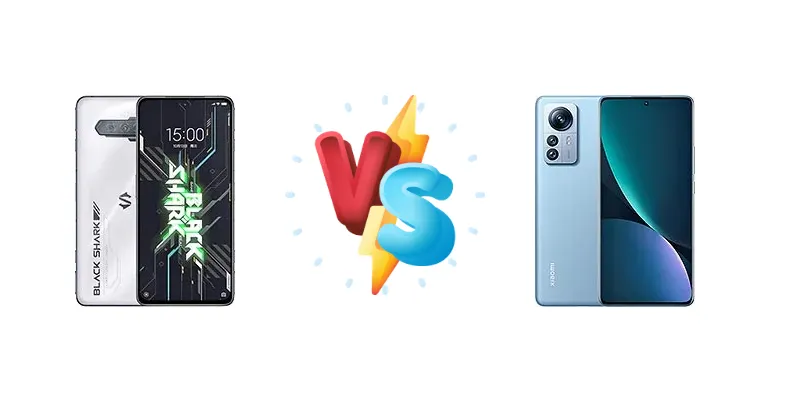
|
🏆 Quick Verdict
For dedicated mobile gamers, the Xiaomi Black Shark 4S offers a compelling package with its Snapdragon 870 and 120W charging. However, the Xiaomi 12 Pro (Dimensity) edges ahead for general users thanks to the more efficient Dimensity 9000+ chipset and its broader feature set, making it the better all-rounder.
| PHONES | ||
|---|---|---|
| Phone Names | Xiaomi Black Shark 4S | Xiaomi 12 Pro (Dimensity) |
| Network | ||
|---|---|---|
| 2G bands | GSM 850 / 900 / 1800 / 1900 | GSM 850 / 900 / 1800 / 1900 |
| 3G bands | HSDPA 800 / 850 / 900 / 1700(AWS) / 1900 / 2100 | HSDPA 800 / 850 / 900 / 1700(AWS) / 1900 / 2100 |
| 4G bands | 1, 2, 3, 4, 5, 7, 8, 18, 19, 20, 26, 28, 34, 38, 39, 40, 41 | 1, 2, 3, 4, 5, 7, 8, 18, 19, 26, 34, 38, 39, 40, 41, 42 |
| 5G bands | 1, 3, 8, 28, 41, 77, 78 SA/NSA | 1, 3, 5, 8, 28, 38, 40, 41, 77, 78 SA/NSA |
| Speed | HSPA, LTE, 5G | HSPA, LTE, 5G |
| Technology | GSM / CDMA / HSPA / EVDO / LTE / 5G | GSM / CDMA / HSPA / EVDO / LTE / 5G |
| CDMA2000 1xEV-DO | CDMA2000 1xEV-DO | |
| Launch | ||
|---|---|---|
| Announced | 2021, October 13 | 2022, July 04 |
| Status | Available. Released 2021, October 16 | Available. Released 2022, July 13 |
| Body | ||
|---|---|---|
| Dimensions | 163.7 x 76.2 x 9.9 mm (6.44 x 3.00 x 0.39 in) | 163.6 x 74.6 x 8.2 mm (6.44 x 2.94 x 0.32 in) |
| SIM | Nano-SIM + Nano-SIM | Nano-SIM + Nano-SIM |
| Weight | 210 g (7.41 oz) | 201 g (7.09 oz) |
| Physical pop-up gaming triggers | - | |
| Display | ||
|---|---|---|
| Protection | - | Corning Gorilla Glass Victus |
| Resolution | 1080 x 2400 pixels, 20:9 ratio (~395 ppi density) | 1440 x 3200 pixels, 20:9 ratio (~521 ppi density) |
| Size | 6.67 inches, 107.4 cm2 (~86.1% screen-to-body ratio) | 6.73 inches, 109.4 cm2 (~89.6% screen-to-body ratio) |
| Type | Super AMOLED, 144Hz, HDR10+, 1300 nits (peak) | LTPO2 AMOLED, 1B colors, 120Hz, Dolby Vision, HDR10+, 1000 nits (HBM), 1500 nits (peak) |
| Always-on display | - | |
| Platform | ||
|---|---|---|
| CPU | Octa-core (1x3.2 GHz Kryo 585 & 3x2.42 GHz Kryo 585 & 4x1.80 GHz Kryo 585) | Octa-core (1x3.20 GHz Cortex-X2 & 3x2.85 GHz Cortex-A710 & 4x1.80 GHz Cortex-A510) |
| Chipset | Qualcomm SM8250-AC Snapdragon 870 5G (7 nm) | Mediatek Dimensity 9000+ (4 nm) |
| GPU | Adreno 650 | Mali-G710 MC10 |
| OS | Android 11, Joy UI 12.8 | Android 12, MIUI 13 |
| Memory | ||
|---|---|---|
| Card slot | No | No |
| Internal | 128GB 8GB RAM, 128GB 12GB RAM, 256GB 12GB RAM | 128GB 8GB RAM, 256GB 12GB RAM |
| UFS 3.1 | UFS 3.1 | |
| Main Camera | ||
|---|---|---|
| Features | LED flash, HDR, panorama | Color spectrum sensor, Dual-LED dual-tone flash, HDR, panorama |
| Single | 20 MP, f/2.0, (wide), 0.8µm | 32 MP, f/2.5, 26mm (wide), 0.7µm |
| Triple | 48 MP, f/1.8, (wide), 1/2.0", 0.8µm, PDAF 8 MP, f/2.2, 120˚ (ultrawide), 1/4.0", 1.12µm 5 MP (macro), AF | 50 MP, f/1.9, 24mm (wide), 1/1.28", 1.22µm, dual pixel PDAF, OIS 13 MP, f/2.4, 15mm, 123˚ (ultrawide), 1/3.06", 1.12µm 5 MP, f/2.4, 50mm (telephoto macro), AF |
| Video | 4K@30/60fps, 1080p@30/60/240fps, 1080p@960fps | 4K@30/60fps, 1080p@30/60/120fps, gyro-EIS |
| Selfie camera | ||
|---|---|---|
| Features | HDR | HDR, panorama |
| Single | 20 MP, f/2.0, (wide), 0.8µm | 32 MP, f/2.5, 26mm (wide), 0.7µm |
| Video | 1080p@30fps | 1080p@30/60fps, 720p@120fps |
| Sound | ||
|---|---|---|
| 3.5mm jack | Yes | No |
| 35mm jack | Yes | No |
| Loudspeaker | Yes, with stereo speakers | Yes, with stereo speakers |
| 24-bit/192kHz audio | 24-bit/192kHz audio Tuned by Harman Kardon | |
| Comms | ||
|---|---|---|
| Bluetooth | 5.2, A2DP, LE, aptX HD, aptX Adaptive | 5.3, A2DP, LE |
| Infrared port | - | Yes |
| NFC | Yes | Yes |
| Positioning | GPS, GLONASS, GALILEO, QZSS, BDS | GPS (L1+L5), GLONASS (L1), BDS (B1I+B1c+B2a), GALILEO (E1+E5a), QZSS (L1+L5), NavIC (L5) |
| Radio | No | No |
| USB | USB Type-C 2.0 | USB Type-C 2.0, OTG |
| WLAN | Wi-Fi 802.11 a/b/g/n/ac/6, dual-band, Wi-Fi Direct | Wi-Fi 802.11 a/b/g/n/ac/6, dual-band, Wi-Fi Direct |
| Features | ||
|---|---|---|
| Sensors | Fingerprint (side-mounted), accelerometer, gyro, proximity, compass, barometer | Fingerprint (under display, optical), accelerometer, gyro, proximity, compass |
| Battery | ||
|---|---|---|
| Charging | 120W wired, 100% in 17 min | 67W wired, PD3.0, QC4 |
| Type | Li-Po 4500 mAh | Li-Po 5160 mAh |
| Misc | ||
|---|---|---|
| Colors | Black, White | Gray, Blue |
| Models | - | 2207122MC |
| Price | About 360 EUR | About 570 EUR |
Xiaomi Black Shark 4S
- Ultra-fast 120W charging
- Dedicated gaming features (triggers)
- Strong gaming performance with Snapdragon 870
- Less refined overall experience
- Potentially inferior camera system
Xiaomi 12 Pro (Dimensity)
- More efficient Dimensity 9000+ chipset
- Likely superior camera performance
- Balanced flagship experience
- Slower 67W charging
- Higher price point (potentially)
Display Comparison
While both devices likely feature high refresh rate AMOLED panels (based on brand history), the specifics aren't provided. The Xiaomi 12 Pro (Dimensity) likely benefits from a more color-accurate display, typical of Xiaomi's flagship offerings. The Black Shark 4S, geared towards gaming, may prioritize refresh rate over absolute color fidelity. The absence of LTPO information means we can't assess dynamic refresh rate capabilities, impacting battery life.
Camera Comparison
Without detailed sensor information, a direct comparison is difficult. However, the Xiaomi 12 Pro (Dimensity), as a flagship, is expected to feature a more sophisticated camera system with a larger primary sensor and advanced image processing algorithms. The Black Shark 4S likely prioritizes value, potentially utilizing a more modest camera setup. The Xiaomi 12 Pro (Dimensity) will likely excel in low-light photography and offer more versatile shooting modes. We can assume the Xiaomi 12 Pro (Dimensity) will have better video recording capabilities.
Performance
The core difference lies in the chipsets. The Xiaomi 12 Pro (Dimensity) boasts the Mediatek Dimensity 9000+ built on a 4nm process, featuring a Cortex-X2 prime core clocked at 3.20 GHz. This contrasts with the Black Shark 4S’s Snapdragon 870 (7nm). The 4nm node of the Dimensity 9000+ translates to superior power efficiency and potentially better sustained performance under load, mitigating thermal throttling. While the Snapdragon 870 is still a capable performer, the Dimensity 9000+’s architecture (Cortex-A710 and A510) offers a more modern and efficient design. Both utilize octa-core configurations, but the Dimensity’s core arrangement provides a performance advantage. The Xiaomi 12 Pro (Dimensity) likely benefits from faster LPDDR5x RAM, further enhancing responsiveness.
Battery Life
The Black Shark 4S’s 120W wired charging is a significant advantage, achieving a full charge in just 17 minutes. The Xiaomi 12 Pro (Dimensity) is limited to 67W, utilizing PD3.0 and QC4 standards. While 67W is still fast, the Black Shark 4S offers a substantially quicker top-up. The actual battery capacity isn't specified, but the Dimensity 9000+'s efficiency could offset a potentially smaller battery in the Xiaomi 12 Pro (Dimensity), resulting in comparable real-world battery life.
Buying Guide
Buy the Xiaomi Black Shark 4S if you prioritize sustained gaming performance, need the fastest possible charging speeds (120W), and appreciate gaming-centric features like shoulder triggers. Buy the Xiaomi 12 Pro (Dimensity) if you value a more refined flagship experience, a potentially better camera system, and the benefits of the Dimensity 9000+'s 4nm process for improved efficiency and thermal management in everyday tasks.