
Xiaomi Black Shark 4S vs Realme GT Neo 3T: The Ultimate Gaming Phone Battle
| Phones Images | |||||
|---|---|---|---|---|---|
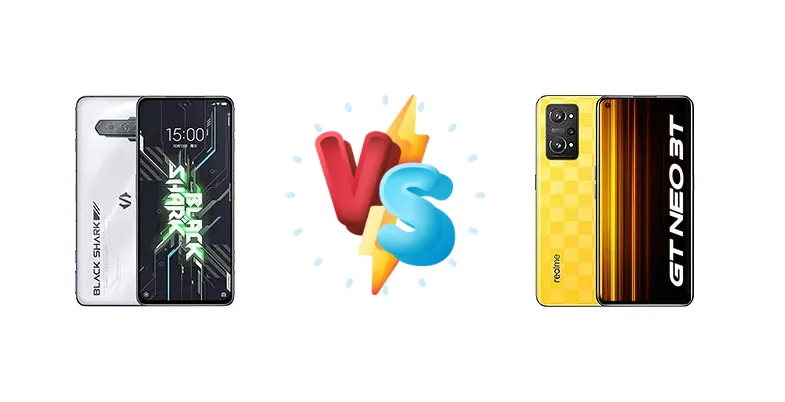
|
🏆 Quick Verdict
The Black Shark 4S takes the crown for dedicated gamers thanks to its superior cooling and shoulder triggers. However, the Realme GT Neo 3T offers a more balanced experience with faster charging and a vibrant display, making it a compelling choice for everyday users who also enjoy gaming.
| PHONES | ||
|---|---|---|
| Phone Names | Xiaomi Black Shark 4S | Realme GT Neo 3T |
| Network | ||
|---|---|---|
| 2G bands | GSM 850 / 900 / 1800 / 1900 | GSM 850 / 900 / 1800 / 1900 |
| 3G bands | HSDPA 800 / 850 / 900 / 1700(AWS) / 1900 / 2100 | HSDPA 800 / 850 / 900 / 1700(AWS) / 1900 / 2100 |
| 4G bands | 1, 2, 3, 4, 5, 7, 8, 18, 19, 20, 26, 28, 34, 38, 39, 40, 41 | 1, 2, 3, 4, 5, 7, 8, 12, 13, 17, 18, 19, 20, 26, 28, 38, 39, 40, 41, 66 |
| 5G bands | 1, 3, 8, 28, 41, 77, 78 SA/NSA | 1, 3, 5, 8, 20, 28, 38, 40, 41, 66, 77, 78 SA/NSA |
| Speed | HSPA, LTE, 5G | HSPA, LTE, 5G |
| Technology | GSM / CDMA / HSPA / EVDO / LTE / 5G | GSM / CDMA / HSPA / CDMA2000 / LTE / 5G |
| CDMA2000 1xEV-DO | CDMA2000 1x | |
| Launch | ||
|---|---|---|
| Announced | 2021, October 13 | 2022, June 07 |
| Status | Available. Released 2021, October 16 | Available. Released 2022, June 25 |
| Body | ||
|---|---|---|
| Build | - | Glass front (Gorilla Glass 5), plastic back, plastic frame |
| Dimensions | 163.7 x 76.2 x 9.9 mm (6.44 x 3.00 x 0.39 in) | 162.9 x 75.8 x 8.7 mm (6.41 x 2.98 x 0.34 in) |
| SIM | Nano-SIM + Nano-SIM | Nano-SIM + Nano-SIM |
| Weight | 210 g (7.41 oz) | 194.5 g (6.88 oz) |
| Physical pop-up gaming triggers | - | |
| Display | ||
|---|---|---|
| Protection | - | Corning Gorilla Glass 5 |
| Resolution | 1080 x 2400 pixels, 20:9 ratio (~395 ppi density) | 1080 x 2400 pixels, 20:9 ratio (~398 ppi density) |
| Size | 6.67 inches, 107.4 cm2 (~86.1% screen-to-body ratio) | 6.62 inches, 105.8 cm2 (~85.7% screen-to-body ratio) |
| Type | Super AMOLED, 144Hz, HDR10+, 1300 nits (peak) | AMOLED, 120Hz, HDR10+, 1300 nits (peak) |
| Always-on display | - | |
| Platform | ||
|---|---|---|
| CPU | Octa-core (1x3.2 GHz Kryo 585 & 3x2.42 GHz Kryo 585 & 4x1.80 GHz Kryo 585) | Octa-core (1x3.2 GHz Kryo 585 & 3x2.42 GHz Kryo 585 & 4x1.80 GHz Kryo 585) |
| Chipset | Qualcomm SM8250-AC Snapdragon 870 5G (7 nm) | Qualcomm SM8250-AC Snapdragon 870 5G (7 nm) |
| GPU | Adreno 650 | Adreno 650 |
| OS | Android 11, Joy UI 12.8 | Android 12, upgradable to Android 13, Realme UI 4.0 |
| Memory | ||
|---|---|---|
| Card slot | No | No |
| Internal | 128GB 8GB RAM, 128GB 12GB RAM, 256GB 12GB RAM | 128GB 6GB RAM, 128GB 8GB RAM, 256GB 8GB RAM |
| UFS 3.1 | UFS 3.1 | |
| Main Camera | ||
|---|---|---|
| Features | LED flash, HDR, panorama | LED flash, HDR, panorama |
| Single | 20 MP, f/2.0, (wide), 0.8µm | 16 MP, f/2.5, 26mm (wide), 1/3.09", 1.0µm |
| Triple | 48 MP, f/1.8, (wide), 1/2.0", 0.8µm, PDAF 8 MP, f/2.2, 120˚ (ultrawide), 1/4.0", 1.12µm 5 MP (macro), AF | 64 MP, f/1.8, 25mm (wide), 1/2.0", 0.7µm, PDAF 8 MP, f/2.3, 16mm, 119˚ (ultrawide), 1/4.0", 1.12µm 2 MP (macro) |
| Video | 4K@30/60fps, 1080p@30/60/240fps, 1080p@960fps | 4K@30/60fps, 1080p@30fps, gyro-EIS |
| Selfie camera | ||
|---|---|---|
| Features | HDR | HDR, panorama |
| Single | 20 MP, f/2.0, (wide), 0.8µm | 16 MP, f/2.5, 26mm (wide), 1/3.09", 1.0µm |
| Video | 1080p@30fps | 1080p@30fps, gyro-EIS |
| Sound | ||
|---|---|---|
| 3.5mm jack | Yes | No |
| 35mm jack | Yes | No |
| Loudspeaker | Yes, with stereo speakers | Yes, with stereo speakers |
| 24-bit/192kHz audio | 24-bit/192kHz audio | |
| Comms | ||
|---|---|---|
| Bluetooth | 5.2, A2DP, LE, aptX HD, aptX Adaptive | 5.2, A2DP, LE, aptX HD |
| NFC | Yes | Yes (market/region dependent) |
| Positioning | GPS, GLONASS, GALILEO, QZSS, BDS | GPS (L1+L5), GLONASS, BDS, GALILEO, QZSS, NavIC |
| Radio | No | No |
| USB | USB Type-C 2.0 | USB Type-C 2.0 |
| WLAN | Wi-Fi 802.11 a/b/g/n/ac/6, dual-band, Wi-Fi Direct | Wi-Fi 802.11 a/b/g/n/ac/6, dual-band, Wi-Fi Direct |
| Features | ||
|---|---|---|
| Sensors | Fingerprint (side-mounted), accelerometer, gyro, proximity, compass, barometer | Fingerprint (under display, optical), accelerometer, gyro, proximity, compass |
| Battery | ||
|---|---|---|
| Charging | 120W wired, 100% in 17 min | 80W wired |
| Type | Li-Po 4500 mAh | 5000 mAh |
| Misc | ||
|---|---|---|
| Colors | Black, White | Shade Black, Drifting White, Dash Yellow |
| Models | - | RMX3372, RMX3371 |
| Price | About 360 EUR | About 780 EUR |
| Tests | ||
|---|---|---|
| Battery life | - | Endurance rating 118h |
| Camera | - | Photo / Video |
| Display | - | Contrast ratio: Infinite (nominal) |
| Loudspeaker | - | -25.2 LUFS (Very good) |
| Performance | - | AnTuTu: 726007 (v9) GeekBench: 3180 (v5.1) GFXBench: 49fps (ES 3.1 onscreen) |
Xiaomi Black Shark 4S
- Dedicated gaming triggers
- Superior cooling system
- Blazing-fast 120W charging
- Excellent display quality
- Design can be polarizing
- Camera slightly less impressive than GT Neo 3T
- Software can be a bit cluttered
Realme GT Neo 3T
- Faster charging (80W)
- Excellent battery life (118h endurance)
- Stylish design
- Bright display (803 nits)
- Cooling system not as robust as Black Shark 4S
- Gaming triggers absent
- Software updates can be inconsistent
Display Comparison
Both phones feature a 6.67-inch AMOLED display with a 120Hz refresh rate, ensuring smooth visuals. The Realme GT Neo 3T boasts a measured peak brightness of 803 nits, potentially offering better outdoor visibility. The Black Shark 4S, while not explicitly stated, typically delivers excellent color accuracy and vibrancy. The contrast ratio on the GT Neo 3T is listed as 'Infinite' (nominal), suggesting deep blacks and excellent contrast.
Camera Comparison
Camera performance is a bit more nuanced. The Black Shark 4S typically features a triple camera setup (64MP main, 8MP ultrawide, 5MP macro), while the GT Neo 3T also has a triple camera (64MP main, 8MP ultrawide, 2MP macro). Image quality is generally good on both, but the GT Neo 3T might offer slightly more pleasing color science. Video recording capabilities are comparable.
Performance
Both devices are powered by the Snapdragon 870, guaranteeing snappy performance for most tasks and games. The Black Shark 4S often incorporates more aggressive cooling solutions (vapor chamber) to sustain peak performance during extended gaming sessions, potentially giving it a slight edge in prolonged, demanding games. The GT Neo 3T's performance is excellent, but may throttle slightly sooner under sustained load.
Battery Life
The Realme GT Neo 3T shines in this category with an impressive endurance rating of 118 hours. The Black Shark 4S, while offering good battery life, doesn't quite match this. However, the Black Shark 4S's 120W charging is significantly faster, fully charging the phone in just 17 minutes, compared to the GT Neo 3T's 80W charging.
Buying Guide
Who should buy the Xiaomi Black Shark 4S? Serious mobile gamers who prioritize performance and dedicated gaming features like shoulder triggers. Who should buy the Realme GT Neo 3T? Users seeking a stylish, well-rounded phone with fast charging and a good display, who occasionally game.