
Black Shark 4S vs. OnePlus 10 Pro: A Deep Dive into Gaming and Flagship Performance
| Phones Images | |||||
|---|---|---|---|---|---|
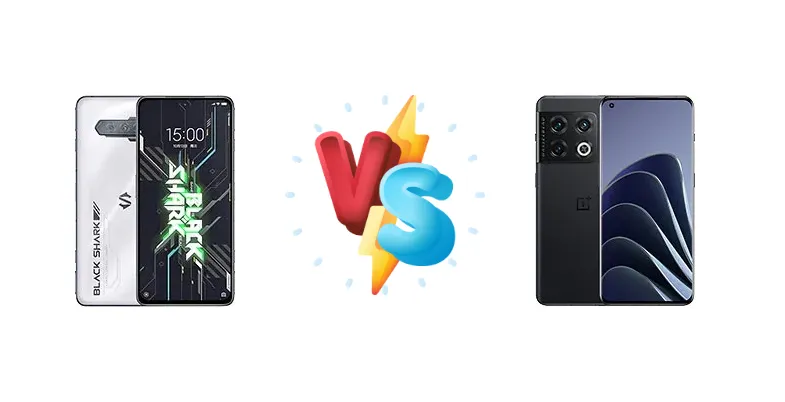
|
🏆 Quick Verdict
For dedicated mobile gamers prioritizing raw performance and ultra-fast charging, the Xiaomi Black Shark 4S is the clear winner. However, the OnePlus 10 Pro offers a more polished, all-around experience with a superior display, more versatile camera system, and longer-term software support, making it the better choice for the average user.
| PHONES | ||
|---|---|---|
| Phone Names | Xiaomi Black Shark 4S | OnePlus 10 Pro |
| Network | ||
|---|---|---|
| 2G bands | GSM 850 / 900 / 1800 / 1900 | GSM 850 / 900 / 1800 / 1900 |
| 3G bands | HSDPA 800 / 850 / 900 / 1700(AWS) / 1900 / 2100 | HSDPA 800 / 850 / 900 / 1700(AWS) / 1900 / 2100 |
| 4G bands | 1, 2, 3, 4, 5, 7, 8, 18, 19, 20, 26, 28, 34, 38, 39, 40, 41 | 1, 2, 3, 4, 5, 7, 8, 12, 13, 17, 18, 19, 20, 25, 26, 28, 30, 32, 38, 39, 40, 41, 46, 48, 66, 71 - International |
| 5G bands | 1, 3, 8, 28, 41, 77, 78 SA/NSA | 1, 2, 3, 5, 7, 8, 20, 25, 28, 30, 38, 40, 41, 48, 66, 71, 77, 78 SA/NSA - International |
| Speed | HSPA, LTE, 5G | HSPA 42.2/5.76 Mbps, LTE (4CA) Cat18 1200/200 Mbps, 5G |
| Technology | GSM / CDMA / HSPA / EVDO / LTE / 5G | GSM / CDMA / HSPA / EVDO / LTE / 5G |
| CDMA2000 1xEV-DO | 1, 3, 5, 8, 28, 40, 41, 78, 79 SA/NSA - India | |
| Launch | ||
|---|---|---|
| Announced | 2021, October 13 | 2022, January 11 |
| Status | Available. Released 2021, October 16 | Available. Released 2022, January 13 |
| Body | ||
|---|---|---|
| Build | - | Glass front (Gorilla Glass Victus), glass back (Gorilla Glass 5), aluminum frame |
| Dimensions | 163.7 x 76.2 x 9.9 mm (6.44 x 3.00 x 0.39 in) | 163 x 73.9 x 8.6 mm (6.42 x 2.91 x 0.34 in) |
| SIM | Nano-SIM + Nano-SIM | · Nano-SIM· Nano-SIM + Nano-SIM |
| Weight | 210 g (7.41 oz) | 201 g (7.09 oz) |
| Physical pop-up gaming triggers | IP68 dust/water resistant - T-Mobile only (not for use underwater, liquid damage is not covered under warranty) | |
| Display | ||
|---|---|---|
| Protection | - | Corning Gorilla Glass Victus |
| Resolution | 1080 x 2400 pixels, 20:9 ratio (~395 ppi density) | 1440 x 3216 pixels, 20:9 ratio (~525 ppi density) |
| Size | 6.67 inches, 107.4 cm2 (~86.1% screen-to-body ratio) | 6.7 inches, 108.4 cm2 (~90.0% screen-to-body ratio) |
| Type | Super AMOLED, 144Hz, HDR10+, 1300 nits (peak) | LTPO2 Fluid AMOLED, 1B colors, 120Hz, HDR10+, 500 nits (typ), 800 nits (HBM), 1300 nits (peak) |
| Always-on display | Always-on display | |
| Platform | ||
|---|---|---|
| CPU | Octa-core (1x3.2 GHz Kryo 585 & 3x2.42 GHz Kryo 585 & 4x1.80 GHz Kryo 585) | Octa-core (1x3.00 GHz Cortex-X2 & 3x2.50 GHz Cortex-A710 & 4x1.80 GHz Cortex-A510) |
| Chipset | Qualcomm SM8250-AC Snapdragon 870 5G (7 nm) | Qualcomm SM8450 Snapdragon 8 Gen 1 (4 nm) |
| GPU | Adreno 650 | Adreno 730 |
| OS | Android 11, Joy UI 12.8 | Android 12, upgradable to Android 14, OxygenOS 14 (International), ColorOS (China) |
| Memory | ||
|---|---|---|
| Card slot | No | No |
| Internal | 128GB 8GB RAM, 128GB 12GB RAM, 256GB 12GB RAM | 128GB 8GB RAM, 256GB 8GB RAM, 256GB 12GB RAM, 512GB 12GB RAM |
| UFS 3.1 | UFS 3.1 | |
| Main Camera | ||
|---|---|---|
| Features | LED flash, HDR, panorama | Laser AF, color spectrum sensor, Hasselblad Color Calibration, Dual-LED dual-tone flash, HDR, panorama |
| Single | 20 MP, f/2.0, (wide), 0.8µm | 32 MP, f/2.2, (wide), 1/2.74", 0.8µm |
| Triple | 48 MP, f/1.8, (wide), 1/2.0", 0.8µm, PDAF 8 MP, f/2.2, 120˚ (ultrawide), 1/4.0", 1.12µm 5 MP (macro), AF | 48 MP, f/1.8, 23mm (wide), 1/1.43", 1.12µm, multi-directional PDAF, OIS 8 MP, f/2.4, 77mm (telephoto), 1.0µm, PDAF, OIS, 3.3x optical zoom 50 MP, f/2.2, 14mm, 150˚ (ultrawide), 1/2.76", 0.64µm |
| Video | 4K@30/60fps, 1080p@30/60/240fps, 1080p@960fps | 8K@24fps, 4K@30/60/120fps, 1080p@30/60/240fps, Auto HDR, gyro-EIS |
| Selfie camera | ||
|---|---|---|
| Features | HDR | HDR |
| Single | 20 MP, f/2.0, (wide), 0.8µm | 32 MP, f/2.2, (wide), 1/2.74", 0.8µm |
| Video | 1080p@30fps | 1080p@30fps, gyro-EIS |
| Sound | ||
|---|---|---|
| 3.5mm jack | Yes | No |
| 35mm jack | Yes | No |
| Loudspeaker | Yes, with stereo speakers | Yes, with stereo speakers |
| 24-bit/192kHz audio | 24-bit/192kHz audio | |
| Comms | ||
|---|---|---|
| Bluetooth | 5.2, A2DP, LE, aptX HD, aptX Adaptive | 5.2, A2DP, LE, aptX HD |
| NFC | Yes | Yes |
| Positioning | GPS, GLONASS, GALILEO, QZSS, BDS | GPS (L1+L5), GLONASS (G1), BDS (B1), GALILEO (E1+E5a) |
| Radio | No | No |
| USB | USB Type-C 2.0 | USB Type-C 3.1, OTG |
| WLAN | Wi-Fi 802.11 a/b/g/n/ac/6, dual-band, Wi-Fi Direct | Wi-Fi 802.11 a/b/g/n/ac/6, dual-band, Wi-Fi Direct |
| Features | ||
|---|---|---|
| Sensors | Fingerprint (side-mounted), accelerometer, gyro, proximity, compass, barometer | Fingerprint (under display, optical), accelerometer, gyro, proximity, compass, barometer |
| Battery | ||
|---|---|---|
| Charging | 120W wired, 100% in 17 min | 80W wired, PD, 100% in 32 min (International) 65W wired, PD, 58% in 15 min (North America) 50W wireless Reverse wireless |
| Type | Li-Po 4500 mAh | Li-Po 5000 mAh |
| Misc | ||
|---|---|---|
| Colors | Black, White | Volcanic Black, Emerald Forest, Panda White (Extreme Edition) |
| Models | - | NE2210, NE2211, NE2213, NE2215, NE2217 |
| Price | About 360 EUR | $ 264.39 / C$ 349.99 / £ 360.00 / € 399.99 |
| SAR | - | 1.16 W/kg (head) 0.70 W/kg (body) |
| Tests | ||
|---|---|---|
| Battery life | - | Endurance rating 107h |
| Camera | - | Photo / Video |
| Display | - | Contrast ratio: Infinite (nominal) |
| Loudspeaker | - | -25.2 LUFS (Very good) |
| Performance | - | AnTuTu: 886248 (v9) GeekBench: 3447 (v5.1) GFXBench: 48fps (ES 3.1 onscreen) |
Xiaomi Black Shark 4S
- Ultra-fast 120W charging
- Strong gaming performance with Snapdragon 870
- Potentially more affordable price point
- Likely less refined camera system
- Potentially shorter software support lifecycle
OnePlus 10 Pro
- Superior display quality and brightness
- More versatile and higher-quality camera system
- Longer battery life and wireless charging
- Refined software experience and longer support
- Slower charging speeds (especially in North America)
- Higher price point
Display Comparison
The OnePlus 10 Pro boasts a brighter display, reaching a measured 780 nits, compared to an unspecified brightness for the Black Shark 4S. While the Black Shark 4S likely offers a high refresh rate suitable for gaming, the OnePlus 10 Pro’s display benefits from a contrast ratio described as 'Infinite (nominal)', suggesting excellent black levels. The OnePlus 10 Pro’s display technology is likely LTPO, enabling variable refresh rates for improved efficiency, a feature not confirmed on the Black Shark 4S. This makes the OnePlus 10 Pro the better choice for outdoor visibility and media consumption.
Camera Comparison
Both phones feature photo/video capabilities, but details are limited. The OnePlus 10 Pro likely benefits from Hasselblad color calibration and a more sophisticated image processing pipeline. Without specific sensor details for the Black Shark 4S, it’s reasonable to assume the OnePlus 10 Pro offers a more versatile and higher-quality camera experience, particularly in low-light conditions. The OnePlus 10 Pro’s camera system is expected to include OIS, a feature likely present on the main sensor of the Black Shark 4S, but potentially absent on other lenses.
Performance
The OnePlus 10 Pro’s Snapdragon 8 Gen 1 (4nm) represents a significant architectural leap over the Black Shark 4S’s Snapdragon 870 (7nm). The Gen 1 features the Cortex-X2 prime core clocked at 3.00 GHz, offering higher peak performance than the 870’s Kryo 585 at 3.2 GHz. However, the 870’s efficiency is noteworthy. The OnePlus 10 Pro’s 4nm process should deliver better thermal efficiency, but the 870 is known for sustained performance. The OnePlus 10 Pro’s LPDDR5 RAM is standard for flagships, while the Black Shark 4S’s RAM specification is unknown, but likely similar. Gamers will see a performance uplift on the OnePlus 10 Pro, but the Black Shark 4S remains a capable performer.
Battery Life
The OnePlus 10 Pro achieves a 107-hour endurance rating, suggesting excellent battery life. While the Black Shark 4S’s battery capacity is unknown, its 120W wired charging is significantly faster than the OnePlus 10 Pro’s 80W (International) or 65W (North America) charging. The Black Shark 4S can reach 100% charge in just 17 minutes, while the OnePlus 10 Pro takes 32 minutes (International). The OnePlus 10 Pro also offers 50W wireless and reverse wireless charging, features absent on the Black Shark 4S. The Black Shark 4S prioritizes charging speed, while the OnePlus 10 Pro balances charging speed with overall battery endurance.
Buying Guide
Buy the Xiaomi Black Shark 4S if you need uncompromising gaming performance, prioritize the fastest possible charging speeds (120W), and are willing to trade off camera versatility and software polish. Buy the OnePlus 10 Pro if you prefer a premium display, a more refined camera experience, longer battery life, and a smoother, more consistent software experience, even if it means sacrificing some raw gaming horsepower.