
Black Shark 4S vs Asus ROG Phone 5s: Which Gaming Phone Delivers the Best Performance?
| Phones Images | |||||
|---|---|---|---|---|---|
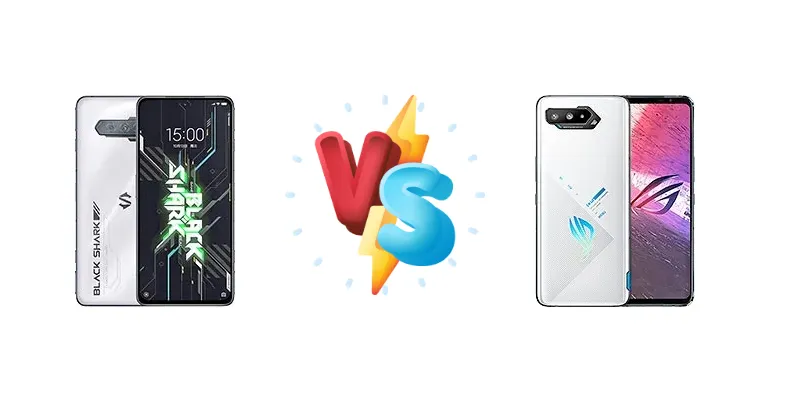
|
🏆 Quick Verdict
For the average gamer prioritizing raw performance and the fastest charging, the Asus ROG Phone 5s is the clear winner. Its Snapdragon 888+ offers a noticeable performance uplift over the Black Shark 4S’s Snapdragon 870, despite a slower charging speed. However, the Black Shark 4S remains a compelling option for budget-conscious gamers.
| PHONES | ||
|---|---|---|
| Phone Names | Xiaomi Black Shark 4S | Asus ROG Phone 5s |
| Network | ||
|---|---|---|
| 2G bands | GSM 850 / 900 / 1800 / 1900 | GSM 850 / 900 / 1800 / 1900 |
| 3G bands | HSDPA 800 / 850 / 900 / 1700(AWS) / 1900 / 2100 | HSDPA 800 / 850 / 900 / 1700(AWS) / 1800 / 1900 / 2100 - Version 1 |
| 4G bands | 1, 2, 3, 4, 5, 7, 8, 18, 19, 20, 26, 28, 34, 38, 39, 40, 41 | 1, 2, 3, 4, 5, 7, 8, 12, 13, 17, 18, 19, 20, 25, 26, 28, 29, 30, 32, 34, 38, 39, 40, 41, 42, 48, 66, 71 - Version 1 |
| 5G bands | 1, 3, 8, 28, 41, 77, 78 SA/NSA | 1, 2, 3, 5, 7, 8, 12, 20, 25, 28, 38, 40, 41, 66, 71, 77, 78, 79 SA/NSA - Version 1 |
| Speed | HSPA, LTE, 5G | HSPA 42.2/5.76 Mbps, LTE (7CA) Cat20 1400/150 Mbps, 5G 4 Gbps DL |
| Technology | GSM / CDMA / HSPA / EVDO / LTE / 5G | GSM / HSPA / LTE / 5G |
| CDMA2000 1xEV-DO | 2, 3, 5, 7, 12, 20, 25, 28, 38, 40, 66, 71, 77, 78, 79 SA/NSA - Version 4 | |
| Launch | ||
|---|---|---|
| Announced | 2021, October 13 | 2021, August 16 |
| Status | Available. Released 2021, October 16 | Available. Released 2021, August 26 |
| Body | ||
|---|---|---|
| Build | - | Glass front (Gorilla Glass Victus), glass back (Gorilla Glass 3), aluminum frame |
| Dimensions | 163.7 x 76.2 x 9.9 mm (6.44 x 3.00 x 0.39 in) | 172.8 x 77.3 x 9.9 mm (6.80 x 3.04 x 0.39 in) |
| SIM | Nano-SIM + Nano-SIM | Nano-SIM + Nano-SIM |
| Weight | 210 g (7.41 oz) | 238 g (8.40 oz) |
| Physical pop-up gaming triggers | RGB light panel (on the back) Pressure sensitive zones (Gaming triggers) | |
| Display | ||
|---|---|---|
| Protection | - | Corning Gorilla Glass Victus |
| Resolution | 1080 x 2400 pixels, 20:9 ratio (~395 ppi density) | 1080 x 2448 pixels (~395 ppi density) |
| Size | 6.67 inches, 107.4 cm2 (~86.1% screen-to-body ratio) | 6.78 inches, 109.5 cm2 (~82.0% screen-to-body ratio) |
| Type | Super AMOLED, 144Hz, HDR10+, 1300 nits (peak) | AMOLED, 1B colors, 144Hz, HDR10+, 800 nits (typ), 1200 nits (peak) |
| Always-on display | - | |
| Platform | ||
|---|---|---|
| CPU | Octa-core (1x3.2 GHz Kryo 585 & 3x2.42 GHz Kryo 585 & 4x1.80 GHz Kryo 585) | Octa-core (1x2.99 GHz Cortex-X1 & 3x2.42 GHz Cortex-A78 & 4x1.80 GHz Cortex-A55) |
| Chipset | Qualcomm SM8250-AC Snapdragon 870 5G (7 nm) | Qualcomm SM8350 Snapdragon 888+ 5G (5 nm) |
| GPU | Adreno 650 | Adreno 660 |
| OS | Android 11, Joy UI 12.8 | Android 11, upgradable to Android 13, ROG UI |
| Memory | ||
|---|---|---|
| Card slot | No | No |
| Internal | 128GB 8GB RAM, 128GB 12GB RAM, 256GB 12GB RAM | 128GB 8GB RAM, 128GB 12GB RAM, 256GB 12GB RAM, 256GB 16GB RAM, 512GB 16GB RAM, 512GB 18GB RAM |
| UFS 3.1 | UFS 3.1 | |
| Main Camera | ||
|---|---|---|
| Features | LED flash, HDR, panorama | LED flash, HDR, panorama |
| Single | 20 MP, f/2.0, (wide), 0.8µm | - |
| Triple | 48 MP, f/1.8, (wide), 1/2.0", 0.8µm, PDAF 8 MP, f/2.2, 120˚ (ultrawide), 1/4.0", 1.12µm 5 MP (macro), AF | 64 MP, f/1.8, 26mm (wide), 1/1.73", 0.8µm, PDAF 13 MP, f/2.4, 11mm, 125˚ (ultrawide) 5 MP (macro) |
| Video | 4K@30/60fps, 1080p@30/60/240fps, 1080p@960fps | 8K@30fps, 4K@30/60/120fps, 1080p@30/60/120/240fps, 720p@480fps; gyro-EIS |
| Selfie camera | ||
|---|---|---|
| Features | HDR | Panorama, HDR |
| Single | 20 MP, f/2.0, (wide), 0.8µm | 24 MP, f/2.5, 27mm (wide), 0.9µm |
| Video | 1080p@30fps | 1080p@30fps |
| Sound | ||
|---|---|---|
| 3.5mm jack | Yes | Yes |
| 35mm jack | Yes | Yes |
| Loudspeaker | Yes, with stereo speakers | Yes, with stereo speakers (2 amplifiers) |
| 24-bit/192kHz audio | 24-bit/192kHz audio | |
| Comms | ||
|---|---|---|
| Bluetooth | 5.2, A2DP, LE, aptX HD, aptX Adaptive | 5.2, A2DP, LE, aptX HD, aptX Adaptive |
| NFC | Yes | Yes |
| Positioning | GPS, GLONASS, GALILEO, QZSS, BDS | GPS (L1+L5), GLONASS (L1), BDS (B1I+B1c+B2a), GALILEO (E1+E5a), QZSS (L1+L5), NavIC (L5) |
| Radio | No | No |
| USB | USB Type-C 2.0 | USB Type-C 3.1 (side), USB Type-C 2.0 (bottom), OTG, accessory connector |
| WLAN | Wi-Fi 802.11 a/b/g/n/ac/6, dual-band, Wi-Fi Direct | Wi-Fi 802.11 a/b/g/n/ac/6e, dual-band, Wi-Fi Direct |
| Features | ||
|---|---|---|
| Sensors | Fingerprint (side-mounted), accelerometer, gyro, proximity, compass, barometer | Fingerprint (under display, optical), accelerometer, gyro, proximity, compass |
| Battery | ||
|---|---|---|
| Charging | 120W wired, 100% in 17 min | 65W wired, PD3.0, QC5, 70% in 30 min, 100% in 52 min 10W reverse wired |
| Type | Li-Po 4500 mAh | Li-Po 6000 mAh |
| Misc | ||
|---|---|---|
| Colors | Black, White | Phantom Black, Storm White |
| Models | - | ZS676KS |
| Price | About 360 EUR | About 1030 EUR |
Xiaomi Black Shark 4S
- Incredibly fast 120W charging
- More affordable price point
- Solid Snapdragon 870 performance
- Snapdragon 870 is less powerful than the 888+
- Potentially less refined software experience
Asus ROG Phone 5s
- More powerful Snapdragon 888+ processor
- Likely superior thermal management
- Potentially better camera performance
- Slower 65W charging
- Higher price tag
Display Comparison
While both phones likely feature high-refresh-rate AMOLED displays (data not provided), the core difference lies in the processing power driving them. The Snapdragon 888+ in the ROG Phone 5s will deliver smoother performance in graphically intensive games, maximizing the benefit of a high refresh rate. The Black Shark 4S, while capable, will be more reliant on optimization to maintain consistent frame rates. The 5nm process of the 888+ also contributes to better thermal efficiency, potentially reducing screen dimming during extended gaming sessions.
Camera Comparison
Neither phone is primarily marketed for its camera capabilities, but the ROG Phone 5s likely benefits from a more advanced image signal processor (ISP) integrated within the Snapdragon 888+. While sensor sizes and lens apertures aren't specified, the ROG Phone 5s’s processor will likely deliver better image processing, particularly in low-light conditions. The Black Shark 4S will still be capable of taking acceptable photos, but the ROG Phone 5s offers a potential edge in image quality.
Performance
The Asus ROG Phone 5s boasts the Qualcomm SM8350 Snapdragon 888+ 5G (5 nm), a significant upgrade over the Black Shark 4S’s SM8250 Snapdragon 870 5G (7 nm). The 888+ features a Cortex-X1 prime core clocked at 2.99 GHz, offering a performance advantage over the Kryo 585 prime core in the 870. This translates to faster loading times, higher sustained frame rates, and improved multitasking. While both utilize octa-core configurations, the architectural improvements in the 888+ provide a tangible benefit for demanding applications. The 5nm process node of the 888+ also contributes to improved power efficiency, potentially leading to longer gaming sessions before thermal throttling.
Battery Life
The Black Shark 4S’s 120W wired charging is a standout feature, achieving a full charge in just 17 minutes. This is significantly faster than the ROG Phone 5s’s 65W charging, which takes 52 minutes for a full charge. However, the ROG Phone 5s supports PD3.0 and QC5 standards, offering broader compatibility. While battery capacity isn't specified, the faster charging of the Black Shark 4S mitigates any potential disadvantage from a smaller battery size, allowing for quicker top-ups during short breaks.
Buying Guide
Buy the Xiaomi Black Shark 4S if you need a high-refresh-rate gaming experience on a tighter budget and value incredibly fast 120W charging. It’s ideal for gamers who don’t necessarily demand the absolute highest frame rates in the most demanding titles. Buy the Asus ROG Phone 5s if you prefer a more powerful processor for consistently higher frame rates, a more polished software experience, and don't mind a slightly longer charging time. This is the phone for competitive gamers and those who want future-proofing.