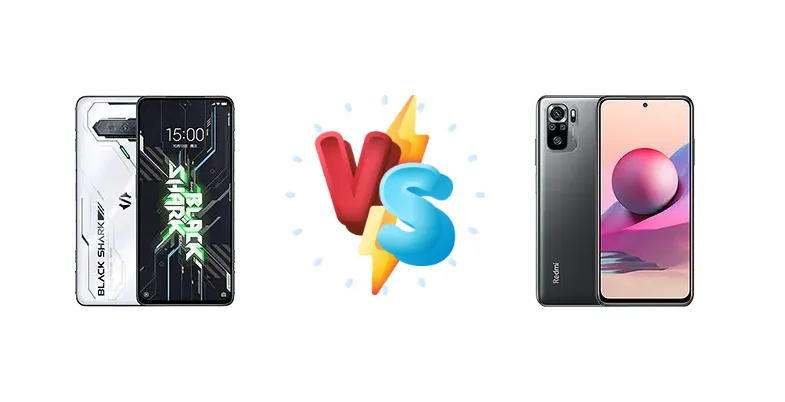
Choosing a new smartphone can be overwhelming, especially with so many options available. Today, we're pitting two Xiaomi contenders against each other: the gaming-focused Black Shark 4S Pro and the budget-friendly Redmi Note 10S. Let's dive into a detailed comparison to see which one comes out on top.
🏆 Quick Verdict
The Black Shark 4S Pro is the clear winner for performance and charging speed, thanks to its Snapdragon 888+ and 120W charging. However, the Redmi Note 10S offers excellent value for money with a decent camera and respectable battery life, making it a strong contender for budget-conscious buyers.
| Network |
|---|
| 2G bands | GSM 850 / 900 / 1800 / 1900 | GSM 850 / 900 / 1800 / 1900 |
| 3G bands | HSDPA 800 / 850 / 900 / 1700(AWS) / 1900 / 2100 | HSDPA 850 / 900 / 1700(AWS) / 1900 / 2100 |
| 4G bands | 1, 2, 3, 4, 5, 7, 8, 18, 19, 20, 26, 28, 34, 38, 39, 40, 41 | 1, 2, 3, 4, 5, 7, 8, 20, 28, 38, 40, 41 |
| 5G bands | 1, 3, 8, 28, 41, 77, 78, 79 SA/NSA | - |
| Speed | HSPA, LTE, 5G | HSPA, LTE |
| Technology | GSM / CDMA / HSPA / EVDO / LTE / 5G | GSM / HSPA / LTE |
| | CDMA2000 1xEV-DO | - |
| Launch |
|---|
| Announced | 2021, October 13 | 2021, March 04 |
| Status | Available. Released 2021, October 16 | Available. Released 2021, April 28 |
| Body |
|---|
| Dimensions | 163.7 x 76.2 x 9.9 mm (6.44 x 3.00 x 0.39 in) | 160.5 x 74.5 x 8.3 mm (6.32 x 2.93 x 0.33 in) |
| SIM | Nano-SIM + Nano-SIM | Nano-SIM + Nano-SIM |
| Weight | 220 g (7.76 oz) | 178.8 g (6.31 oz) |
| | Physical pop-up gaming triggers | IP53, dust and splash resistant |
| Display |
|---|
| Protection | - | Corning Gorilla Glass 3 |
| Resolution | 1080 x 2400 pixels, 20:9 ratio (~395 ppi density) | 1080 x 2400 pixels, 20:9 ratio (~409 ppi density) |
| Size | 6.67 inches, 107.4 cm2 (~86.1% screen-to-body ratio) | 6.43 inches, 99.8 cm2 (~83.5% screen-to-body ratio) |
| Type | Super AMOLED, 144Hz, HDR10+, 1300 nits (peak) | AMOLED, 450 nits (typ), 1100 nits (peak) |
| | Always-on display | - |
| Platform |
|---|
| CPU | Octa-core (1x3.0 GHz Cortex-X1 & 3x2.42 GHz Cortex-A78 & 4x1.80 GHz Cortex-A55) | Octa-core (2x2.05 GHz Cortex-A76 & 6x2.0 GHz Cortex-A55) |
| Chipset | Qualcomm SM8350 Snapdragon 888+ 5G (5 nm) | Mediatek MT6785V/CD Helio G95 (12 nm) |
| GPU | Adreno 660 | Mali-G76 MC4 |
| OS | Android 11, Joy UI 12.8 | Android 11, upgradable to Android 13, MIUI 14 |
| Memory |
|---|
| Card slot | No | microSDXC (dedicated slot) |
| Internal | 256GB 8GB RAM, 256GB 12GB RAM, 512GB 16GB RAM | 64GB 4GB RAM, 64GB 6GB RAM, 128GB 4GB RAM, 128GB 6GB RAM, 128GB 8GB RAM |
| | UFS 3.1 | UFS 2.2 |
| Main Camera |
|---|
| Features | LED flash, HDR, panorama | LED flash, HDR, panorama |
| Quad | - | 64 MP, f/1.8, 26mm (wide), 1/1.97", 0.7µm, PDAF
8 MP, f/2.2, 118˚ (ultrawide), 1/4.0", 1.12µm
2 MP (macro)
Auxiliary lens |
| Single | 20 MP, f/2.5, (wide), 0.8µm | 13 MP, f/2.5, (wide), 1/3.06", 1.12µm |
| Triple | 64 MP, f/1.8, (wide), 1/1.97", 0.7µm, PDAF
8 MP, f/2.2, 120˚ (ultrawide), 1/4.0", 1.12µm
5 MP (macro), AF | - |
| Video | 4K@30/60fps, 1080p@30/60/240fps, 1080p@960fps; HDR10+ | 4K@30fps, 1080p@30/60/120fps, 720p@960fps |
| Selfie camera |
|---|
| Features | HDR | HDR |
| Single | 20 MP, f/2.5, (wide), 0.8µm | 13 MP, f/2.5, (wide), 1/3.06", 1.12µm |
| Video | 1080p@30fps | 1080p@30fps |
| Sound |
|---|
| 3.5mm jack | Yes | Yes |
| 35mm jack | Yes | Yes |
| Loudspeaker | Yes, with stereo speakers | Yes, with stereo speakers |
| | 24-bit/192kHz audio | 24-bit/192kHz audio |
| Comms |
|---|
| Bluetooth | 5.2, A2DP, LE, aptX HD, aptX Adaptive | 5.1, A2DP, LE |
| Infrared port | - | Yes |
| NFC | Yes | Yes (market/region dependent) |
| Positioning | GPS, GLONASS, GALILEO, QZSS, BDS | GPS, GLONASS, GALILEO, BDS |
| Radio | No | FM radio |
| USB | USB Type-C 2.0 | USB Type-C 2.0 |
| WLAN | Wi-Fi 802.11 a/b/g/n/ac/6, dual-band, Wi-Fi Direct | Wi-Fi 802.11 a/b/g/n/ac, dual-band, Wi-Fi Direct |
| Features |
|---|
| Sensors | Fingerprint (side-mounted), accelerometer, gyro, proximity, compass, barometer | Fingerprint (side-mounted), accelerometer, gyro, compass |
| | - | Virtual proximity sensing |
| Battery |
|---|
| Charging | 120W wired, 50% in 5 min, 100% in 15 min | 33W wired |
| Type | Li-Po 4500 mAh | Li-Po 5000 mAh |
| Misc |
|---|
| Colors | Black, White | Deep Sea Blue (Ocean Blue), Shadow Black (Onyx Gray), (Frost White) Pebble White |
| Models | - | M2101K7BG, M2101K7BI, M2101K7BNY, M2101K7BL |
| Price | About 650 EUR | € 101.48 / £ 135.82 / ₹ 13,999 |
| SAR | - | 1.07 W/kg (head) 0.81 W/kg (body) |
| SAR EU | - | 0.60 W/kg (head) 0.90 W/kg (body) |
Xiaomi Black Shark 4S Pro
- Exceptional Performance
- Blazing-Fast 120W Charging
- High Refresh Rate AMOLED Display
- Dedicated Gaming Features (Triggers)
- Higher Price
- Less Versatile Camera System Compared to Redmi Note 10S
- Bulky Design
Xiaomi Redmi Note 10S
- Excellent Value for Money
- Versatile Quad-Camera System
- Good Battery Life
- Sleek and Lightweight Design
- Lower Performance
- Slower Charging Speed
- Less Ideal for Demanding Games
Display Comparison
The Black Shark 4S Pro boasts a 144Hz AMOLED display, offering vibrant colors and incredibly smooth scrolling. The Redmi Note 10S features a 120Hz AMOLED display, also providing a good viewing experience, but lacks the peak brightness and responsiveness of the Black Shark. The Black Shark's display is generally considered superior for gaming.
Camera Comparison
The Redmi Note 10S has a quad-camera setup (108MP main, 8MP ultrawide, 2MP macro, 2MP depth), offering versatility. The Black Shark 4S Pro has a triple camera (108MP main, 13MP ultrawide, 5MP macro). While both take decent photos, the Redmi Note 10S's higher resolution main sensor often captures more detail, especially in good lighting. Low-light performance is comparable.
Performance
Here's where the Black Shark 4S Pro truly shines. The Snapdragon 888+ is a powerhouse, easily handling demanding games and multitasking. The Redmi Note 10S's Helio G95 is capable for everyday tasks, but struggles with graphically intensive games. The difference in performance is significant.
Battery Life
The Black Shark 4S Pro's 120W charging is a game-changer, allowing for incredibly fast charging times. The Redmi Note 10S's 33W charging is respectable, but significantly slower. Both phones have similar battery capacities (around 4500mAh), but the Black Shark's charging advantage makes it more convenient.
Buying Guide
The Xiaomi Black Shark 4S Pro is ideal for mobile gamers and power users who demand top-tier performance and lightning-fast charging. The Xiaomi Redmi Note 10S is perfect for everyday users seeking a reliable phone with a good camera and long battery life without breaking the bank.
Frequently Asked Questions
❓ Is the Black Shark 4S Pro worth the extra money?
If you're a serious mobile gamer or need top-tier performance, the Black Shark 4S Pro's extra cost is justified. Otherwise, the Redmi Note 10S offers excellent value.
❓ Which phone has better battery life?
While both have similar battery capacities, the Black Shark 4S Pro's incredibly fast charging makes it more convenient overall.