
Xiaomi Black Shark 4S Pro vs Redmi K40 Pro: The Ultimate Showdown
| Phones Images | |||||
|---|---|---|---|---|---|
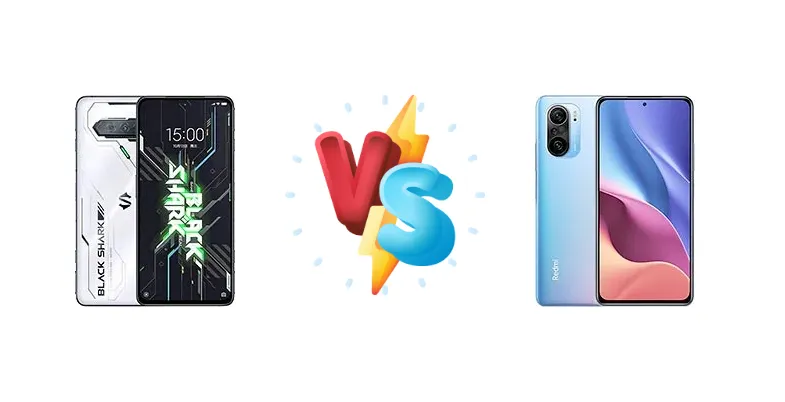
|
🏆 Quick Verdict
The Black Shark 4S Pro is the clear winner for gamers, thanks to its superior cooling, 120W charging, and gaming-centric features. However, the Redmi K40 Pro offers exceptional value with a great display, capable camera, and faster charging for a significantly lower price.
| PHONES | ||
|---|---|---|
| Phone Names | Xiaomi Black Shark 4S Pro | Xiaomi Redmi K40 Pro |
| Network | ||
|---|---|---|
| 2G bands | GSM 850 / 900 / 1800 / 1900 | GSM 850 / 900 / 1800 / 1900 |
| 3G bands | HSDPA 800 / 850 / 900 / 1700(AWS) / 1900 / 2100 | HSDPA 850 / 900 / 1700(AWS) / 1900 / 2100 |
| 4G bands | 1, 2, 3, 4, 5, 7, 8, 18, 19, 20, 26, 28, 34, 38, 39, 40, 41 | 1, 2, 3, 4, 5, 7, 8, 12, 17, 18, 19, 20, 26, 28, 34, 38, 39, 40, 41, 42 |
| 5G bands | 1, 3, 8, 28, 41, 77, 78, 79 SA/NSA | 1, 3, 28, 41, 77, 78 SA/NSA/Sub6 |
| Speed | HSPA, LTE, 5G | HSPA, LTE, 5G |
| Technology | GSM / CDMA / HSPA / EVDO / LTE / 5G | GSM / CDMA / HSPA / CDMA2000 / LTE / 5G |
| CDMA2000 1xEV-DO | CDMA2000 1x | |
| Launch | ||
|---|---|---|
| Announced | 2021, October 13 | 2021, February 25 |
| Status | Available. Released 2021, October 16 | Available. Released 2021, March 04 |
| Body | ||
|---|---|---|
| Dimensions | 163.7 x 76.2 x 9.9 mm (6.44 x 3.00 x 0.39 in) | 163.7 x 76.4 x 7.8 mm (6.44 x 3.01 x 0.31 in) |
| SIM | Nano-SIM + Nano-SIM | Nano-SIM + Nano-SIM |
| Weight | 220 g (7.76 oz) | 196 g (6.91 oz) |
| Physical pop-up gaming triggers | IP53, dust and splash resistant | |
| Display | ||
|---|---|---|
| Protection | - | Corning Gorilla Glass 5 |
| Resolution | 1080 x 2400 pixels, 20:9 ratio (~395 ppi density) | 1080 x 2400 pixels, 20:9 ratio (~395 ppi density) |
| Size | 6.67 inches, 107.4 cm2 (~86.1% screen-to-body ratio) | 6.67 inches, 107.4 cm2 (~85.9% screen-to-body ratio) |
| Type | Super AMOLED, 144Hz, HDR10+, 1300 nits (peak) | Super AMOLED, 120Hz, HDR10+, 1300 nits (peak) |
| Always-on display | - | |
| Platform | ||
|---|---|---|
| CPU | Octa-core (1x3.0 GHz Cortex-X1 & 3x2.42 GHz Cortex-A78 & 4x1.80 GHz Cortex-A55) | Octa-core (1x2.84 GHz Cortex-X1 & 3x2.42 GHz Cortex-A78 & 4x1.80 GHz Cortex-A55) |
| Chipset | Qualcomm SM8350 Snapdragon 888+ 5G (5 nm) | Qualcomm SM8350 Snapdragon 888 5G (5 nm) |
| GPU | Adreno 660 | Adreno 660 |
| OS | Android 11, Joy UI 12.8 | Android 11, MIUI 12 |
| Memory | ||
|---|---|---|
| Card slot | No | No |
| Internal | 256GB 8GB RAM, 256GB 12GB RAM, 512GB 16GB RAM | 128GB 6GB RAM, 128GB 8GB RAM, 256GB 8GB RAM, 256GB 12GB RAM |
| UFS 3.1 | UFS 3.1 | |
| Main Camera | ||
|---|---|---|
| Features | LED flash, HDR, panorama | Color spectrum sensor, LED flash, HDR, panorama |
| Single | 20 MP, f/2.5, (wide), 0.8µm | 20 MP, f/2.5, (wide), 1/3.4", 0.8µm |
| Triple | 64 MP, f/1.8, (wide), 1/1.97", 0.7µm, PDAF 8 MP, f/2.2, 120˚ (ultrawide), 1/4.0", 1.12µm 5 MP (macro), AF | 64 MP, f/1.9, 26mm (wide), 1/1.7", 0.8µm, PDAF 8 MP, f/2.2, 119˚ (ultrawide) 5 MP, f/2.4, 50mm (macro) |
| Video | 4K@30/60fps, 1080p@30/60/240fps, 1080p@960fps; HDR10+ | 8K@30fps, 4K@30/60fps, 1080p@30/60/120/240/960fps, gyro-EIS, HDR10+ |
| Selfie camera | ||
|---|---|---|
| Features | HDR | HDR |
| Single | 20 MP, f/2.5, (wide), 0.8µm | 20 MP, f/2.5, (wide), 1/3.4", 0.8µm |
| Video | 1080p@30fps | 1080p@30fps, 720p@120fps |
| Sound | ||
|---|---|---|
| 3.5mm jack | Yes | No |
| 35mm jack | Yes | No |
| Loudspeaker | Yes, with stereo speakers | Yes, with stereo speakers |
| 24-bit/192kHz audio | 24-bit/192kHz audio | |
| Comms | ||
|---|---|---|
| Bluetooth | 5.2, A2DP, LE, aptX HD, aptX Adaptive | 5.2, A2DP, LE, aptX HD, aptX Adaptive |
| Infrared port | - | Yes |
| NFC | Yes | Yes |
| Positioning | GPS, GLONASS, GALILEO, QZSS, BDS | GPS (L1+L5), GLONASS (G1), BDS (B1I+B1c+B2a), GALILEO (E1+E5a), QZSS (L1+L5), NavIC (L5) |
| Radio | No | No |
| USB | USB Type-C 2.0 | USB Type-C 2.0, OTG |
| WLAN | Wi-Fi 802.11 a/b/g/n/ac/6, dual-band, Wi-Fi Direct | Wi-Fi 802.11 a/b/g/n/ac/6e, dual-band, Wi-Fi Direct |
| Features | ||
|---|---|---|
| Sensors | Fingerprint (side-mounted), accelerometer, gyro, proximity, compass, barometer | Fingerprint (side-mounted), accelerometer, gyro, proximity, compass, barometer |
| Battery | ||
|---|---|---|
| Charging | 120W wired, 50% in 5 min, 100% in 15 min | 33W wired, PD3.0, QC3, 100% in 52 min |
| Type | Li-Po 4500 mAh | Li-Po 4520 mAh |
| Misc | ||
|---|---|---|
| Colors | Black, White | Black, White, Aurora |
| Models | - | M2012K11C |
| Price | About 650 EUR | About 360 EUR |
Xiaomi Black Shark 4S Pro
- Blazing-fast 120W charging
- Superior cooling for sustained gaming
- Gaming-specific features (triggers, software)
- Powerful Snapdragon 888+
- Camera performance not as strong as Redmi K40 Pro
- Design may not appeal to everyone
- Potentially higher price
Xiaomi Redmi K40 Pro
- Excellent value for money
- High-quality AMOLED display
- Versatile and capable camera system
- Faster charging than many competitors
- Slower charging compared to Black Shark 4S Pro
- May throttle under prolonged heavy load
- Less gaming-focused features
Display Comparison
The Redmi K40 Pro typically features an AMOLED display with a 120Hz refresh rate, often boasting higher peak brightness and color accuracy than the Black Shark 4S Pro's display. While the Black Shark 4S Pro has a high refresh rate, the Redmi K40 Pro's panel often provides a more visually pleasing experience for general use.
Camera Comparison
The Redmi K40 Pro generally has a more versatile and higher-resolution camera system, often including a larger primary sensor and improved image processing. The Black Shark 4S Pro's camera is competent, but not its primary focus. Expect better low-light performance and more detailed photos from the Redmi K40 Pro.
Performance
While both phones use the Snapdragon 888 series, the Black Shark 4S Pro's enhanced cooling system allows it to sustain peak performance for longer periods, crucial for demanding games. The slightly higher clock speed on the X1 core also gives it a marginal edge. The Redmi K40 Pro performs admirably, but may throttle under extended load.
Battery Life
The Black Shark 4S Pro's 120W charging is a game-changer, allowing for incredibly fast top-ups. The Redmi K40 Pro's 33W charging is still respectable, but significantly slower. Battery capacity is likely similar, but the Black Shark 4S Pro's charging speed provides a significant advantage.
Buying Guide
Buy the Black Shark 4S Pro if you're a serious mobile gamer prioritizing performance and rapid charging. Buy the Redmi K40 Pro if you want a well-rounded flagship experience with excellent value for money, focusing on everyday use and photography.