
Xiaomi Black Shark 4S Pro vs Lenovo Legion 2 Pro: The Ultimate Gaming Phone Battle
| Phones Images | |||||
|---|---|---|---|---|---|
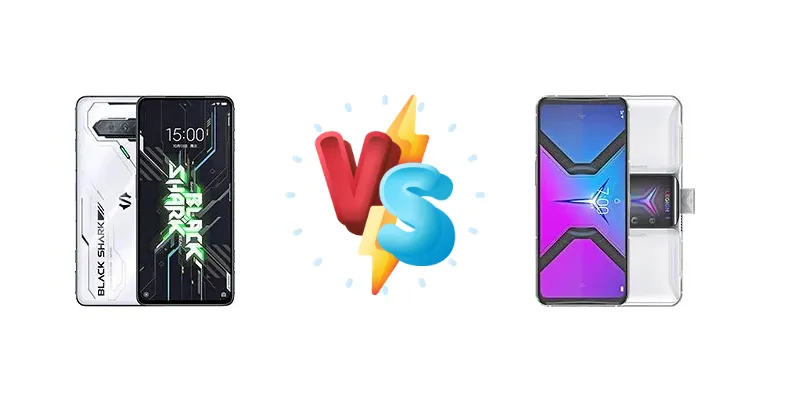
|
🏆 Quick Verdict
The Black Shark 4S Pro takes the crown thanks to its significantly faster 120W charging and slightly superior processor clock speeds. While the Legion 2 Pro offers excellent cooling and a unique dual-port charging setup, the Black Shark's raw speed and charging prowess give it the edge for serious gamers.
| PHONES | ||
|---|---|---|
| Phone Names | Xiaomi Black Shark 4S Pro | Lenovo Legion 2 Pro |
| Network | ||
|---|---|---|
| 2G bands | GSM 850 / 900 / 1800 / 1900 | GSM 850 / 900 / 1800 / 1900 |
| 3G bands | HSDPA 800 / 850 / 900 / 1700(AWS) / 1900 / 2100 | HSDPA 800 / 850 / 900 / 1900 / 2100 |
| 4G bands | 1, 2, 3, 4, 5, 7, 8, 18, 19, 20, 26, 28, 34, 38, 39, 40, 41 | 1, 2, 3, 4, 5, 7, 8, 12, 17, 18, 19, 20, 26, 34, 38, 39, 40, 41, 42, 43 |
| 5G bands | 1, 3, 8, 28, 41, 77, 78, 79 SA/NSA | 1, 3, 28, 41, 77, 78, 79 SA/NSA/Sub6 |
| Speed | HSPA, LTE, 5G | HSPA, LTE, 5G |
| Technology | GSM / CDMA / HSPA / EVDO / LTE / 5G | GSM / CDMA / HSPA / CDMA2000 / LTE / 5G |
| CDMA2000 1xEV-DO | CDMA2000 1x | |
| Launch | ||
|---|---|---|
| Announced | 2021, October 13 | 2021, April 08 |
| Status | Available. Released 2021, October 16 | Available. Released 2021, April 26 |
| Body | ||
|---|---|---|
| Build | - | Glass front (Gorilla Glass 5), glass back, aluminum frame |
| Dimensions | 163.7 x 76.2 x 9.9 mm (6.44 x 3.00 x 0.39 in) | 176 x 78.5 x 9.9 mm (6.93 x 3.09 x 0.39 in) |
| SIM | Nano-SIM + Nano-SIM | Nano-SIM + Nano-SIM |
| Weight | 220 g (7.76 oz) | 259 g (9.14 oz) |
| Physical pop-up gaming triggers | Built-in two cooling fans RGB light panel (on the back) 6 pressure sensitive zones (Gaming triggers): 4 ultrasonic buttons (top), 2 capacitive sliding buttons (back) | |
| Display | ||
|---|---|---|
| Protection | - | Corning Gorilla Glass 5 |
| Resolution | 1080 x 2400 pixels, 20:9 ratio (~395 ppi density) | 1080 x 2460 pixels (~388 ppi density) |
| Size | 6.67 inches, 107.4 cm2 (~86.1% screen-to-body ratio) | 6.92 inches, 113.7 cm2 (~82.3% screen-to-body ratio) |
| Type | Super AMOLED, 144Hz, HDR10+, 1300 nits (peak) | AMOLED, 144Hz, HDR10+, 1300 nits (peak) |
| Always-on display | - | |
| Platform | ||
|---|---|---|
| CPU | Octa-core (1x3.0 GHz Cortex-X1 & 3x2.42 GHz Cortex-A78 & 4x1.80 GHz Cortex-A55) | Octa-core (1x2.84 GHz Cortex-X1 & 3x2.42 GHz Cortex-A78 & 4x1.80 GHz Cortex-A55) |
| Chipset | Qualcomm SM8350 Snapdragon 888+ 5G (5 nm) | Qualcomm SM8350 Snapdragon 888 5G (5 nm) |
| GPU | Adreno 660 | Adreno 660 |
| OS | Android 11, Joy UI 12.8 | Android 11, Legion OS |
| Memory | ||
|---|---|---|
| Card slot | No | No |
| Internal | 256GB 8GB RAM, 256GB 12GB RAM, 512GB 16GB RAM | 128GB 8GB RAM, 128GB 12GB RAM, 256GB 12GB RAM, 512GB 16GB RAM, 512GB 18GB RAM |
| UFS 3.1 | UFS 3.1 | |
| Main Camera | ||
|---|---|---|
| Dual | - | 64 MP, f/1.9, 25mm (wide), 1/1.32", 1.0µm, PDAF 16 MP, f/2.2, 123˚, 16mm (ultrawide), 1.0µm |
| Features | LED flash, HDR, panorama | Dual-LED flash, panorama, HDR |
| Single | 20 MP, f/2.5, (wide), 0.8µm | - |
| Triple | 64 MP, f/1.8, (wide), 1/1.97", 0.7µm, PDAF 8 MP, f/2.2, 120˚ (ultrawide), 1/4.0", 1.12µm 5 MP (macro), AF | - |
| Video | 4K@30/60fps, 1080p@30/60/240fps, 1080p@960fps; HDR10+ | 8K@24fps, 4K@30/60fps, 1080p@30/60/240fps, gyro-EIS, HDR10+ rec. |
| Selfie camera | ||
|---|---|---|
| Features | HDR | HDR |
| Single | 20 MP, f/2.5, (wide), 0.8µm | Motorized pop-up 44 MP, f/2.0, 24mm (wide), 1/2.65", 1.0µm, AF |
| Video | 1080p@30fps | 4K@30/60fps, 1080p@30/60/120fps |
| Sound | ||
|---|---|---|
| 3.5mm jack | Yes | No |
| 35mm jack | Yes | No |
| Loudspeaker | Yes, with stereo speakers | Yes, with stereo speakers |
| 24-bit/192kHz audio | - | |
| Comms | ||
|---|---|---|
| Bluetooth | 5.2, A2DP, LE, aptX HD, aptX Adaptive | 5.2, A2DP, LE |
| NFC | Yes | Yes |
| Positioning | GPS, GLONASS, GALILEO, QZSS, BDS | GPS (L1+L5), GLONASS, GALILEO, BDS, QZSS |
| Radio | No | No |
| USB | USB Type-C 2.0 | Two USB Type-C (2.0 & 3.1), OTG |
| WLAN | Wi-Fi 802.11 a/b/g/n/ac/6, dual-band, Wi-Fi Direct | Wi-Fi 802.11 a/b/g/n/ac/6, dual-band, Wi-Fi Direct |
| Features | ||
|---|---|---|
| Sensors | Fingerprint (side-mounted), accelerometer, gyro, proximity, compass, barometer | Fingerprint (under display, optical), accelerometer, gyro, proximity, compass |
| Battery | ||
|---|---|---|
| Charging | 120W wired, 50% in 5 min, 100% in 15 min | 90W wired (dual USB-C ports), 50% in 12 min, 100% in 30 min 65W wired (single USB-C port) |
| Type | Li-Po 4500 mAh | Li-Po 5500 mAh |
| Misc | ||
|---|---|---|
| Colors | Black, White | Titanium White, Ultimate Black |
| Models | - | L70081 |
| Price | About 650 EUR | About 880 EUR |
Xiaomi Black Shark 4S Pro
- Blazing-fast 120W charging
- Slightly faster processor clock speeds
- High refresh rate display
- Good camera system
- Gaming-focused design may not appeal to everyone
- Cooling system not as advanced as Legion 2 Pro
Lenovo Legion 2 Pro
- Excellent cooling system
- Larger display for immersive gaming
- Dual USB-C ports for versatile charging
- Good performance
- Slower charging speeds compared to Black Shark 4S Pro
- Camera system not as impressive as Black Shark 4S Pro
Display Comparison
Both phones feature vibrant AMOLED displays with high refresh rates (144Hz on the Black Shark, 144Hz on the Legion). The Legion 2 Pro boasts a slightly larger 6.81-inch display compared to the Black Shark's 6.67-inch, offering a more immersive experience. Color accuracy and brightness are comparable, making both excellent for gaming and media consumption.
Camera Comparison
The Black Shark 4S Pro features a triple camera system (108MP main, 13MP ultrawide, 5MP macro) while the Legion 2 Pro has a dual camera setup (64MP main, 16MP ultrawide). Image quality is generally good on both, but the Black Shark's higher resolution main sensor provides more detail. Video recording capabilities are comparable.
Performance
Both are powered by the Snapdragon 888+ chipset, but the Black Shark 4S Pro has a slightly higher CPU clock speed (3.0 GHz vs 2.84 GHz on the Legion 2 Pro). In real-world gaming, both handle demanding titles with ease, but the Black Shark might exhibit marginally better frame rates in the most intensive scenarios. The Legion 2 Pro's advanced cooling system helps maintain sustained performance during extended gaming sessions.
Battery Life
The Black Shark 4S Pro's 120W charging is a game-changer, allowing for incredibly fast charging times (50% in 5 minutes, 100% in 15 minutes). The Legion 2 Pro offers 90W charging (single port) or 65W (dual port), which is still fast but significantly slower than the Black Shark. Both phones have a similar battery capacity (4500mAh), so battery life under typical usage is comparable.
Buying Guide
The Xiaomi Black Shark 4S Pro is ideal for gamers prioritizing charging speed and peak performance. The Lenovo Legion 2 Pro is a great choice for those who value advanced cooling, a larger display, and a more versatile feature set, even if it means slightly slower charging.