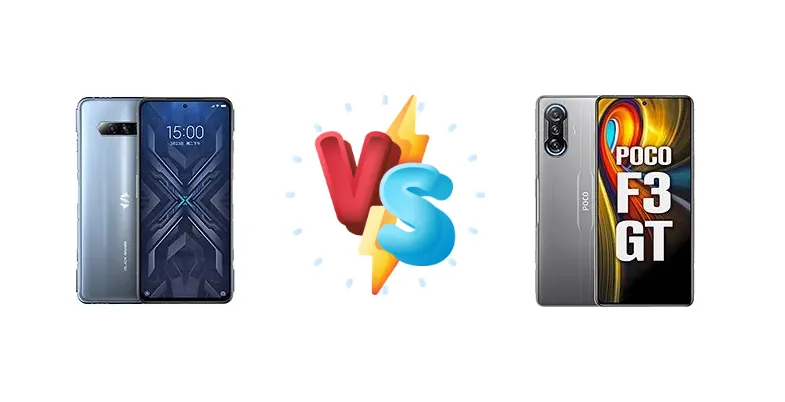
Xiaomi has aggressively targeted the gaming market with both the Black Shark and Poco sub-brands. The Black Shark 4 prioritizes sustained performance and battery life, while the Poco F3 GT aims for peak performance with a focus on rapid charging. This comparison dissects the key differences to determine which device best suits your gaming needs and budget.
🏆 Quick Verdict
For the average gamer prioritizing long play sessions and overall endurance, the Xiaomi Black Shark 4 is the better choice. Its 96-hour endurance rating and 120W charging significantly outperform the Poco F3 GT, despite the latter's slightly different chipset.
| Network |
|---|
| 2G bands | GSM 850 / 900 / 1800 / 1900 | GSM 850 / 900 / 1800 / 1900 |
| 3G bands | HSDPA 800 / 850 / 900 / 1700(AWS) / 1900 / 2100 | HSDPA 850 / 900 / 1900 / 2100 |
| 4G bands | 1, 2, 3, 4, 5, 7, 8, 18, 19, 20, 26, 28, 34, 38, 39, 40, 41 - International, China | 1, 3, 5, 8, 40, 41 |
| 5G bands | 1, 3, 8, 28, 41, 77, 78, 79 SA/NSA - China | 77, 78 SA/NSA |
| Speed | HSPA, LTE, 5G | HSPA, LTE, 5G |
| Technology | GSM / CDMA / HSPA / EVDO / LTE / 5G | GSM / HSPA / LTE / 5G |
| | CDMA2000 1xEV-DO | - |
| Launch |
|---|
| Announced | 2021, March 23 | 2021, July 23 |
| Status | Available. Released 2021, March 30 | Available. Released 2021, July 26 |
| Body |
|---|
| Build | - | Glass front (Gorilla Glass 5), glass back (Gorilla Glass 5) |
| Dimensions | 163.8 x 76.4 x 9.9 mm (6.45 x 3.01 x 0.39 in) | 161.9 x 76.9 x 8.3 mm (6.37 x 3.03 x 0.33 in) |
| SIM | Nano-SIM + Nano-SIM | Nano-SIM + Nano-SIM |
| Weight | 210 g (7.41 oz) | 205 g (7.23 oz) |
| | Physical pop-up gaming triggers | Physical pop-up gaming triggers
IP53, dust and splash resistant |
| Display |
|---|
| Protection | - | Corning Gorilla Glass 5 |
| Resolution | 1080 x 2400 pixels, 20:9 ratio (~395 ppi density) | 1080 x 2400 pixels, 20:9 ratio (~395 ppi density) |
| Size | 6.67 inches, 107.4 cm2 (~85.8% screen-to-body ratio) | 6.67 inches, 107.4 cm2 (~86.3% screen-to-body ratio) |
| Type | Super AMOLED, 144Hz, HDR10+, 1300 nits (peak) | AMOLED, 1B colors, 120Hz, HDR10+, 500 nits (typ) |
| | Always-on display | - |
| Platform |
|---|
| CPU | Octa-core (1x3.2 GHz Kryo 585 & 3x2.42 GHz Kryo 585 & 4x1.80 GHz Kryo 585) | Octa-core (1x3.0 GHz Cortex-A78 & 3x2.6 GHz Cortex-A78 & 4x2.0 GHz Cortex-A55) |
| Chipset | Qualcomm SM8250-AC Snapdragon 870 5G (7 nm) | Mediatek Dimensity 1200 (6 nm) |
| GPU | Adreno 650 | Mali-G77 MC9 |
| OS | Android 11, Joy UI 12.5 | Android 11, upgradable to Android 12, MIUI 13 for POCO |
| Memory |
|---|
| Card slot | No | No |
| Internal | 128GB 6GB RAM, 128GB 8GB RAM, 128GB 12GB RAM, 256GB 8GB RAM, 256GB 12GB RAM | 128GB 6GB RAM, 128GB 8GB RAM, 256GB 8GB RAM |
| | UFS 3.1 | UFS 3.1 |
| Main Camera |
|---|
| Features | LED flash, HDR, panorama | Dual-LED flash, HDR, panorama |
| Single | 20 MP, f/2.0, (wide), 0.8µm | 16 MP, f/2.5, (wide), 1/3.06" 1.0µm |
| Triple | 48 MP, f/1.8, (wide), 1/2.0", 0.8µm, PDAF
8 MP, f/2.2, 120˚ (ultrawide), 1/4.0", 1.12µm
5 MP (macro), AF | 64 MP, f/1.7, 26mm (wide), 1/2.0", 0.7µm, PDAF
8 MP, f/2.2, 120˚ (ultrawide)
2 MP (macro) |
| Video | 4K@30/60fps, 1080p@30/60/240fps, 1080p@960fps | 4K@30fps, 1080p@30/60/120fps, 720p@960fps, HDR |
| Selfie camera |
|---|
| Features | HDR | HDR, panorama |
| Single | 20 MP, f/2.0, (wide), 0.8µm | 16 MP, f/2.5, (wide), 1/3.06" 1.0µm |
| Video | 1080p@30fps | 1080p@30fps, HDR |
| Sound |
|---|
| 3.5mm jack | Yes | No |
| 35mm jack | Yes | No |
| Loudspeaker | Yes, with stereo speakers | Yes, with stereo speakers |
| | 24-bit/192kHz audio | 24-bit/192kHz audio
Tuned by JBL |
| Comms |
|---|
| Bluetooth | 5.2, A2DP, LE, aptX HD, aptX Adaptive | 5.1, A2DP, LE |
| Infrared port | - | Yes |
| NFC | Yes | Yes (market/region dependent) |
| Positioning | GPS, GLONASS, GALILEO, QZSS, BDS | GPS, GLONASS, GALILEO, BDS |
| Radio | No | No |
| USB | USB Type-C 2.0 | USB Type-C 2.0, OTG |
| WLAN | Wi-Fi 802.11 a/b/g/n/ac/6, dual-band, Wi-Fi Direct | Wi-Fi 802.11 a/b/g/n/ac/6, dual-band, Wi-Fi Direct |
| Features |
|---|
| Sensors | Fingerprint (side-mounted), accelerometer, gyro, proximity, compass, barometer | Fingerprint (side-mounted), accelerometer, gyro, proximity, compass |
| Battery |
|---|
| Charging | 120W wired, 100% in 17 min | 67W wired, PD3.0, QC3, 100% in 42 min |
| Type | Li-Po 4500 mAh | Li-Po 5065 mAh |
| Misc |
|---|
| Colors | Mirror Black, Pale Grey, Black, Blue, Silver | Predator Black, Gunmetal Silver |
| Models | SHARK PRS-H0, SHARK PRS-A0, SHARK KSR-A0 | MZB09C6IN, M2104K10I |
| Price | About 930 EUR | About 300 EUR |
| SAR | - | 0.81 W/kg (head) 0.48 W/kg (body) |
| Tests |
|---|
| Battery life |
Endurance rating 96h
| - |
| Camera |
Photo / Video | - |
| Display |
Contrast ratio: Infinite (nominal) | - |
| Loudspeaker |
-27.4 LUFS (Good)
| - |
| Performance |
AnTuTu: 617456 (v8)
GeekBench: 3448 (v5.1)
GFXBench: 54fps (ES 3.1 onscreen) | - |
Xiaomi Black Shark 4
- Exceptional 96-hour battery endurance
- Ultra-fast 120W charging (17 minutes)
- Potentially better thermal management with Snapdragon 870
- Peak CPU clock speed slightly lower than Poco F3 GT
- Camera specifications are unknown and likely average
Xiaomi Poco F3 GT
- Higher peak CPU clock speed with Dimensity 1200
- Fast 67W charging with PD3.0 and QC3 support
- Potentially strong single-core performance
- Significantly lower battery endurance (unspecified mAh)
- Slower charging time (42 minutes) compared to Black Shark 4
Display Comparison
Both phones lack detailed display specifications beyond the Black Shark 4’s measured 694 nits of peak brightness. While both likely utilize high refresh rate panels common in this segment, the Black Shark 4’s brightness suggests better visibility in outdoor conditions. Contrast ratio is listed as infinite (nominal) for the Black Shark 4, indicating a typical AMOLED panel. Without further data, it’s difficult to assess color accuracy or PWM dimming rates, but the Black Shark 4’s gaming focus suggests optimization for low latency.
Camera Comparison
Both devices are listed with basic 'Photo / Video' capabilities, indicating neither prioritizes camera performance. Detailed sensor information is absent. Given the gaming focus, camera quality is likely adequate but not exceptional. Without specifics, it’s impossible to compare image quality or features. We can assume both will offer standard features like HDR and portrait modes, but don't expect flagship-level photography.
Performance
The core difference lies in the chipsets: the Black Shark 4 utilizes the Qualcomm Snapdragon 870 5G (7nm) while the Poco F3 GT features the MediaTek Dimensity 1200 (6nm). The Dimensity 1200 boasts a slightly higher peak CPU clock speed (3.0 GHz vs 3.2 GHz), but the Snapdragon 870 benefits from Qualcomm’s established optimizations and generally superior GPU performance. The 7nm process of the Snapdragon 870 also contributes to better thermal efficiency, potentially reducing throttling during prolonged gaming. The Dimensity 1200’s 6nm process is more efficient than older nodes, but the Snapdragon 870’s architecture and software integration give it an edge in sustained performance.
Battery Life
The Black Shark 4’s 96-hour endurance rating is a significant advantage, suggesting excellent battery optimization. Coupled with its 120W wired charging (0-100% in 17 minutes), it offers a compelling combination of longevity and rapid replenishment. The Poco F3 GT’s 67W charging, while still fast, takes 42 minutes to fully charge, nearly 2.5 times longer. This difference is crucial for gamers who need to quickly get back into the action. The actual battery capacity (mAh) is not provided for either device, but the endurance rating clearly favors the Black Shark 4.
Buying Guide
Buy the Xiaomi Black Shark 4 if you need exceptional battery life for extended gaming marathons, value sustained performance over short bursts of peak power, and appreciate the fastest charging available. Buy the Xiaomi Poco F3 GT if you prefer a phone that can rapidly replenish its battery between matches, and prioritize raw CPU performance for demanding tasks beyond gaming.
Frequently Asked Questions
❓ Will the Dimensity 1200 in the Poco F3 GT overheat during extended PUBG sessions?
The Dimensity 1200 is a powerful chip, but it can be prone to thermal throttling under sustained load. While the 6nm process helps, the Snapdragon 870 in the Black Shark 4 generally exhibits better thermal management, potentially leading to more consistent frame rates over longer gaming sessions.
❓ How much of a difference does the 120W charging make in real-world usage on the Black Shark 4?
The 120W charging is a game-changer. Going from 0% to 100% in just 17 minutes minimizes downtime and allows you to quickly jump back into gaming. This is a significant advantage over the Poco F3 GT’s 42-minute charge time, especially during competitive play.
❓ Is the lack of detailed camera specs a dealbreaker for casual photography?
If camera quality is a priority, both phones are likely to disappoint. They are primarily gaming devices, and camera hardware appears to be a secondary consideration. Expect adequate results for social media, but not flagship-level image quality.
❓ Does either phone support external cooling solutions?
While not explicitly stated in the provided specs, the Black Shark series is known for supporting external cooling accessories. It's highly probable that the Black Shark 4 is compatible with Black Shark's cooling fans, which can further improve sustained performance.