
Xiaomi Black Shark 4 vs. Samsung Galaxy S21 Ultra 5G: A Deep Dive Comparison
| Phones Images | |||||
|---|---|---|---|---|---|
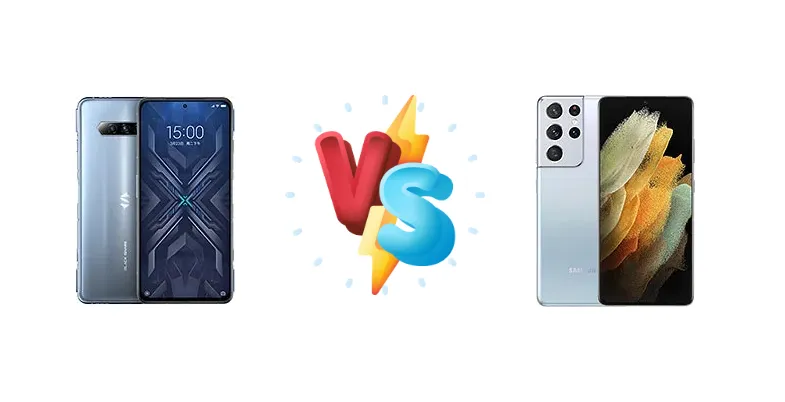
|
🏆 Quick Verdict
For the average user, the Samsung Galaxy S21 Ultra 5G emerges as the more versatile choice. Its superior camera system, brighter display, and longer battery endurance outweigh the Black Shark 4’s faster charging and slightly more affordable price. However, dedicated mobile gamers will find the Black Shark 4’s optimized performance compelling.
| PHONES | ||
|---|---|---|
| Phone Names | Xiaomi Black Shark 4 | Samsung Galaxy S21 Ultra 5G |
| Network | ||
|---|---|---|
| 2G bands | GSM 850 / 900 / 1800 / 1900 | GSM 850 / 900 / 1800 / 1900 |
| 3G bands | HSDPA 800 / 850 / 900 / 1700(AWS) / 1900 / 2100 | HSDPA 850 / 900 / 1700(AWS) / 1900 / 2100 |
| 4G bands | 1, 2, 3, 4, 5, 7, 8, 18, 19, 20, 26, 28, 34, 38, 39, 40, 41 - International, China | 1, 2, 3, 4, 5, 7, 8, 12, 13, 14, 18, 19, 20, 25, 26, 28, 30, 38, 39, 40, 41, 46, 48, 66, 71 - SM-G998U1 |
| 5G bands | 1, 3, 8, 28, 41, 77, 78, 79 SA/NSA - China | 2, 5, 25, 41, 66, 71, 260, 261 SA/NSA/Sub6/mmWave - SM-G998U1 |
| Speed | HSPA, LTE, 5G | HSPA 42.2/5.76 Mbps, LTE (7CA) Cat20 2000/200 Mbps, 5G (5+ Gbps DL) |
| Technology | GSM / CDMA / HSPA / EVDO / LTE / 5G | GSM / CDMA / HSPA / EVDO / LTE / 5G |
| CDMA2000 1xEV-DO | 1, 3, 5, 7, 8, 20, 28, 38, 40, 41, 66, 77, 78 SA/NSA/Sub6 - SM-G998B | |
| Launch | ||
|---|---|---|
| Announced | 2021, March 23 | 2021, January 14 |
| Status | Available. Released 2021, March 30 | Available. Released 2021, January 29 |
| Body | ||
|---|---|---|
| Build | - | Glass front (Gorilla Glass Victus), glass back (Gorilla Glass Victus), aluminum frame |
| Dimensions | 163.8 x 76.4 x 9.9 mm (6.45 x 3.01 x 0.39 in) | 165.1 x 75.6 x 8.9 mm (6.5 x 2.98 x 0.35 in) |
| SIM | Nano-SIM + Nano-SIM | · Nano-SIM + eSIM· Nano-SIM + Nano-SIM + eSIM (max 2 at a time) |
| Weight | 210 g (7.41 oz) | 227 g (Sub6), 229 g (mmWave) (8.01 oz) |
| Physical pop-up gaming triggers | IP68 dust/water resistant (up to 1.5m for 30 min) Stylus support | |
| Display | ||
|---|---|---|
| Protection | - | Corning Gorilla Glass Victus |
| Resolution | 1080 x 2400 pixels, 20:9 ratio (~395 ppi density) | 1440 x 3200 pixels, 20:9 ratio (~515 ppi density) |
| Size | 6.67 inches, 107.4 cm2 (~85.8% screen-to-body ratio) | 6.8 inches, 112.1 cm2 (~89.8% screen-to-body ratio) |
| Type | Super AMOLED, 144Hz, HDR10+, 1300 nits (peak) | Dynamic AMOLED 2X, 120Hz, HDR10+, 1500 nits (peak) |
| Always-on display | Always-on display | |
| Platform | ||
|---|---|---|
| CPU | Octa-core (1x3.2 GHz Kryo 585 & 3x2.42 GHz Kryo 585 & 4x1.80 GHz Kryo 585) | Octa-core (1x2.9 GHz Cortex-X1 & 3x2.80 GHz Cortex-A78 & 4x2.2 GHz Cortex-A55) - InternationalOcta-core (1x2.84 GHz Cortex-X1 & 3x2.42 GHz Cortex-A78 & 4x1.80 GHz Cortex-A55) - USA/China |
| Chipset | Qualcomm SM8250-AC Snapdragon 870 5G (7 nm) | Exynos 2100 (5 nm) - InternationalQualcomm SM8350 Snapdragon 888 5G (5 nm) - USA/China |
| GPU | Adreno 650 | Mali-G78 MP14 - InternationalAdreno 660 - USA/China |
| OS | Android 11, Joy UI 12.5 | Android 11, up to 4 major Android upgrades, One UI 6.1 |
| Memory | ||
|---|---|---|
| Card slot | No | No |
| Internal | 128GB 6GB RAM, 128GB 8GB RAM, 128GB 12GB RAM, 256GB 8GB RAM, 256GB 12GB RAM | 128GB 8GB RAM, 128GB 12GB RAM, 256GB 12GB RAM, 256GB 16GB RAM, 512GB 12GB RAM, 512GB 16GB RAM |
| UFS 3.1 | UFS 3.1 | |
| Main Camera | ||
|---|---|---|
| Features | LED flash, HDR, panorama | Laser AF, LED flash, auto-HDR, panorama |
| Quad | - | 108 MP, f/1.8, 24mm (wide), 1/1.33", 0.8µm, PDAF, OIS 10 MP, f/2.4, 72mm (telephoto), 1/3.24", 1.22µm, dual pixel PDAF, OIS, 3x optical zoom 10 MP, f/4.9, 240mm (periscope telephoto), 1/3.24", 1.22µm, dual pixel PDAF, OIS, 10x optical zoom 12 MP, f/2.2, 13mm (ultrawide), 1/2.55", 1.4µm, dual pixel PDAF, Super Steady video |
| Single | 20 MP, f/2.0, (wide), 0.8µm | - |
| Triple | 48 MP, f/1.8, (wide), 1/2.0", 0.8µm, PDAF 8 MP, f/2.2, 120˚ (ultrawide), 1/4.0", 1.12µm 5 MP (macro), AF | - |
| Video | 4K@30/60fps, 1080p@30/60/240fps, 1080p@960fps | 8K@24fps, 4K@30/60fps, 1080p@30/60/120/240fps, HDR10+, stereo sound rec., gyro-EIS |
| Selfie camera | ||
|---|---|---|
| Features | HDR | HDR |
| Single | 20 MP, f/2.0, (wide), 0.8µm | 40 MP, f/2.2, 26mm (wide), 1/2.8", 0.7µm, PDAF |
| Video | 1080p@30fps | 4K@30/60fps, 1080p@30fps |
| Sound | ||
|---|---|---|
| 3.5mm jack | Yes | No |
| 35mm jack | Yes | No |
| Loudspeaker | Yes, with stereo speakers | Yes, with stereo speakers |
| 24-bit/192kHz audio | 32-bit/384kHz audio Tuned by AKG | |
| Comms | ||
|---|---|---|
| Bluetooth | 5.2, A2DP, LE, aptX HD, aptX Adaptive | 5.2, A2DP, LE |
| NFC | Yes | Yes |
| Positioning | GPS, GLONASS, GALILEO, QZSS, BDS | GPS, GLONASS, BDS, GALILEO |
| Radio | No | FM radio (Snapdragon model only; market/operator dependent) |
| USB | USB Type-C 2.0 | USB Type-C 3.2, OTG |
| WLAN | Wi-Fi 802.11 a/b/g/n/ac/6, dual-band, Wi-Fi Direct | Wi-Fi 802.11 a/b/g/n/ac/6e, dual-band, Wi-Fi Direct |
| Features | ||
|---|---|---|
| Sensors | Fingerprint (side-mounted), accelerometer, gyro, proximity, compass, barometer | Fingerprint (under display, ultrasonic), accelerometer, gyro, proximity, compass, barometer |
| - | Samsung DeX, Samsung Wireless DeX (desktop experience support) Bixby natural language commands and dictation Samsung Pay (Visa, MasterCard certified) Ultra Wideband (UWB) support | |
| Battery | ||
|---|---|---|
| Charging | 120W wired, 100% in 17 min | 25W wired, PD3.0 15W wireless (Qi) 4.5W reverse wireless |
| Type | Li-Po 4500 mAh | Li-Ion 5000 mAh |
| Misc | ||
|---|---|---|
| Colors | Mirror Black, Pale Grey, Black, Blue, Silver | Phantom Black, Phantom Silver, Phantom Titanium, Phantom Navy, Phantom Brown, Navy |
| Models | SHARK PRS-H0, SHARK PRS-A0, SHARK KSR-A0 | SM-G998B, SM-G998B/DS, SM-G998U, SM-G998U1, SM-G998W, SM-G998N, SM-G9980 |
| Price | About 930 EUR | $ 240.01 / C$ 353.20 / £ 202.99 / € 264.99 |
| SAR | - | 0.77 W/kg (head) 1.02 W/kg (body) |
| SAR EU | - | 0.71 W/kg (head) 1.58 W/kg (body) |
| Pricing | ||
|---|---|---|
| 128GB 12GB RAM | - | $ 384.99 |
| 256GB 12GB RAM | - | $ 998.00 |
| 512GB 12GB RAM | - | $ 1,179.99 |
| RENEWED | - | $ 459.00 |
| Tests | ||
|---|---|---|
| Battery life | Endurance rating 96h | Endurance rating 114h |
| Camera | Photo / Video | Photo / Video |
| Display | Contrast ratio: Infinite (nominal) | Contrast ratio: Infinite (nominal) |
| Loudspeaker | -27.4 LUFS (Good) | -25.5 LUFS (Very good) |
| Performance | AnTuTu: 617456 (v8) GeekBench: 3448 (v5.1) GFXBench: 54fps (ES 3.1 onscreen) | AnTuTu: 657150 (v8) GeekBench: 3518 (v5.1) GFXBench: 33fps (ES 3.1 onscreen) |
Xiaomi Black Shark 4
- Blazing-fast 120W charging (0-100% in 17 minutes)
- Optimized Snapdragon 870 for gaming
- More affordable price point
- Inferior camera system compared to the S21 Ultra
- Less bright display, potentially impacting outdoor visibility
Samsung Galaxy S21 Ultra 5G
- Exceptional camera system with versatile zoom capabilities
- Brighter and more color-accurate display
- Longer battery life and wireless charging options
- Significantly slower charging speed (25W)
- Higher price tag
Display Comparison
The Samsung Galaxy S21 Ultra boasts a significantly brighter display, reaching 1023 nits compared to the Black Shark 4’s 694 nits. This translates to superior visibility in direct sunlight. Both displays share an 'Infinite' (nominal) contrast ratio, suggesting deep blacks, but the S21 Ultra’s Dynamic AMOLED 2X panel is widely regarded for its color accuracy and vibrancy. While the Black Shark 4’s refresh rate isn’t specified, the S21 Ultra’s adaptive 120Hz refresh rate contributes to smoother scrolling and animations. The S21 Ultra’s panel is also likely to benefit from LTPO technology, dynamically adjusting refresh rate for improved efficiency.
Camera Comparison
The S21 Ultra is the clear winner in the camera department, though specifics beyond 'Photo / Video' capabilities are absent in the provided data. Samsung’s flagship consistently ranks among the best camera phones, offering exceptional image quality, versatile zoom capabilities, and advanced video recording features. The Black Shark 4, while capable, is likely to prioritize gaming features over camera innovation. The S21 Ultra’s larger sensor size (typically found in its flagship models) and advanced image processing algorithms will deliver superior low-light performance and dynamic range. The absence of detail regarding the Black Shark 4’s camera sensors suggests a less sophisticated system.
Performance
The chipset choice is a key differentiator. The Black Shark 4 utilizes the Qualcomm Snapdragon 870 5G (7nm), while the S21 Ultra comes in two variants: the Exynos 2100 (5nm) for international markets and the Snapdragon 888 5G (5nm) for USA/China. The 5nm process node used in both S21 Ultra chipsets offers greater transistor density and improved power efficiency compared to the 870’s 7nm node. The S21 Ultra’s Cortex-X1 prime core (2.9GHz/2.84GHz) provides a performance advantage in single-threaded tasks, while the Black Shark 4’s Kryo 585 cores (up to 3.2 GHz) are optimized for sustained gaming performance. The S21 Ultra’s LPDDR5 RAM complements its powerful chipset, ensuring smooth multitasking.
Battery Life
The Galaxy S21 Ultra edges out the Black Shark 4 in battery endurance, achieving 114 hours compared to the Black Shark 4’s 96 hours. However, the Black Shark 4 compensates with its groundbreaking 120W wired charging, capable of fully charging the device in just 17 minutes. The S21 Ultra’s 25W wired charging, while supporting PD3.0, is significantly slower. The S21 Ultra also offers 15W wireless charging and 4.5W reverse wireless charging, features absent in the provided Black Shark 4 specifications. The Black Shark 4’s faster charging is a game-changer for users who prioritize minimizing downtime.
Buying Guide
Buy the Xiaomi Black Shark 4 if you prioritize uninterrupted gaming sessions, demand the fastest possible charging speeds (fully charging in just 17 minutes), and are willing to compromise on camera versatility. Buy the Samsung Galaxy S21 Ultra 5G if you value a premium camera experience, a stunningly bright and color-accurate display, and all-day battery life, even if it means slower charging and a higher price tag.