
Xiaomi Black Shark 4 vs. Realme GT 8 Pro: A Deep Dive into Gaming and Charging Prowess
| Phones Images | |||||
|---|---|---|---|---|---|
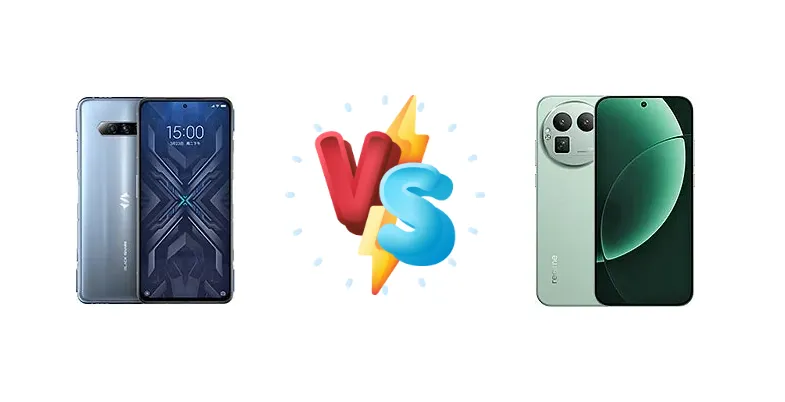
|
🏆 Quick Verdict
For the average user prioritizing raw performance and future-proofing, the Realme GT 8 Pro is the clear winner. Its Snapdragon 8 Elite Gen 5 offers a substantial leap in processing power and efficiency. However, the Black Shark 4 remains a compelling option for budget-conscious gamers who value fast charging and a proven chipset.
| PHONES | ||
|---|---|---|
| Phone Names | Xiaomi Black Shark 4 | Realme GT 8 Pro |
| Network | ||
|---|---|---|
| 2G bands | GSM 850 / 900 / 1800 / 1900 | GSM 850 / 900 / 1800 / 1900 |
| 3G bands | HSDPA 800 / 850 / 900 / 1700(AWS) / 1900 / 2100 | HSDPA 800 / 850 / 900 / 1700(AWS) / 1900 / 2100 |
| 4G bands | 1, 2, 3, 4, 5, 7, 8, 18, 19, 20, 26, 28, 34, 38, 39, 40, 41 - International, China | 1, 2, 3, 4, 5, 7, 8, 12, 13, 17, 18, 19, 20, 26, 28, 38, 39, 40, 41, 42, 48, 66, 71 - International |
| 5G bands | 1, 3, 8, 28, 41, 77, 78, 79 SA/NSA - China | 1, 2, 3, 5, 7, 8, 20, 28, 38, 40, 41, 48, 66, 71, 77, 78, 79 SA/NSA - International |
| Speed | HSPA, LTE, 5G | HSPA, LTE, 5G |
| Technology | GSM / CDMA / HSPA / EVDO / LTE / 5G | GSM / HSPA / LTE / 5G |
| CDMA2000 1xEV-DO | - | |
| Launch | ||
|---|---|---|
| Announced | 2021, March 23 | 2025, October 21 |
| Status | Available. Released 2021, March 30 | Available. Released 2025, October 21 |
| Body | ||
|---|---|---|
| Build | - | Glass front (Gorilla Glass 7i), aluminum alloy frame, fiber-reinforced plastic back or silicone polymer (eco leather) back |
| Dimensions | 163.8 x 76.4 x 9.9 mm (6.45 x 3.01 x 0.39 in) | 161.8 x 76.9 x 8.2 mm (6.37 x 3.03 x 0.32 in) |
| SIM | Nano-SIM + Nano-SIM | · Nano-SIM + Nano-SIM + eSIM (max 2 at a time) - International· Nano-SIM + Nano-SIM - China |
| Weight | 210 g (7.41 oz) | 214 g or 218 g (7.69 oz) |
| Physical pop-up gaming triggers | - | |
| Display | ||
|---|---|---|
| Protection | - | Corning Gorilla Glass 7i, Mohs level 4 |
| Resolution | 1080 x 2400 pixels, 20:9 ratio (~395 ppi density) | 1440 x 3136 pixels, 19.5:9 ratio (~508 ppi density) |
| Size | 6.67 inches, 107.4 cm2 (~85.8% screen-to-body ratio) | 6.79 inches, 112.8 cm2 (~90.7% screen-to-body ratio) |
| Type | Super AMOLED, 144Hz, HDR10+, 1300 nits (peak) | AMOLED, 1B colors, 144Hz, HDR10+, HDR Vivid, Dolby Vision, 1000 nits (typ), 2000 nits (HBM), 7000 nits (peak) |
| Always-on display | - | |
| Platform | ||
|---|---|---|
| CPU | Octa-core (1x3.2 GHz Kryo 585 & 3x2.42 GHz Kryo 585 & 4x1.80 GHz Kryo 585) | Octa-core (2x4.6 GHz Oryon V3 Phoenix L + 6x3.62 GHz Oryon V3 Phoenix M) |
| Chipset | Qualcomm SM8250-AC Snapdragon 870 5G (7 nm) | Qualcomm SM8850-AC Snapdragon 8 Elite Gen 5 (3 nm) |
| GPU | Adreno 650 | Adreno 840 |
| OS | Android 11, Joy UI 12.5 | Android 16, up to 4 major Android upgrades, Realme UI 7.0 |
| Memory | ||
|---|---|---|
| Card slot | No | No |
| Internal | 128GB 6GB RAM, 128GB 8GB RAM, 128GB 12GB RAM, 256GB 8GB RAM, 256GB 12GB RAM | 256GB 12GB RAM, 256GB 16GB RAM, 512GB 12GB RAM, 512GB 16GB RAM, 1TB 16GB RAM |
| UFS 3.1 | - | |
| Main Camera | ||
|---|---|---|
| Features | LED flash, HDR, panorama | Ricoh lens, Color spectrum sensor, LED flash, HDR, panorama, switchable camera bump |
| Single | 20 MP, f/2.0, (wide), 0.8µm | - |
| Triple | 48 MP, f/1.8, (wide), 1/2.0", 0.8µm, PDAF 8 MP, f/2.2, 120˚ (ultrawide), 1/4.0", 1.12µm 5 MP (macro), AF | 50 MP, f/1.8, 22mm (wide), 1/1.56", 1.0µm, multi-directional PDAF, OIS 200 MP, f/2.6, 65mm, (periscope telephoto), 1/1.56", 0.5µm, multi-directional PDAF, OIS, 3x optical zoom 50 MP, f/2.0, 16mm, 116˚ (ultrawide), 1/2.88", 0.64µm |
| Video | 4K@30/60fps, 1080p@30/60/240fps, 1080p@960fps | 8K@30fps, 4K@30/60/120fps, 1080p@30/60/120/240fps, gyro-EIS, HDR, Dolby Vision, 10-bit LOG |
| Selfie camera | ||
|---|---|---|
| Features | HDR | Panorama |
| Single | 20 MP, f/2.0, (wide), 0.8µm | 32 MP, f/2.4, 24mm (wide), 1/3.1", 0.7µm |
| Video | 1080p@30fps | 4K@30/60fps, 1080p@30/60fps; gyro-EIS, HDR, Dolby Vision |
| Sound | ||
|---|---|---|
| 3.5mm jack | Yes | - |
| 35mm jack | Yes | No |
| Loudspeaker | Yes, with stereo speakers | Yes, with stereo speakers |
| 24-bit/192kHz audio | - | |
| Comms | ||
|---|---|---|
| Bluetooth | 5.2, A2DP, LE, aptX HD, aptX Adaptive | 6.0, A2DP, LE, aptX HD, LHDC 5 |
| Infrared port | - | Yes |
| NFC | Yes | Yes, 360˚ |
| Positioning | GPS, GLONASS, GALILEO, QZSS, BDS | GPS (L1+L5), BDS (B1I+B1c+B2a), GALILEO (E1+E5a), QZSS (L1+L5), GLONASS, NavIC (L5) |
| Radio | No | No |
| USB | USB Type-C 2.0 | USB Type-C 2.0, OTG |
| WLAN | Wi-Fi 802.11 a/b/g/n/ac/6, dual-band, Wi-Fi Direct | Wi-Fi 802.11 a/b/g/n/ac/6/7, dual-band |
| Features | ||
|---|---|---|
| Sensors | Fingerprint (side-mounted), accelerometer, gyro, proximity, compass, barometer | Fingerprint (under display, ultrasonic), accelerometer, gyro, proximity, compass |
| Battery | ||
|---|---|---|
| Charging | 120W wired, 100% in 17 min | 120W wired, 120W UFCS, 14.4W PD, 55W PPS, 14.4W QC, 15 min to 50%, 43 min to 100% 50W wireless, 79 min to 100% 10W wireless reverse 5W reverse wired |
| Type | Li-Po 4500 mAh | Si/C Li-Ion 7000 mAh |
| Misc | ||
|---|---|---|
| Colors | Mirror Black, Pale Grey, Black, Blue, Silver | Diary White, Urban Blue, Green, Aston Martin Green |
| Models | SHARK PRS-H0, SHARK PRS-A0, SHARK KSR-A0 | RMX5210 |
| Price | About 930 EUR | € 899.99 |
| SAR | - | 0.99 W/kg (head) 1.27 W/kg (body) |
| Tests | ||
|---|---|---|
| Battery life | Endurance rating 96h | - |
| Camera | Photo / Video | - |
| Display | Contrast ratio: Infinite (nominal) | - |
| Loudspeaker | -27.4 LUFS (Good) | - |
| Performance | AnTuTu: 617456 (v8) GeekBench: 3448 (v5.1) GFXBench: 54fps (ES 3.1 onscreen) | - |
| EU LABEL | ||
|---|---|---|
| Battery | - | 60:32h endurance, 1100 cycles |
| Energy | - | Class B |
| Free fall | - | Class D (60 falls) |
| Repairability | - | Class C |
Xiaomi Black Shark 4
- Extremely fast 120W wired charging
- More affordable price point
- Proven Snapdragon 870 performance
- Significantly dimmer display
- Less powerful chipset compared to the GT 8 Pro
- Limited charging versatility
Realme GT 8 Pro
- Superior Snapdragon 8 Elite Gen 5 performance
- Incredibly bright display (2262 nits)
- Versatile charging options (wired, wireless, reverse)
- Higher price tag
- Slightly slower endurance rating than Black Shark 4
Display Comparison
The Realme GT 8 Pro’s display is a standout feature, boasting a measured peak brightness of 2262 nits, dwarfing the Black Shark 4’s 694 nits. This difference translates to significantly better visibility in direct sunlight. While both displays offer an infinite (nominal) contrast ratio, the GT 8 Pro’s superior brightness makes it the clear winner for outdoor use. The Black Shark 4’s display, while adequate, lacks the vibrancy and clarity of the GT 8 Pro’s panel. We lack PWM frequency data for both, but the brightness difference is the dominant factor.
Camera Comparison
Both phones list 'Photo / Video' capabilities, but lack specific details. Given the market positioning, we can infer the GT 8 Pro likely features a more sophisticated camera system. The Black Shark 4 prioritizes gaming, so its camera is likely a secondary consideration. Without sensor size or aperture information, a detailed comparison is impossible. However, the GT 8 Pro’s higher price point suggests a greater investment in camera technology, potentially including features like optical image stabilization (OIS).
Performance
The core difference lies in the chipsets. The Realme GT 8 Pro’s Snapdragon 8 Elite Gen 5 (3nm) represents a generational leap over the Black Shark 4’s Snapdragon 870 (7nm). The GT 8 Pro’s octa-core CPU, with its 2x4.6 GHz Oryon V3 Phoenix L cores and 6x3.62 GHz Oryon V3 Phoenix M cores, delivers significantly higher peak performance than the Black Shark 4’s 1x3.2 GHz Kryo 585, 3x2.42 GHz Kryo 585, and 4x1.80 GHz Kryo 585 configuration. The 3nm process node of the Snapdragon 8 Elite Gen 5 also contributes to improved thermal efficiency, potentially reducing throttling during extended gaming sessions. While the Black Shark 4’s 870 is still a capable performer, the GT 8 Pro offers a demonstrably smoother and more responsive experience.
Battery Life
The Realme GT 8 Pro offers a more comprehensive charging solution. While both support 120W wired charging, the GT 8 Pro adds 120W UFCS, 14.4W PD, 55W PPS, 14.4W QC, and even 50W wireless charging with reverse wired/wireless capabilities. The GT 8 Pro reaches 50% charge in 15 minutes and 100% in 43 minutes, while the Black Shark 4 achieves 100% in 17 minutes. Despite the Black Shark 4’s slightly faster initial charge, the GT 8 Pro’s versatility and wireless charging options are significant advantages. Endurance testing shows the Black Shark 4 at 96 hours versus the GT 8 Pro’s 60:32h, but the GT 8 Pro’s active use score of 20:24h suggests more efficient power management under load, and a reported 1100 charge cycles.
Buying Guide
Buy the Xiaomi Black Shark 4 if you need a capable gaming phone at a more accessible price point, and prioritize extremely fast 120W charging. It's ideal for users who enjoy mobile gaming but don't demand the absolute highest frame rates or cutting-edge features. Buy the Realme GT 8 Pro if you prefer uncompromising performance, a significantly brighter display, and a more versatile charging ecosystem, including wireless options. This phone is geared towards enthusiasts who want the best possible mobile gaming experience and are willing to pay a premium.