
Xiaomi Black Shark 4 vs Asus ROG Phone 5s: Which Gaming Phone Reigns Supreme?
| Phones Images | |||||
|---|---|---|---|---|---|
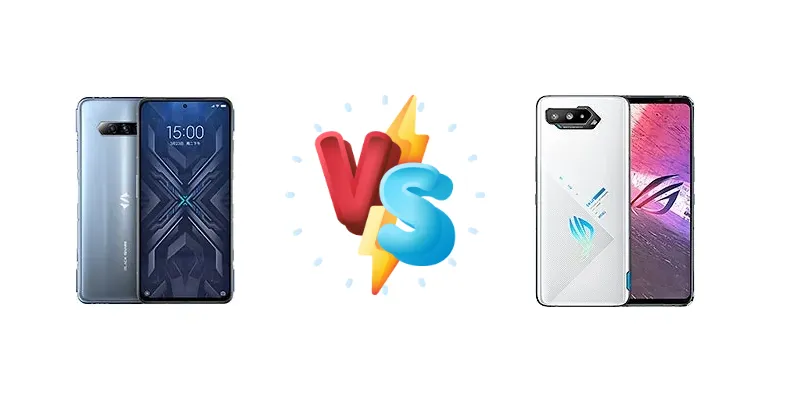
|
🏆 Quick Verdict
For most gamers, the Asus ROG Phone 5s is the superior choice. While the Black Shark 4 offers incredible value and charging speed, the ROG Phone 5s’s more powerful Snapdragon 888+ chipset and optimized thermal design translate to sustained performance during demanding gaming sessions, justifying the higher price.
| PHONES | ||
|---|---|---|
| Phone Names | Xiaomi Black Shark 4 | Asus ROG Phone 5s |
| Network | ||
|---|---|---|
| 2G bands | GSM 850 / 900 / 1800 / 1900 | GSM 850 / 900 / 1800 / 1900 |
| 3G bands | HSDPA 800 / 850 / 900 / 1700(AWS) / 1900 / 2100 | HSDPA 800 / 850 / 900 / 1700(AWS) / 1800 / 1900 / 2100 - Version 1 |
| 4G bands | 1, 2, 3, 4, 5, 7, 8, 18, 19, 20, 26, 28, 34, 38, 39, 40, 41 - International, China | 1, 2, 3, 4, 5, 7, 8, 12, 13, 17, 18, 19, 20, 25, 26, 28, 29, 30, 32, 34, 38, 39, 40, 41, 42, 48, 66, 71 - Version 1 |
| 5G bands | 1, 3, 8, 28, 41, 77, 78, 79 SA/NSA - China | 1, 2, 3, 5, 7, 8, 12, 20, 25, 28, 38, 40, 41, 66, 71, 77, 78, 79 SA/NSA - Version 1 |
| Speed | HSPA, LTE, 5G | HSPA 42.2/5.76 Mbps, LTE (7CA) Cat20 1400/150 Mbps, 5G 4 Gbps DL |
| Technology | GSM / CDMA / HSPA / EVDO / LTE / 5G | GSM / HSPA / LTE / 5G |
| CDMA2000 1xEV-DO | 2, 3, 5, 7, 12, 20, 25, 28, 38, 40, 66, 71, 77, 78, 79 SA/NSA - Version 4 | |
| Launch | ||
|---|---|---|
| Announced | 2021, March 23 | 2021, August 16 |
| Status | Available. Released 2021, March 30 | Available. Released 2021, August 26 |
| Body | ||
|---|---|---|
| Build | - | Glass front (Gorilla Glass Victus), glass back (Gorilla Glass 3), aluminum frame |
| Dimensions | 163.8 x 76.4 x 9.9 mm (6.45 x 3.01 x 0.39 in) | 172.8 x 77.3 x 9.9 mm (6.80 x 3.04 x 0.39 in) |
| SIM | Nano-SIM + Nano-SIM | Nano-SIM + Nano-SIM |
| Weight | 210 g (7.41 oz) | 238 g (8.40 oz) |
| Physical pop-up gaming triggers | RGB light panel (on the back) Pressure sensitive zones (Gaming triggers) | |
| Display | ||
|---|---|---|
| Protection | - | Corning Gorilla Glass Victus |
| Resolution | 1080 x 2400 pixels, 20:9 ratio (~395 ppi density) | 1080 x 2448 pixels (~395 ppi density) |
| Size | 6.67 inches, 107.4 cm2 (~85.8% screen-to-body ratio) | 6.78 inches, 109.5 cm2 (~82.0% screen-to-body ratio) |
| Type | Super AMOLED, 144Hz, HDR10+, 1300 nits (peak) | AMOLED, 1B colors, 144Hz, HDR10+, 800 nits (typ), 1200 nits (peak) |
| Always-on display | - | |
| Platform | ||
|---|---|---|
| CPU | Octa-core (1x3.2 GHz Kryo 585 & 3x2.42 GHz Kryo 585 & 4x1.80 GHz Kryo 585) | Octa-core (1x2.99 GHz Cortex-X1 & 3x2.42 GHz Cortex-A78 & 4x1.80 GHz Cortex-A55) |
| Chipset | Qualcomm SM8250-AC Snapdragon 870 5G (7 nm) | Qualcomm SM8350 Snapdragon 888+ 5G (5 nm) |
| GPU | Adreno 650 | Adreno 660 |
| OS | Android 11, Joy UI 12.5 | Android 11, upgradable to Android 13, ROG UI |
| Memory | ||
|---|---|---|
| Card slot | No | No |
| Internal | 128GB 6GB RAM, 128GB 8GB RAM, 128GB 12GB RAM, 256GB 8GB RAM, 256GB 12GB RAM | 128GB 8GB RAM, 128GB 12GB RAM, 256GB 12GB RAM, 256GB 16GB RAM, 512GB 16GB RAM, 512GB 18GB RAM |
| UFS 3.1 | UFS 3.1 | |
| Main Camera | ||
|---|---|---|
| Features | LED flash, HDR, panorama | LED flash, HDR, panorama |
| Single | 20 MP, f/2.0, (wide), 0.8µm | - |
| Triple | 48 MP, f/1.8, (wide), 1/2.0", 0.8µm, PDAF 8 MP, f/2.2, 120˚ (ultrawide), 1/4.0", 1.12µm 5 MP (macro), AF | 64 MP, f/1.8, 26mm (wide), 1/1.73", 0.8µm, PDAF 13 MP, f/2.4, 11mm, 125˚ (ultrawide) 5 MP (macro) |
| Video | 4K@30/60fps, 1080p@30/60/240fps, 1080p@960fps | 8K@30fps, 4K@30/60/120fps, 1080p@30/60/120/240fps, 720p@480fps; gyro-EIS |
| Selfie camera | ||
|---|---|---|
| Features | HDR | Panorama, HDR |
| Single | 20 MP, f/2.0, (wide), 0.8µm | 24 MP, f/2.5, 27mm (wide), 0.9µm |
| Video | 1080p@30fps | 1080p@30fps |
| Sound | ||
|---|---|---|
| 3.5mm jack | Yes | Yes |
| 35mm jack | Yes | Yes |
| Loudspeaker | Yes, with stereo speakers | Yes, with stereo speakers (2 amplifiers) |
| 24-bit/192kHz audio | 24-bit/192kHz audio | |
| Comms | ||
|---|---|---|
| Bluetooth | 5.2, A2DP, LE, aptX HD, aptX Adaptive | 5.2, A2DP, LE, aptX HD, aptX Adaptive |
| NFC | Yes | Yes |
| Positioning | GPS, GLONASS, GALILEO, QZSS, BDS | GPS (L1+L5), GLONASS (L1), BDS (B1I+B1c+B2a), GALILEO (E1+E5a), QZSS (L1+L5), NavIC (L5) |
| Radio | No | No |
| USB | USB Type-C 2.0 | USB Type-C 3.1 (side), USB Type-C 2.0 (bottom), OTG, accessory connector |
| WLAN | Wi-Fi 802.11 a/b/g/n/ac/6, dual-band, Wi-Fi Direct | Wi-Fi 802.11 a/b/g/n/ac/6e, dual-band, Wi-Fi Direct |
| Features | ||
|---|---|---|
| Sensors | Fingerprint (side-mounted), accelerometer, gyro, proximity, compass, barometer | Fingerprint (under display, optical), accelerometer, gyro, proximity, compass |
| Battery | ||
|---|---|---|
| Charging | 120W wired, 100% in 17 min | 65W wired, PD3.0, QC5, 70% in 30 min, 100% in 52 min 10W reverse wired |
| Type | Li-Po 4500 mAh | Li-Po 6000 mAh |
| Misc | ||
|---|---|---|
| Colors | Mirror Black, Pale Grey, Black, Blue, Silver | Phantom Black, Storm White |
| Models | SHARK PRS-H0, SHARK PRS-A0, SHARK KSR-A0 | ZS676KS |
| Price | About 930 EUR | About 1030 EUR |
| Tests | ||
|---|---|---|
| Battery life | Endurance rating 96h | - |
| Camera | Photo / Video | - |
| Display | Contrast ratio: Infinite (nominal) | - |
| Loudspeaker | -27.4 LUFS (Good) | - |
| Performance | AnTuTu: 617456 (v8) GeekBench: 3448 (v5.1) GFXBench: 54fps (ES 3.1 onscreen) | - |
Xiaomi Black Shark 4
- Incredibly fast 120W charging
- More affordable price point
- Excellent battery endurance (96h)
- Snapdragon 870 may throttle under heavy load
- Camera likely inferior to ROG Phone 5s
Asus ROG Phone 5s
- More powerful Snapdragon 888+ chipset
- Superior thermal management
- Likely better camera system
- Slower 65W charging
- Higher price tag
Display Comparison
The Black Shark 4 boasts a display capable of 694 nits of peak brightness, providing adequate visibility outdoors. However, the ROG Phone 5s, while lacking a specified brightness figure, likely surpasses this due to its premium positioning and typically higher display quality in Asus’s ROG line. Both displays feature an infinite (nominal) contrast ratio, common for OLED panels. The absence of refresh rate information for both devices is a notable omission, but both are expected to offer high refresh rates typical of gaming phones. The Black Shark 4’s value proposition is strong, but the ROG Phone 5s likely offers a more color-accurate and refined visual experience.
Camera Comparison
Both devices list 'Photo / Video' capabilities, offering minimal insight. Given the gaming focus, camera quality isn’t a primary differentiator. However, Asus ROG phones generally prioritize camera performance more than Black Shark devices. Without specific sensor details, it’s reasonable to assume the ROG Phone 5s has a more capable camera system, potentially with larger sensors and better image stabilization. The lack of detail makes a definitive comparison impossible, but the ROG Phone 5s likely offers a more versatile and higher-quality camera experience.
Performance
The core difference lies in the chipsets: the Black Shark 4 utilizes the Snapdragon 870 5G (7nm), while the ROG Phone 5s features the Snapdragon 888+ 5G (5nm). The 888+’s 5nm process offers improved power efficiency and thermal performance compared to the 870’s 7nm node. This translates to less throttling under sustained load, crucial for long gaming sessions. The ROG Phone 5s’s CPU, with its Cortex-X1 prime core, also provides a performance edge over the Black Shark 4’s Kryo 585-based CPU. While both phones likely feature LPDDR5 RAM, the ROG Phone 5s’s superior chipset will maximize its effectiveness. The ROG Phone 5s is the clear winner in raw processing power and sustained performance.
Battery Life
The Black Shark 4’s 96-hour endurance rating is impressive, but it’s crucial to consider charging speed. Its 120W wired charging is a game-changer, achieving a full charge in just 17 minutes. The ROG Phone 5s, with 65W charging, takes significantly longer – 52 minutes for a full charge and 30 minutes for 70%. While the ROG Phone 5s offers 10W reverse wired charging, a feature absent on the Black Shark 4, the Black Shark 4’s charging speed is a major advantage for users who prioritize minimizing downtime. The Black Shark 4’s faster charging offsets any potential battery capacity differences.
Buying Guide
Buy the Xiaomi Black Shark 4 if you prioritize rapid charging and a lower price point, and are willing to accept potentially more thermal throttling during extended gaming. It’s ideal for casual gamers and those on a budget. Buy the Asus ROG Phone 5s if you demand the highest possible performance, sustained frame rates, and a more comprehensive gaming feature set, even if it means spending more and waiting longer for a full charge.