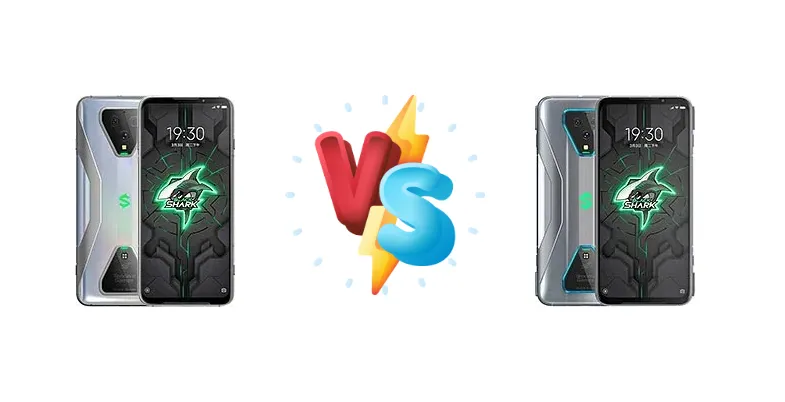
Xiaomi's Black Shark series carved a niche for itself by prioritizing raw gaming performance. The Black Shark 3 and its Pro sibling both leverage the Snapdragon 865, but diverge in key areas like display size, battery capacity, and overall design. This comparison dissects these differences to determine which device delivers the ultimate mobile gaming experience.
🏆 Quick Verdict
For most gamers, the Black Shark 3 offers the best value. It delivers flagship-level performance with 65W charging at a potentially lower price point. The 3 Pro’s larger screen and slightly refined design are worthwhile for those prioritizing immersion and extended gaming sessions.
| Network |
|---|
| 2G bands | GSM 850 / 900 / 1800 / 1900 | GSM 850 / 900 / 1800 / 1900 |
| 3G bands | HSDPA 800 / 850 / 900 / 1700(AWS) / 1900 / 2100 | HSDPA 800 / 850 / 900 / 1700(AWS) / 1900 / 2100 |
| 4G bands | 1, 3, 4, 5, 7, 8, 12, 17, 20, 34, 38, 39, 40, 41 | 1, 3, 4, 5, 7, 8, 12, 17, 20, 34, 38, 39, 40, 41 |
| 5G bands | 41, 78, 79 SA/NSA | 41, 78, 79 SA/NSA |
| Speed | HSPA, LTE, 5G | HSPA, LTE, 5G |
| Technology | GSM / CDMA / HSPA / EVDO / LTE / 5G | GSM / CDMA / HSPA / EVDO / LTE / 5G |
| | CDMA2000 1xEV-DO | CDMA2000 1xEV-DO |
| Launch |
|---|
| Announced | 2020, March 03. Released 2020, March 06 | 2020, March 03. Released 2020, March 17 |
| Status | Discontinued | Discontinued |
| Body |
|---|
| Build | Glass front, aluminum back, aluminum frame | Glass front, aluminum back, aluminum frame |
| Dimensions | 168.7 x 77.3 x 10.4 mm (6.64 x 3.04 x 0.41 in) | 177.8 x 83.3 x 10.1 mm (7.00 x 3.28 x 0.40 in) |
| SIM | Nano-SIM + Nano-SIM | Nano-SIM + Nano-SIM |
| Weight | 222 g (7.83 oz) | 253 g (8.92 oz) |
| | - | Physical pop-up gaming triggers |
| Display |
|---|
| Resolution | 1080 x 2400 pixels, 20:9 ratio (~395 ppi density) | 1440 x 3120 pixels, 19.5:9 ratio (~484 ppi density) |
| Size | 6.67 inches, 107.4 cm2 (~82.4% screen-to-body ratio) | 7.1 inches, 123.7 cm2 (~83.6% screen-to-body ratio) |
| Type | AMOLED, 90Hz, HDR10+, 500 nits (typ) | AMOLED, 90Hz, HDR10+, 500 nits (typ) |
| | Always-on display | Always-on display |
| Platform |
|---|
| CPU | Octa-core (1x2.84 GHz Cortex-A77 & 3x2.42 GHz Cortex-A77 & 4x1.80 GHz Cortex-A55) | Octa-core (1x2.84 GHz Cortex-A77 & 3x2.42 GHz Cortex-A77 & 4x1.80 GHz Cortex-A55) |
| Chipset | Qualcomm SM8250 Snapdragon 865 5G (7 nm+) | Qualcomm SM8250 Snapdragon 865 5G (7 nm+) |
| GPU | Adreno 650 | Adreno 650 |
| OS | Android 10 | Android 10 |
| Memory |
|---|
| Card slot | No | No |
| Internal | 128GB 8GB RAM, 128GB 12GB RAM, 256GB 12GB RAM | 256GB 8GB RAM, 256GB 12GB RAM, 512GB 12GB RAM |
| | UFS 3.0 | UFS 3.0 |
| Main Camera |
|---|
| Features | LED flash, HDR, panorama | LED flash, HDR, panorama |
| Triple | 64 MP, f/1.8, 26mm (wide), 1/1.72", 0.8µm, PDAF
13 MP, f/2.3, (ultrawide)
Auxiliary lens | 64 MP, f/1.8, 26mm (wide), 1/1.72", 0.8µm, PDAF
13 MP, f/2.3, (ultrawide)
Auxiliary lens |
| Video | 4K@30/60fps, 1080p@30/60/240fps, 720p@1920fps | 4K@30/60fps, 1080p@30/60/240fps, 720p@1920fps |
| Selfie camera |
|---|
| Features | HDR | HDR |
| Single | 20 MP, f/2.2, (wide), 1/3", 0.9µm | 20 MP, f/2.2, (wide), 1/3", 0.9µm |
| Video | 1080p@30fps | 1080p@30fps |
| Sound |
|---|
| 3.5mm jack | Yes | Yes |
| 35mm jack | Yes | Yes |
| Loudspeaker | Yes, with stereo speakers | Yes, with stereo speakers |
| Comms |
|---|
| Bluetooth | 5.0, A2DP, LE, aptX HD, aptX Adaptive | 5.0, A2DP, LE, aptX HD, aptX Adaptive |
| NFC | No | No |
| Positioning | GPS, GLONASS, GALILEO, QZSS, BDS | GPS, GLONASS, GALILEO, QZSS, BDS |
| Radio | No | No |
| USB | USB Type-C 2.0 | USB Type-C 2.0 |
| WLAN | Wi-Fi 802.11 a/b/g/n/ac/6, dual-band, Wi-Fi Direct | Wi-Fi 802.11 a/b/g/n/ac/6, dual-band, Wi-Fi Direct |
| Features |
|---|
| Sensors | Fingerprint (under display, optical), accelerometer, gyro, proximity, compass | Fingerprint (under display, optical), accelerometer, gyro, proximity, compass |
| Battery |
|---|
| Charging | 65W wired, 100% in 38 min
30W wired (128/8 model)
18W magnetic wireless | 65W wired, 100% in 38 min
18W magnetic wireless |
| Type | Li-Po 4720 mAh | Li-Po 5000 mAh |
| Misc |
|---|
| Colors | Lightning Black, Armor Gray, Star Silver | Phantom Black, Armor Gray |
| Models | KLE-H0, KLE-A0 | SHARK MBU-A0, SHARK MBU-H0 |
| Price | About 390 EUR | About 940 EUR |
Xiaomi Black Shark 3
- Faster value proposition (likely lower price)
- More manageable size for one-handed use
- 65W fast charging for quick power-ups
- Potentially more prone to thermal throttling
- Smaller display may feel less immersive
Xiaomi Black Shark 3 Pro
- Larger, more immersive display
- Potentially better sustained performance due to improved thermal management
- 65W fast charging for quick power-ups
- Higher price point
- Larger size may be less comfortable for some users
Display Comparison
Both the Black Shark 3 and 3 Pro feature high refresh rate displays, crucial for smooth gaming visuals. While exact refresh rates aren't specified, both are expected to support at least 90Hz. The Pro model boasts a larger 7.09-inch display compared to the standard 3’s 6.67-inch panel, offering a more immersive experience. The larger surface area on the Pro also aids in thermal dissipation. While both likely utilize AMOLED technology, specific details like peak brightness and color accuracy are not provided, but given the target market, both are expected to deliver vibrant and color-accurate visuals.
Camera Comparison
Camera specifications are not detailed in the provided data. However, given the gaming focus, camera performance is likely a secondary consideration. Both devices likely feature a multi-camera setup, but the sensor sizes and lens apertures are unknown. It's reasonable to assume the Pro model might have a slightly more advanced camera system, but the difference is unlikely to be significant for most users. The inclusion of OIS (Optical Image Stabilization) would be a beneficial feature, but its presence is unconfirmed.
Performance
At the heart of both devices lies the Qualcomm SM8250 Snapdragon 865 5G (7 nm+). The CPU configuration is identical – an octa-core setup with 1x2.84 GHz Cortex-A77, 3x2.42 GHz Cortex-A77, and 4x1.80 GHz Cortex-A55 cores. This means raw processing power is virtually identical. However, the Black Shark 3 Pro’s larger form factor provides more space for heat dissipation, potentially allowing the Snapdragon 865 to maintain peak performance for longer durations during extended gaming sessions, mitigating thermal throttling. Both devices utilize LPDDR5 RAM, ensuring fast data access and responsiveness.
Battery Life
Both the Black Shark 3 and 3 Pro support 65W wired charging, achieving a full charge in approximately 38 minutes – a significant advantage for gamers who need to quickly top up their battery. Both also support 18W magnetic wireless charging. While the exact battery capacity isn't specified, the larger size of the Pro model suggests a potentially larger battery, offering longer gaming sessions on a single charge. However, the 65W charging largely mitigates the impact of a smaller battery on the standard model.
Buying Guide
Buy the Xiaomi Black Shark 3 if you need a powerful gaming phone that balances performance and affordability, and prefer a more manageable size. Buy the Xiaomi Black Shark 3 Pro if you prioritize a larger, more immersive display, and are willing to pay a premium for a slightly more refined design and potentially better sustained performance due to its larger chassis aiding thermal dissipation.
Frequently Asked Questions
❓ Will the Black Shark 3 or 3 Pro overheat during prolonged gaming sessions?
Both devices utilize the Snapdragon 865, which can generate significant heat. However, the Black Shark 3 Pro’s larger chassis provides more surface area for heat dissipation, potentially leading to less thermal throttling during extended gaming. Active cooling accessories can further mitigate this issue on both models.
❓ Does either phone support external displays or controllers?
While not explicitly stated, both Black Shark 3 models are expected to support external displays via USB-C. The Black Shark series is known for its gaming accessories, and dedicated controllers are available for both phones, enhancing the gaming experience.
❓ What kind of RAM does each phone use, and how does it affect gaming?
Both the Black Shark 3 and 3 Pro utilize LPDDR5 RAM, which is a fast type of memory. This ensures quick loading times for games and smooth multitasking, contributing to a more responsive gaming experience.