
Black Shark 3 vs. Galaxy S20+ 5G: A Deep Dive into Gaming and Flagship Performance
| Phones Images | |||||
|---|---|---|---|---|---|
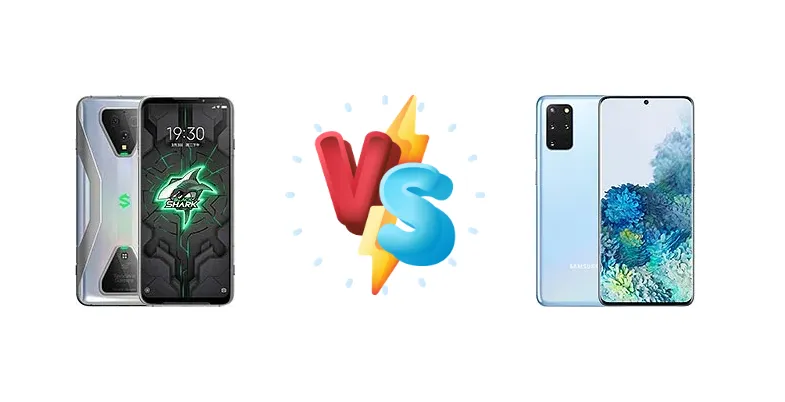
|
🏆 Quick Verdict
For dedicated mobile gamers, the Xiaomi Black Shark 3 is the clear winner, offering significantly faster 65W charging and a chipset optimized for sustained performance. However, the Samsung Galaxy S20+ 5G provides a more polished, versatile experience with a superior camera system and broader ecosystem integration, making it the better choice for everyday users.
| PHONES | ||
|---|---|---|
| Phone Names | Xiaomi Black Shark 3 | Samsung Galaxy S20+ 5G |
| Network | ||
|---|---|---|
| 2G bands | GSM 850 / 900 / 1800 / 1900 | GSM 850 / 900 / 1800 / 1900 |
| 3G bands | HSDPA 800 / 850 / 900 / 1700(AWS) / 1900 / 2100 | HSDPA 850 / 900 / 1700(AWS) / 1900 / 2100 |
| 4G bands | 1, 3, 4, 5, 7, 8, 12, 17, 20, 34, 38, 39, 40, 41 | 1, 2, 3, 4, 5, 7, 8, 12, 13, 17, 18, 19, 20, 25, 26, 28, 32, 38, 39, 40, 41, 66 - SM-G986B |
| 5G bands | 41, 78, 79 SA/NSA | 1, 3, 5, 7, 8, 28, 40, 77, 78 SA/NSA/Sub6 - SM-G986B |
| Speed | HSPA, LTE, 5G | HSPA 42.2/5.76 Mbps, LTE (7CA) Cat20 2000/200 Mbps, 5G (5+ Gbps DL) |
| Technology | GSM / CDMA / HSPA / EVDO / LTE / 5G | GSM / CDMA / HSPA / EVDO / LTE / 5G |
| CDMA2000 1xEV-DO | - | |
| Launch | ||
|---|---|---|
| Announced | 2020, March 03. Released 2020, March 06 | 2020, February 11 |
| Status | Discontinued | Available. Released 2020, March 06 |
| Body | ||
|---|---|---|
| Build | Glass front, aluminum back, aluminum frame | Glass front (Gorilla Glass 6), glass back (Gorilla Glass 6), aluminum frame |
| Dimensions | 168.7 x 77.3 x 10.4 mm (6.64 x 3.04 x 0.41 in) | 161.9 x 73.7 x 7.8 mm (6.37 x 2.90 x 0.31 in) |
| SIM | Nano-SIM + Nano-SIM | · Nano-SIM + eSIM· Nano-SIM + Nano-SIM |
| Weight | 222 g (7.83 oz) | 188 g (6.63 oz) |
| Display | ||
|---|---|---|
| Protection | - | Corning Gorilla Glass 6 |
| Resolution | 1080 x 2400 pixels, 20:9 ratio (~395 ppi density) | 1440 x 3200 pixels, 20:9 ratio (~525 ppi density) |
| Size | 6.67 inches, 107.4 cm2 (~82.4% screen-to-body ratio) | 6.7 inches, 108.0 cm2 (~90.5% screen-to-body ratio) |
| Type | AMOLED, 90Hz, HDR10+, 500 nits (typ) | Dynamic AMOLED 2X, 120Hz, HDR10+, 1200 nits (peak) |
| Always-on display | - | |
| Platform | ||
|---|---|---|
| CPU | Octa-core (1x2.84 GHz Cortex-A77 & 3x2.42 GHz Cortex-A77 & 4x1.80 GHz Cortex-A55) | Octa-core (2x2.73 GHz Mongoose M5 & 2x2.50 GHz Cortex-A76 & 4x2.0 GHz Cortex-A55) - GlobalOcta-core (1x2.84 GHz Cortex-A77 & 3x2.42 GHz Cortex-A77 & 4x1.80 GHz Cortex-A55) - USA |
| Chipset | Qualcomm SM8250 Snapdragon 865 5G (7 nm+) | Exynos 990 (7 nm+) - GlobalQualcomm SM8250 Snapdragon 865 5G (7 nm+) - USA |
| GPU | Adreno 650 | Mali-G77 MP11 - GlobalAdreno 650 - USA |
| OS | Android 10 | Android 10, upgradable to Android 13, One UI 5.1 |
| Memory | ||
|---|---|---|
| Card slot | No | microSDXC (uses shared SIM slot) |
| Internal | 128GB 8GB RAM, 128GB 12GB RAM, 256GB 12GB RAM | 128GB 8GB RAM, 128GB 12GB RAM, 256GB 12GB RAM, 512GB 12GB RAM |
| UFS 3.0 | - | |
| Main Camera | ||
|---|---|---|
| Features | LED flash, HDR, panorama | LED flash, auto-HDR, panorama |
| Triple | 64 MP, f/1.8, 26mm (wide), 1/1.72", 0.8µm, PDAF 13 MP, f/2.3, (ultrawide) Auxiliary lens | 12 MP, f/1.8, 26mm (wide), 1/1.76", 1.8µm, dual pixel PDAF, OIS 64 MP, f/2.0, 29mm (telephoto), 1/1.72", 0.8µm, PDAF, OIS, 1.1x optical zoom, 3x hybrid zoom 12 MP, f/2.2, 13mm, 120˚ (ultrawide), 1/2.55" 1.4µm, Super Steady video 0.3 MP, TOF 3D, f/1.0, (depth) |
| Video | 4K@30/60fps, 1080p@30/60/240fps, 720p@1920fps | 8K@24fps, 4K@30/60fps, 1080p@30/60/240fps, 720p@960fps, HDR10+, stereo sound rec., gyro-EIS & OIS |
| Selfie camera | ||
|---|---|---|
| Features | HDR | HDR |
| Single | 20 MP, f/2.2, (wide), 1/3", 0.9µm | 10 MP, f/2.2, 26mm (wide), 1/3.24", 1.22µm, dual pixel PDAF |
| Video | 1080p@30fps | 4K@30/60fps, 1080p@30fps |
| Sound | ||
|---|---|---|
| 3.5mm jack | Yes | No |
| 35mm jack | Yes | No |
| Loudspeaker | Yes, with stereo speakers | Yes, with stereo speakers |
| Comms | ||
|---|---|---|
| Bluetooth | 5.0, A2DP, LE, aptX HD, aptX Adaptive | 5.0, A2DP, LE |
| NFC | No | Yes |
| Positioning | GPS, GLONASS, GALILEO, QZSS, BDS | GPS, GLONASS, BDS, GALILEO |
| Radio | No | FM radio (Snapdragon model only; market/operator dependent) |
| USB | USB Type-C 2.0 | USB Type-C 3.2, OTG |
| WLAN | Wi-Fi 802.11 a/b/g/n/ac/6, dual-band, Wi-Fi Direct | Wi-Fi 802.11 a/b/g/n/ac/6, dual-band, Wi-Fi Direct |
| Features | ||
|---|---|---|
| Sensors | Fingerprint (under display, optical), accelerometer, gyro, proximity, compass | Fingerprint (under display, ultrasonic), accelerometer, gyro, proximity, compass, barometer |
| Battery | ||
|---|---|---|
| Charging | 65W wired, 100% in 38 min 30W wired (128/8 model) 18W magnetic wireless | 25W wired, PD3.0 15W wireless (Qi) 4.5W reverse wireless |
| Type | Li-Po 4720 mAh | Li-Ion 4500 mAh |
| Misc | ||
|---|---|---|
| Colors | Lightning Black, Armor Gray, Star Silver | Cosmic Black, Cosmic Grey, Cloud Blue, Cloud White, Aura Red, Aura Blue |
| Models | KLE-H0, KLE-A0 | SM-G986, SM-G986F, SM-G986F/DS, SM-G986U, SM-G986U1, SM-G9860, SM-G986B/DS, SM-G986N, SM-G986B, SM-G986W, SCG02 |
| Price | About 390 EUR | $ 174.17 / C$ 684.99 / € 299.97 |
| SAR | - | 1.08 W/kg (head) 1.02 W/kg (body) |
| SAR EU | - | 1.09 W/kg (head) 1.57 W/kg (body) |
Xiaomi Black Shark 3
- Blazing-fast 65W charging
- Optimized for sustained gaming performance
- Aggressive cooling system
- Likely inferior camera quality
- Bulky, gamer-centric design
Samsung Galaxy S20+ 5G
- Superior camera system with advanced features
- Refined software experience and ecosystem integration
- More balanced and versatile performance
- Slower 25W charging
- Potential for thermal throttling (Exynos variant)
Display Comparison
While both devices utilize 7nm+ fabrication, display details are limited. The S20+ likely boasts a higher peak brightness and potentially better color accuracy due to Samsung’s Display expertise. The Black Shark 3’s display is geared towards high refresh rates for gaming, but lacks specifics on peak brightness or color calibration. The S20+’s likely higher resolution and potentially LTPO technology (based on Samsung’s flagship offerings) would contribute to a smoother, more efficient viewing experience.
Camera Comparison
The S20+ 5G is expected to significantly outperform the Black Shark 3 in camera quality. While the Black Shark 3’s camera specs are not provided, Samsung’s flagship typically features larger sensors, advanced image processing algorithms, and optical image stabilization (OIS) on multiple lenses. The S20+’s camera system is designed for versatility, excelling in various lighting conditions and offering features like Single Take and Pro Video mode. The Black Shark 3 likely prioritizes functionality over image quality, focusing on capturing gameplay or quick snapshots.
Performance
The chipset is a key differentiator. The USA variant of the S20+ 5G shares the Snapdragon 865 with the Black Shark 3, offering comparable peak CPU performance with the Cortex-A77 cores. However, the global S20+ with the Exynos 990 faces potential thermal throttling issues due to its historically less efficient architecture compared to the Snapdragon. The Black Shark 3’s design, with its focus on cooling, is likely to sustain higher clock speeds for longer periods. The S20+ benefits from potentially faster RAM (LPDDR5x) depending on the region, but the Black Shark 3’s optimized software and cooling could offset this advantage.
Battery Life
The Black Shark 3’s 65W wired charging is a game-changer, achieving a full charge in just 38 minutes. This is a massive advantage over the S20+ 5G’s 25W charging, which, while supporting PD3.0, takes considerably longer. The Black Shark 3 also offers 18W magnetic wireless charging, while the S20+ 5G provides 15W Qi wireless charging and 4.5W reverse wireless charging. While battery capacity isn’t specified, the faster charging of the Black Shark 3 mitigates any potential capacity disadvantage.
Buying Guide
Buy the Xiaomi Black Shark 3 if you prioritize uninterrupted gaming sessions, demand the fastest possible charging speeds, and appreciate a more aggressive, gamer-centric design. Buy the Samsung Galaxy S20+ 5G if you value a premium camera experience, a refined software interface, and a more balanced smartphone experience that excels in everyday tasks alongside gaming.