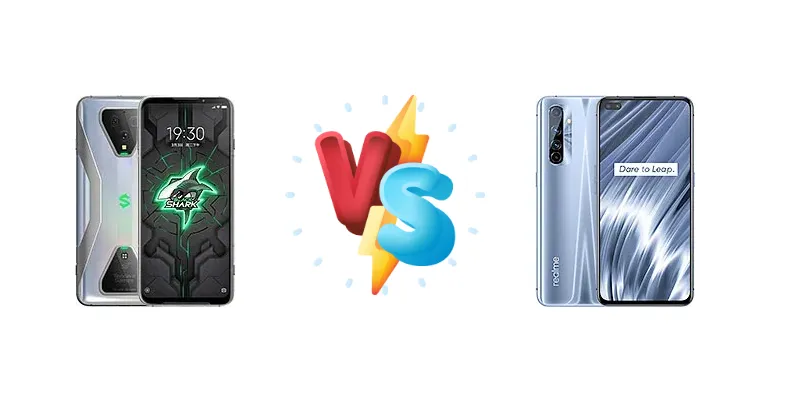
The Xiaomi Black Shark 3 and Realme X50 Pro Player represent a fascinating intersection of flagship power and aggressive pricing. Both leverage the Qualcomm Snapdragon 865, but diverge in their approach to delivering a premium experience. The Black Shark 3 doubles down on gaming-centric features, while the X50 Pro Player emphasizes fast charging and a more streamlined user experience. This comparison dissects their strengths and weaknesses to help you choose the right device.
🏆 Quick Verdict
For dedicated mobile gamers, the Xiaomi Black Shark 3 is the superior choice due to its specialized gaming features. However, the Realme X50 Pro Player offers a compelling alternative for users prioritizing rapid charging and a cleaner software experience, achieving a full charge in 35 minutes.
| Network |
|---|
| 2G bands | GSM 850 / 900 / 1800 / 1900 | GSM 850 / 900 / 1800 / 1900 |
| 3G bands | HSDPA 800 / 850 / 900 / 1700(AWS) / 1900 / 2100 | HSDPA 800 / 850 / 900 / 1700(AWS) / 1900 / 2100 |
| 4G bands | 1, 3, 4, 5, 7, 8, 12, 17, 20, 34, 38, 39, 40, 41 | 1, 2, 3, 4, 5, 7, 8, 12, 17, 20, 34, 38, 39, 40, 41 |
| 5G bands | 41, 78, 79 SA/NSA | 1, 3, 41, 77, 78, 79 SA/NSA |
| Speed | HSPA, LTE, 5G | HSPA, LTE, 5G |
| Technology | GSM / CDMA / HSPA / EVDO / LTE / 5G | GSM / CDMA / HSPA / EVDO / LTE / 5G |
| | CDMA2000 1xEV-DO | CDMA2000 1xEV-DO |
| Launch |
|---|
| Announced | 2020, March 03. Released 2020, March 06 | 2020, May 25. Released 2020, June 01 |
| Status | Discontinued | Discontinued |
| Body |
|---|
| Build | Glass front, aluminum back, aluminum frame | Glass front (Unspecified), glass back (Unspecified), aluminum frame |
| Dimensions | 168.7 x 77.3 x 10.4 mm (6.64 x 3.04 x 0.41 in) | 159 x 74.2 x 8.9 mm (6.26 x 2.92 x 0.35 in) |
| SIM | Nano-SIM + Nano-SIM | Nano-SIM + Nano-SIM |
| Weight | 222 g (7.83 oz) | 209 g (7.37 oz) |
| Display |
|---|
| Protection | - | Unspecified |
| Resolution | 1080 x 2400 pixels, 20:9 ratio (~395 ppi density) | 1080 x 2400 pixels, 20:9 ratio (~409 ppi density) |
| Size | 6.67 inches, 107.4 cm2 (~82.4% screen-to-body ratio) | 6.44 inches, 100.1 cm2 (~84.9% screen-to-body ratio) |
| Type | AMOLED, 90Hz, HDR10+, 500 nits (typ) | Super AMOLED, 90Hz, HDR10+ |
| | Always-on display | - |
| Platform |
|---|
| CPU | Octa-core (1x2.84 GHz Cortex-A77 & 3x2.42 GHz Cortex-A77 & 4x1.80 GHz Cortex-A55) | Octa-core (1x2.84 GHz Cortex-A77 & 3x2.42 GHz Cortex-A77 & 4x1.80 GHz Cortex-A55) |
| Chipset | Qualcomm SM8250 Snapdragon 865 5G (7 nm+) | Qualcomm SM8250 Snapdragon 865 5G (7 nm+) |
| GPU | Adreno 650 | Adreno 650 |
| OS | Android 10 | Android 10, Realme UI |
| Memory |
|---|
| Card slot | No | No |
| Internal | 128GB 8GB RAM, 128GB 12GB RAM, 256GB 12GB RAM | 128GB 6GB RAM, 128GB 8GB RAM, 128GB 12GB RAM |
| | UFS 3.0 | UFS 3.1 |
| Main Camera |
|---|
| Features | LED flash, HDR, panorama | LED flash, HDR, panorama |
| Quad | - | 48 MP, f/1.8, 26mm (wide), 1/2.0", 0.8µm, PDAF
8 MP, f/2.3, 119˚, 16mm (ultrawide)
2 MP (macro)
Auxiliary lens |
| Triple | 64 MP, f/1.8, 26mm (wide), 1/1.72", 0.8µm, PDAF
13 MP, f/2.3, (ultrawide)
Auxiliary lens | - |
| Video | 4K@30/60fps, 1080p@30/60/240fps, 720p@1920fps | 4K@30/60fps, 1080p@30/60/240/960fps; gyro-EIS |
| Selfie camera |
|---|
| Dual | - | 16 MP, f/2.5, 29mm (standard), 1/3.06", 1.0µm
2 MP, f/2.4, (depth) |
| Features | HDR | HDR |
| Single | 20 MP, f/2.2, (wide), 1/3", 0.9µm | - |
| Video | 1080p@30fps | 1080p@30/120fps, gyro-EIS |
| Sound |
|---|
| 3.5mm jack | Yes | No |
| 35mm jack | Yes | No |
| Loudspeaker | Yes, with stereo speakers | Yes, with dual speakers |
| | - | 24-bit/192kHz audio |
| Comms |
|---|
| Bluetooth | 5.0, A2DP, LE, aptX HD, aptX Adaptive | 5.1, A2DP, LE, aptX HD |
| NFC | No | Yes |
| Positioning | GPS, GLONASS, GALILEO, QZSS, BDS | GPS, GLONASS, BDS, NavIC |
| Radio | No | No |
| USB | USB Type-C 2.0 | USB Type-C 2.0 |
| WLAN | Wi-Fi 802.11 a/b/g/n/ac/6, dual-band, Wi-Fi Direct | Wi-Fi 802.11 a/b/g/n/ac/6, dual-band, Wi-Fi Direct |
| Features |
|---|
| Sensors | Fingerprint (under display, optical), accelerometer, gyro, proximity, compass | Fingerprint (under display, optical), accelerometer, gyro, proximity, compass |
| Battery |
|---|
| Charging | 65W wired, 100% in 38 min
30W wired (128/8 model)
18W magnetic wireless | 65W wired, PD, 100% in 35 min |
| Type | Li-Po 4720 mAh | 4200 mAh |
| Misc |
|---|
| Colors | Lightning Black, Armor Gray, Star Silver | Light Speed Silver, Phantom Black |
| Models | KLE-H0, KLE-A0 | RMX2072 |
| Price | About 390 EUR | About 350 EUR |
Xiaomi Black Shark 3
- Dedicated gaming triggers for enhanced control
- Likely superior cooling system for sustained performance
- Magnetic wireless charging offers convenience
- Potentially bulkier design due to cooling features
- Software may be heavily customized for gaming, not appealing to all
Realme X50 Pro Player
- Faster wired charging (35 minutes vs 38 minutes)
- PD charging support for wider compatibility
- Cleaner, more streamlined software experience
- Lacks dedicated gaming hardware like triggers
- Potentially more prone to thermal throttling under sustained load
Display Comparison
Both devices utilize displays capable of high refresh rates, though specific refresh rate data isn't provided. The shared Snapdragon 865 chipset ensures both can drive high frame rates. The absence of LTPO technology in either device suggests a less dynamic refresh rate adjustment, potentially impacting battery life during variable content viewing. Bezels are likely comparable given the similar market positioning, and color accuracy will depend on software calibration, a detail not specified in the provided data.
Camera Comparison
The provided data lacks specific camera details, making a direct comparison difficult. Given the market segment, both likely feature multi-camera setups. However, the X50 Pro Player, historically, has leaned towards more versatile camera systems. The Black Shark 3’s camera is likely tuned for quick snapshots and social media sharing, prioritizing speed over ultimate image quality. Without sensor size or aperture information, it’s reasonable to assume the X50 Pro Player offers a more refined camera experience.
Performance
Both the Black Shark 3 and X50 Pro Player are powered by the Qualcomm SM8250 Snapdragon 865 5G (7 nm+), featuring the same octa-core CPU configuration (1x2.84 GHz Cortex-A77, 3x2.42 GHz Cortex-A77, 4x1.80 GHz Cortex-A55). This means raw processing power will be virtually identical. However, the Black Shark 3’s cooling system, while not detailed in the data, is likely more aggressive to sustain peak performance during extended gaming sessions, potentially mitigating thermal throttling compared to the X50 Pro Player. RAM speed (LPDDR5) is assumed to be similar, but the Black Shark 3’s gaming optimizations could lead to more efficient memory management.
Battery Life
While mAh capacity isn't specified, the charging speeds are a key differentiator. The Black Shark 3 offers 65W wired charging (38 minutes to 100%), 30W for the 128/8GB model, and 18W magnetic wireless charging. The X50 Pro Player matches the 65W wired charging, achieving a full charge in 35 minutes, and supports PD (Power Delivery). The slightly faster charging time of the X50 Pro Player, combined with PD support for broader charger compatibility, gives it a slight edge in convenience. The Black Shark 3’s magnetic wireless charging is a unique feature, but slower than wired options.
Buying Guide
Buy the Xiaomi Black Shark 3 if you need dedicated gaming hardware like shoulder triggers, a robust cooling system, and a software experience tailored for performance. Buy the Realme X50 Pro Player if you prefer a faster-charging phone with a more conventional Android experience and value a slightly more refined design aesthetic. Both offer excellent value, but cater to different priorities.
Frequently Asked Questions
❓ Does the Black Shark 3's cooling system significantly reduce throttling during prolonged gaming sessions like Genshin Impact?
While the provided data doesn't quantify the cooling system's effectiveness, Black Shark is known for aggressive cooling solutions. This likely results in less performance throttling compared to the X50 Pro Player during extended gaming, allowing for more consistent frame rates over longer periods.
❓ Is the 65W charging on the Realme X50 Pro Player compatible with all USB-C chargers, or do I need a specific Power Delivery (PD) charger?
The X50 Pro Player supports Power Delivery (PD) charging. While it *may* charge with some non-PD USB-C chargers, you'll achieve the full 65W charging speed and optimal compatibility with a PD-compliant charger. Using a standard USB-C charger may result in slower charging times.
❓ Can the Black Shark 3's gaming triggers be customized for different games?
Yes, the Black Shark 3's shoulder triggers are fully customizable through the Shark Space software. You can map them to specific on-screen actions within supported games, providing a competitive advantage and a more console-like gaming experience.