
Xiaomi 17 vs 13T: A Deep Dive into Performance, Battery, and Value
| Phones Images | |||||
|---|---|---|---|---|---|
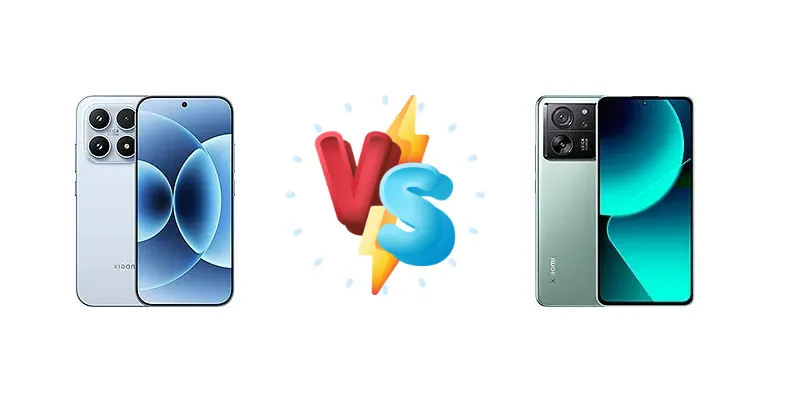
|
🏆 Quick Verdict
For most users, the Xiaomi 13T remains a highly capable and excellent value proposition. However, the Xiaomi 17’s Snapdragon 8 Elite Gen 5 delivers a significant performance leap, particularly in demanding tasks like gaming and video editing, making it the clear choice for those prioritizing raw power and future-proofing.
| PHONES | ||
|---|---|---|
| Phone Names | Xiaomi 17 | Xiaomi 13T |
| Network | ||
|---|---|---|
| 2G bands | GSM 850 / 900 / 1800 / 1900 | GSM 850 / 900 / 1800 / 1900 |
| 3G bands | HSDPA 800 / 850 / 900 / 1700(AWS) / 1900 / 2100 | HSDPA 800 / 850 / 900 / 1700(AWS) / 1900 / 2100 |
| 4G bands | 1, 2, 3, 4, 5, 7, 8, 12, 17, 18, 19, 20, 25, 26, 28, 34, 38, 39, 40, 41, 42, 48, 66 | 1, 2, 3, 4, 5, 7, 8, 12, 13, 17, 18, 19, 20, 26, 28, 32, 38, 40, 41, 66 |
| 5G bands | 1, 2, 3, 5, 7, 8, 12, 18, 20, 25, 26, 28, 38, 40, 41, 48, 66, 77, 78, 80, 81, 83, 84, 89 SA/NSA | 1, 3, 5, 7, 8, 20, 28, 38, 40, 41, 66, 77, 78 SA/NSA |
| Speed | HSPA, LTE, 5G | HSPA, LTE, 5G |
| Technology | GSM / HSPA / LTE / 5G | GSM / HSPA / LTE / 5G |
| Launch | ||
|---|---|---|
| Announced | 2025, September 25 | 2023, September 26 |
| Status | Available. Released 2025, September 27 | Available. Released 2023, September 26 |
| Body | ||
|---|---|---|
| Build | Glass front (Dragon Crystal Glass), aluminum frame | Glass front (Gorilla Glass 5), glass back or silicone polymer back, plastic frame |
| Dimensions | 151.1 x 71.8 x 8.1 mm (5.95 x 2.83 x 0.32 in) | 162.2 x 75.7 x 8.5 mm (6.39 x 2.98 x 0.33 in) |
| SIM | Nano-SIM + Nano-SIM | · Nano-SIM + eSIM· Nano-SIM + Nano-SIM |
| Weight | 191 g (6.74 oz) | 193 g or 197 g (6.81 oz) |
| Display | ||
|---|---|---|
| Protection | Xiaomi Dragon Crystal Glass | Corning Gorilla Glass 5 |
| Resolution | 1220 x 2656 pixels, 19.5:9 ratio (~464 ppi density) | 1220 x 2712 pixels, 20:9 ratio (~446 ppi density) |
| Size | 6.3 inches, 97.1 cm2 (~89.5% screen-to-body ratio) | 6.67 inches, 107.4 cm2 (~87.5% screen-to-body ratio) |
| Type | LTPO AMOLED, 68B colors, 2160Hz PWM, 120Hz, Dolby Vision, HDR Vivid, HDR10+, 3500 nits (peak) | AMOLED, 68B colors, 144Hz, Dolby Vision, HDR10+, 1200 nits (HBM), 2600 nits (peak) |
| Platform | ||
|---|---|---|
| CPU | Octa-core (2x4.6 GHz Oryon V3 Phoenix L + 6x3.62 GHz Oryon V3 Phoenix M) | Octa-core (1x3.1 GHz Cortex-A78 & 3x3.0 GHz Cortex-A78 & 4x2.0 GHz Cortex-A55) |
| Chipset | Qualcomm SM8850-AC Snapdragon 8 Elite Gen 5 (3 nm) | Mediatek Dimensity 8200 Ultra (4 nm) |
| GPU | Adreno 840 | Mali-G610 MC6 |
| OS | Android 16, HyperOS 3 | Android 13, up to 4 major Android upgrades, HyperOS |
| Memory | ||
|---|---|---|
| Card slot | No | No |
| Internal | 256GB 12GB RAM, 512GB 12GB RAM, 512GB 16GB RAM, 1TB 16GB RAM | 256GB 8GB RAM, 256GB 12GB RAM |
| Main Camera | ||
|---|---|---|
| Features | Laser AF, color spectrum sensor, Leica lens, Dual-LED dual-tone flash, HDR, panorama | Leica lens, color spectrum sensor, LED flash, HDR, panorama |
| Triple | 50 MP, f/1.7, 23mm (wide), 1/1.31", 1.2µm, dual pixel PDAF, OIS 50 MP, f/2.0, 60mm (telephoto), 1/2.76", 0.64µm, PDAF (10cm - ∞), OIS, 2.6x optical zoom 50 MP, f/2.4, 17mm, 102˚ (ultrawide), 1/2.76", 0.64µm | 50 MP, f/1.9, 24mm (wide), 1/1.28", 1.22µm, PDAF, OIS 50 MP, f/1.9, 50mm (telephoto), 1/2.88", 0.61µm, PDAF, 2x optical zoom 12 MP, f/2.2, 15mm (ultrawide), 1/3.06", 1.12µm |
| Video | 8K@30fps (HDR), 4K@30/60fps (HDR10+, 10-bit Dolby Vision HDR, 10-bit LOG), 1080p@30/60/120/240/960fps, 720p@1920fps, gyro-EIS | 4K@30fps (HDR10+), 1080p@30/60/120fps, gyro-EIS |
| Selfie camera | ||
|---|---|---|
| Features | HDR, panorama | HDR |
| Single | 50 MP, f/2.2, 21mm (wide), PDAF | 20 MP, f/2.2, (wide), 0.8µm |
| Video | 4K@30/60fps, 1080p@30/60fps, HDR10+, gyro-EIS | 1080p@30fps, HDR10+ |
| Sound | ||
|---|---|---|
| 35mm jack | No | No |
| Loudspeaker | Yes, with stereo speakers (with Dolby Atmos) | Yes, with stereo speakers |
| Comms | ||
|---|---|---|
| Bluetooth | 5.4, A2DP, LE, aptX HD, aptX Adaptive, LHDC 5 | 5.4, A2DP, LE |
| Infrared port | Yes | Yes |
| NFC | Yes | Yes (market/region dependent) |
| Positioning | GPS (L1+L5), BDS (B1I+B1c+B2a), GALILEO (E1+E5a), QZSS (L1+L5), NavIC (L5), GLONASS | GPS (L1+L5), GLONASS (G1), GALILEO (E1+E5a), QZSS (L1+L5), NavIC (L5), BDS |
| Radio | No | No |
| USB | USB Type-C 3.2, Display Port, OTG | USB Type-C 2.0, OTG |
| WLAN | Wi-Fi 802.11 a/b/g/n/ac/6/7, dual-band, Wi-Fi Direct | Wi-Fi 802.11 a/b/g/n/ac/6, dual-band |
| Features | ||
|---|---|---|
| Sensors | Fingerprint (under display, ultrasonic), accelerometer, proximity, gyro, compass, barometer | Fingerprint (under display, optical), accelerometer, gyro, proximity, compass |
| Battery | ||
|---|---|---|
| Charging | 100W wired, PD3.0, QC3+, 100W PPS 50W wireless 22.5W reverse wireless | 67W wired, PD3.0, QC4, 100% in 42 min |
| Type | Si/C Li-Ion 7000 mAh | Li-Po 5000 mAh |
| Misc | ||
|---|---|---|
| Colors | Black, Blue, Pink, White | Alpine Blue, Meadow Green, Black |
| Models | - | 2306EPN60G |
| Price | About 540 EUR | $ 255.96 / £ 326.27 / € 204.18 |
| SAR EU | - | 0.99 W/kg (head) 0.99 W/kg (body) |
Xiaomi 17
- Unmatched performance with Snapdragon 8 Elite Gen 5
- Significantly faster charging speeds (100W wired, 50W wireless)
- Potential for advanced camera features and image quality
- Likely higher price point
- Battery life potentially lower than 13T (pending testing)
Xiaomi 13T
- Excellent battery life (12:23h active use, 101h endurance)
- Bright and vibrant display (1264 nits)
- More affordable price
- Slower charging speeds (67W wired)
- Less powerful chipset (Dimensity 8200 Ultra)
Display Comparison
The Xiaomi 13T boasts a measured peak brightness of 1264 nits, ensuring excellent visibility even in direct sunlight. While the Xiaomi 17’s display specifications are currently unknown, given its flagship positioning, we anticipate a comparable or superior brightness level. The key differentiator will likely be panel technology; the 17 may incorporate LTPO for adaptive refresh rates, improving power efficiency. Bezels and color accuracy will also be critical areas of comparison, potentially favoring the newer model with advancements in display manufacturing.
Camera Comparison
Detailed camera analysis is hampered by a lack of Xiaomi 17 camera specifications. However, given its flagship status, we expect a significant upgrade in sensor size and image processing capabilities. The Xiaomi 13T offers a competent photo and video experience, but the 17 is likely to feature a larger main sensor with improved low-light performance and enhanced optical image stabilization (OIS). The focus will be on computational photography advancements, leveraging the Snapdragon 8 Elite Gen 5’s ISP for superior image quality and dynamic range. We anticipate the 17 will also offer more advanced video recording features, such as 8K recording and improved stabilization.
Performance
The core of the difference lies in the chipsets. The Xiaomi 17’s Qualcomm SM8850-AC Snapdragon 8 Elite Gen 5 (3nm) represents a substantial leap over the Xiaomi 13T’s Mediatek Dimensity 8200 Ultra (4nm). The Snapdragon 8 Elite Gen 5 utilizes Oryon V3 Phoenix cores – two high-performance 'L' cores clocked at 4.6 GHz and six efficiency 'M' cores at 3.62 GHz – offering a more sophisticated architecture than the Dimensity 8200 Ultra’s Cortex-A78 and A55 configuration. The 3nm process node of the Snapdragon promises significantly improved power efficiency and thermal management, reducing throttling during sustained workloads. This translates to longer gaming sessions and faster rendering times for the Xiaomi 17. The 13T’s Dimensity 8200 Ultra remains a capable performer, but will struggle to match the 17’s peak performance.
Battery Life
The Xiaomi 13T delivers a solid 12:23h of active use and an impressive endurance rating of 101 hours, showcasing excellent battery optimization. The Xiaomi 17, while lacking specific battery life data, compensates with significantly faster charging capabilities. Its 100W wired charging (supporting PD3.0, QC3+, and 100W PPS), 50W wireless charging, and 22.5W reverse wireless charging far surpass the 13T’s 67W wired charging and 42-minute 0-100% time. The 17’s faster charging mitigates any potential battery life disadvantage, allowing for quick top-ups throughout the day. The inclusion of PPS support also indicates more efficient charging with compatible adapters.
Buying Guide
Buy the Xiaomi 17 if you demand the absolute best performance available in a smartphone, frequently engage in graphically intensive gaming, or rely on your phone for professional content creation. Buy the Xiaomi 13T if you prioritize excellent battery life, a bright and vibrant display, and a more affordable price point without sacrificing core smartphone functionality.