
Xiaomi 17 vs Xiaomi 13 Pro: A Deep Dive into Xiaomi's Flagship Showdown
| Phones Images | |||||
|---|---|---|---|---|---|
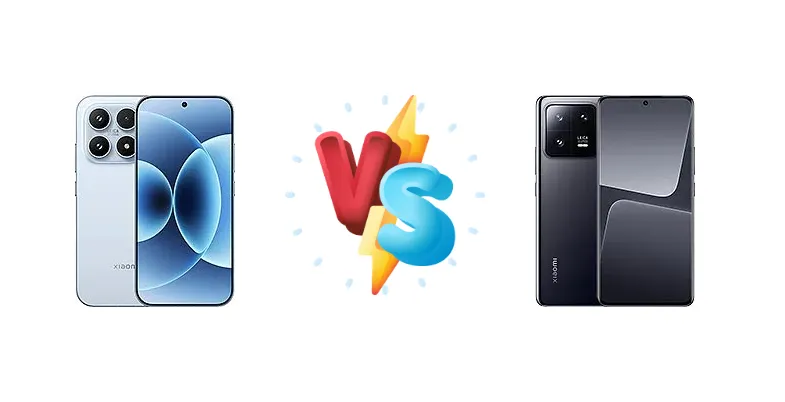
|
🏆 Quick Verdict
For users prioritizing raw performance and future-proofing, the Xiaomi 17 is the clear winner thanks to its Snapdragon 8 Elite Gen 5. However, the Xiaomi 13 Pro remains a compelling choice, offering excellent battery life (10:55h active use) and a refined experience at a potentially lower price point.
| PHONES | ||
|---|---|---|
| Phone Names | Xiaomi 17 | Xiaomi 13 Pro |
| Network | ||
|---|---|---|
| 2G bands | GSM 850 / 900 / 1800 / 1900 | GSM 850 / 900 / 1800 / 1900 |
| 3G bands | HSDPA 800 / 850 / 900 / 1700(AWS) / 1900 / 2100 | HSDPA 800 / 850 / 900 / 1700(AWS) / 1900 / 2100 |
| 4G bands | 1, 2, 3, 4, 5, 7, 8, 12, 17, 18, 19, 20, 25, 26, 28, 34, 38, 39, 40, 41, 42, 48, 66 | 1, 2, 3, 4, 5, 7, 8, 12, 13, 17, 18, 19, 20, 25, 26, 28, 32, 38, 39, 40, 41, 42, 48, 66 - International |
| 5G bands | 1, 2, 3, 5, 7, 8, 12, 18, 20, 25, 26, 28, 38, 40, 41, 48, 66, 77, 78, 80, 81, 83, 84, 89 SA/NSA | 1, 3, 5, 7, 8, 20, 28, 38, 40, 41, 66, 71, 75, 77, 78 SA/NSA - International |
| Speed | HSPA, LTE, 5G | HSPA, LTE, 5G |
| Technology | GSM / HSPA / LTE / 5G | GSM / CDMA / HSPA / CDMA2000 / LTE / 5G |
| - | 1, 3, 5, 8, 28, 38, 40, 41, 77, 78, 79 SA/NSA - China | |
| Launch | ||
|---|---|---|
| Announced | 2025, September 25 | 2022, December 11 |
| Status | Available. Released 2025, September 27 | Available. Released 2022, December 14 |
| Body | ||
|---|---|---|
| Build | Glass front (Dragon Crystal Glass), aluminum frame | Glass front (Gorilla Glass Victus), ceramic back or silicone polymer back, aluminum frame |
| Dimensions | 151.1 x 71.8 x 8.1 mm (5.95 x 2.83 x 0.32 in) | 162.9 x 74.6 x 8.4 mm or 8.7 mm |
| SIM | Nano-SIM + Nano-SIM | · Nano-SIM + eSIM· Nano-SIM + Nano-SIM |
| Weight | 191 g (6.74 oz) | 210 g or 229 g (7.41 oz) |
| - | IP68 dust/water resistant (up to 1.5m for 30 min) | |
| Display | ||
|---|---|---|
| Protection | Xiaomi Dragon Crystal Glass | Corning Gorilla Glass Victus |
| Resolution | 1220 x 2656 pixels, 19.5:9 ratio (~464 ppi density) | 1440 x 3200 pixels, 20:9 ratio (~522 ppi density) |
| Size | 6.3 inches, 97.1 cm2 (~89.5% screen-to-body ratio) | 6.73 inches, 108.9 cm2 (~89.6% screen-to-body ratio) |
| Type | LTPO AMOLED, 68B colors, 2160Hz PWM, 120Hz, Dolby Vision, HDR Vivid, HDR10+, 3500 nits (peak) | LTPO AMOLED, 1B colors, 120Hz, Dolby Vision, HDR10+, 1200 nits (HBM), 1900 nits (peak) |
| Platform | ||
|---|---|---|
| CPU | Octa-core (2x4.6 GHz Oryon V3 Phoenix L + 6x3.62 GHz Oryon V3 Phoenix M) | Octa-core (1x3.2 GHz Cortex-X3 & 2x2.8 GHz Cortex-A715 & 2x2.8 GHz Cortex-A710 & 3x2.0 GHz Cortex-A510) |
| Chipset | Qualcomm SM8850-AC Snapdragon 8 Elite Gen 5 (3 nm) | Qualcomm SM8550-AB Snapdragon 8 Gen 2 (4 nm) |
| GPU | Adreno 840 | Adreno 740 |
| OS | Android 16, HyperOS 3 | Android 13, upgradable to Android 14, HyperOS |
| Memory | ||
|---|---|---|
| Card slot | No | No |
| Internal | 256GB 12GB RAM, 512GB 12GB RAM, 512GB 16GB RAM, 1TB 16GB RAM | 128GB 8GB RAM, 256GB 8GB RAM, 256GB 12GB RAM, 512GB 12GB RAM |
| - | UFS 3.1 - 128GB UFS 4.0 - 256/512GB | |
| Main Camera | ||
|---|---|---|
| Features | Laser AF, color spectrum sensor, Leica lens, Dual-LED dual-tone flash, HDR, panorama | Laser AF, color spectrum sensor, Leica lens, Dual-LED dual-tone flash, HDR, panorama |
| Triple | 50 MP, f/1.7, 23mm (wide), 1/1.31", 1.2µm, dual pixel PDAF, OIS 50 MP, f/2.0, 60mm (telephoto), 1/2.76", 0.64µm, PDAF (10cm - ∞), OIS, 2.6x optical zoom 50 MP, f/2.4, 17mm, 102˚ (ultrawide), 1/2.76", 0.64µm | 50.3 MP, f/1.9, 23mm (wide), 1.0"-type, 1.6µm, dual pixel PDAF, OIS 50 MP, f/2.0, 75mm (telephoto), PDAF (10cm - ∞), 3.2x optical zoom 50 MP, f/2.2, 14mm, 115˚ (ultrawide), AF |
| Video | 8K@30fps (HDR), 4K@30/60fps (HDR10+, 10-bit Dolby Vision HDR, 10-bit LOG), 1080p@30/60/120/240/960fps, 720p@1920fps, gyro-EIS | 8K@24fps (HDR), 4K@24/30/60fps (HDR10+, 10-bit Dolby Vision HDR, 10-bit LOG), 1080p@30/120/240/960fps, 1080p@1920fps, gyro-EIS |
| Selfie camera | ||
|---|---|---|
| Features | HDR, panorama | HDR, panorama |
| Single | 50 MP, f/2.2, 21mm (wide), PDAF | 32 MP, f/2.0, 22mm (wide), 1/3.14", 0.7µm |
| Video | 4K@30/60fps, 1080p@30/60fps, HDR10+, gyro-EIS | 1080p@30fps |
| Sound | ||
|---|---|---|
| 3.5mm jack | - | No |
| 35mm jack | No | No |
| Loudspeaker | Yes, with stereo speakers (with Dolby Atmos) | Yes, with stereo speakers |
| - | 24-bit/192kHz audio | |
| Comms | ||
|---|---|---|
| Bluetooth | 5.4, A2DP, LE, aptX HD, aptX Adaptive, LHDC 5 | 5.3, A2DP, aptX HD, aptX Adaptive |
| Infrared port | Yes | Yes |
| NFC | Yes | Yes |
| Positioning | GPS (L1+L5), BDS (B1I+B1c+B2a), GALILEO (E1+E5a), QZSS (L1+L5), NavIC (L5), GLONASS | GPS (L1+L5), GLONASS (G1), BDS (B1I+B1c+B2a), GALILEO (E1+E5a), QZSS (L1+L5), NavIC (L5) |
| Radio | No | No |
| USB | USB Type-C 3.2, Display Port, OTG | USB Type-C 2.0, OTG |
| WLAN | Wi-Fi 802.11 a/b/g/n/ac/6/7, dual-band, Wi-Fi Direct | Wi-Fi 802.11 a/b/g/n/ac/6e, dual-band, Wi-Fi Direct |
| Features | ||
|---|---|---|
| Sensors | Fingerprint (under display, ultrasonic), accelerometer, proximity, gyro, compass, barometer | Fingerprint (under display, optical), accelerometer, proximity, gyro, compass, barometer |
| Battery | ||
|---|---|---|
| Charging | 100W wired, PD3.0, QC3+, 100W PPS 50W wireless 22.5W reverse wireless | 120W wired, PD3.0, QC4, 100% in 19 min 50W wireless, 100% in 36 min 10W reverse wireless |
| Type | Si/C Li-Ion 7000 mAh | Li-Po 4820 mAh |
| Misc | ||
|---|---|---|
| Colors | Black, Blue, Pink, White | Ceramic White, Ceramic Black, Ceramic Flora Green, Mountain Blue |
| Models | - | 2210132G, 2210132C |
| Price | About 540 EUR | About 750 EUR |
| Tests | ||
|---|---|---|
| Battery life | - | Endurance rating 115h |
| Camera | - | Photo / Video |
| Display | - | Contrast ratio: Infinite (nominal) |
| Loudspeaker | - | -25.6 LUFS (Very good) |
| Performance | - | AnTuTu: 1281666 (v9) GeekBench: 5087 (v5.1), 5323 (v6) GFXBench: 64fps (ES 3.1 onscreen) |
Xiaomi 17
- Significantly faster processor with Snapdragon 8 Elite Gen 5
- Improved reverse wireless charging (22.5W)
- Potential for enhanced thermal efficiency due to 3nm process
- Battery capacity currently unknown
- Higher price expected
Xiaomi 13 Pro
- Excellent battery life (10:55h active use)
- Fast 120W wired charging
- Proven camera performance
- Older generation Snapdragon 8 Gen 2
- Slower reverse wireless charging (10W)
Display Comparison
The Xiaomi 13 Pro boasts a bright display, peaking at 1253 nits, ensuring excellent visibility even in direct sunlight. While the Xiaomi 17’s display specs are currently unknown, we anticipate a similar or improved brightness level given its flagship status. The 13 Pro’s infinite contrast ratio (nominal) delivers deep blacks and vibrant colors. The key differentiator will likely be the display technology employed by the Xiaomi 17 – potential advancements in LTPO for variable refresh rates and power efficiency will be crucial. Bezels and color accuracy will also be key areas to compare upon the Xiaomi 17’s full reveal.
Camera Comparison
Both devices are expected to offer robust camera systems, focusing on photo and video capabilities. However, without specific sensor details for the Xiaomi 17, it’s difficult to make a definitive comparison. The Xiaomi 13 Pro’s camera performance is well-regarded, but the Xiaomi 17 has the opportunity to leapfrog it with a larger main sensor, improved image processing algorithms, and enhanced optical image stabilization (OIS). We anticipate Xiaomi will focus on computational photography advancements in the 17, leveraging the increased processing power of the Snapdragon 8 Elite Gen 5. Ignoring the typical 2MP macro lens found on many smartphones, the quality of the primary and ultrawide sensors will be the deciding factor.
Performance
The core battleground is the chipset. The Xiaomi 17’s Snapdragon 8 Elite Gen 5 (3nm) represents a significant architectural shift with its Oryon V3 Phoenix CPU cores. The octa-core configuration (2x4.6 GHz Phoenix L + 6x3.62 GHz Phoenix M) promises substantial gains over the Xiaomi 13 Pro’s Snapdragon 8 Gen 2 (4nm) which uses a more traditional Cortex-X3/A715/A710/A510 setup peaking at 3.2 GHz. The 3nm process node of the 8 Elite Gen 5 should translate to improved thermal efficiency, potentially reducing throttling during sustained workloads. The Xiaomi 17 is poised to deliver a noticeable performance uplift in CPU-intensive tasks and gaming. RAM speed (likely LPDDR5x on both) will also play a role, but the CPU architecture is the primary differentiator.
Battery Life
The Xiaomi 13 Pro achieves an impressive 10:55h active use score and an endurance rating of 115 hours, demonstrating excellent battery life. The Xiaomi 17 features faster charging capabilities – 100W wired (vs 120W on the 13 Pro), 50W wireless (matching the 13 Pro), and 22.5W reverse wireless (significantly improved from the 13 Pro’s 10W). While the Xiaomi 17’s battery capacity is unknown, the faster charging speeds, particularly the 100W PPS support, will allow for quicker top-ups. The 13 Pro’s 120W wired charging achieves 100% in 19 minutes, while the 17’s 100W should be close. The improved reverse wireless charging on the 17 is a boon for users who frequently charge accessories.
Buying Guide
Buy the Xiaomi 17 if you demand the absolute fastest Android performance for demanding tasks like gaming and video editing, and are willing to pay a premium for the latest technology. Buy the Xiaomi 13 Pro if you prioritize a balanced experience with excellent battery life, a proven camera system, and potentially better value for your money, especially if you can find it at a discounted price.