
Xiaomi 17 vs. Samsung Galaxy S23 Ultra: The Ultimate Android Flagship Showdown
| Phones Images | |||||
|---|---|---|---|---|---|
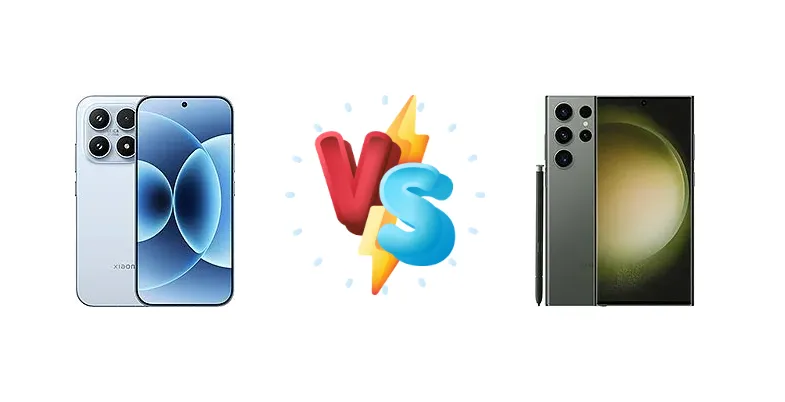
|
🏆 Quick Verdict
For the power user prioritizing raw performance and blazing-fast charging, the Xiaomi 17 takes the lead. However, the Samsung Galaxy S23 Ultra offers a more polished, refined experience with exceptional battery endurance and a consistently excellent camera system, making it the better choice for the average user.
| PHONES | ||
|---|---|---|
| Phone Names | Xiaomi 17 | Samsung Galaxy S23 Ultra |
| Network | ||
|---|---|---|
| 2G bands | GSM 850 / 900 / 1800 / 1900 | GSM 850 / 900 / 1800 / 1900 |
| 3G bands | HSDPA 800 / 850 / 900 / 1700(AWS) / 1900 / 2100 | HSDPA 850 / 900 / 1700(AWS) / 1900 / 2100 |
| 4G bands | 1, 2, 3, 4, 5, 7, 8, 12, 17, 18, 19, 20, 25, 26, 28, 34, 38, 39, 40, 41, 42, 48, 66 | 1, 2, 3, 4, 5, 7, 8, 12, 13, 17, 18, 19, 20, 25, 26, 28, 32, 38, 39, 40, 41, 66 - International |
| 5G bands | 1, 2, 3, 5, 7, 8, 12, 18, 20, 25, 26, 28, 38, 40, 41, 48, 66, 77, 78, 80, 81, 83, 84, 89 SA/NSA | 1, 2, 3, 5, 7, 8, 12, 20, 25, 28, 38, 40, 41, 66, 75, 77, 78 SA/NSA/Sub6 - International |
| Speed | HSPA, LTE, 5G | HSPA, LTE (up to 7CA), 5G |
| Technology | GSM / HSPA / LTE / 5G | GSM / CDMA / HSPA / EVDO / LTE / 5G |
| - | 1, 7, 28, 41, 66, 71, 78, 258, 260, 261 SA/NSA/Sub6/mmWave - USA | |
| Launch | ||
|---|---|---|
| Announced | 2025, September 25 | 2023, February 01 |
| Status | Available. Released 2025, September 27 | Available. Released 2023, February 17 |
| Body | ||
|---|---|---|
| Build | Glass front (Dragon Crystal Glass), aluminum frame | Glass front (Gorilla Glass Victus 2), glass back (Gorilla Glass Victus 2), aluminum frame |
| Dimensions | 151.1 x 71.8 x 8.1 mm (5.95 x 2.83 x 0.32 in) | 163.4 x 78.1 x 8.9 mm (6.43 x 3.07 x 0.35 in) |
| SIM | Nano-SIM + Nano-SIM | · Nano-SIM + eSIM· Nano-SIM + Nano-SIM + eSIM (max 2 at a time) |
| Weight | 191 g (6.74 oz) | 234 g (8.25 oz) |
| - | IP68 dust/water resistant (up to 1.5m for 30 min) Armor aluminum frame with tougher drop and scratch resistance (advertised) Stylus (Bluetooth integration, accelerometer, gyro) | |
| Display | ||
|---|---|---|
| Protection | Xiaomi Dragon Crystal Glass | Corning Gorilla Glass Victus 2 |
| Resolution | 1220 x 2656 pixels, 19.5:9 ratio (~464 ppi density) | 1440 x 3088 pixels, 19.3:9 ratio (~500 ppi density) |
| Size | 6.3 inches, 97.1 cm2 (~89.5% screen-to-body ratio) | 6.8 inches, 114.7 cm2 (~89.9% screen-to-body ratio) |
| Type | LTPO AMOLED, 68B colors, 2160Hz PWM, 120Hz, Dolby Vision, HDR Vivid, HDR10+, 3500 nits (peak) | Dynamic AMOLED 2X, 120Hz, HDR10+, 1200 nits (HBM), 1750 nits (peak) |
| - | Always-on display | |
| Platform | ||
|---|---|---|
| CPU | Octa-core (2x4.6 GHz Oryon V3 Phoenix L + 6x3.62 GHz Oryon V3 Phoenix M) | Octa-core (1x3.36 GHz Cortex-X3 & 2x2.8 GHz Cortex-A715 & 2x2.8 GHz Cortex-A710 & 3x2.0 GHz Cortex-A510) |
| Chipset | Qualcomm SM8850-AC Snapdragon 8 Elite Gen 5 (3 nm) | Qualcomm SM8550-AC Snapdragon 8 Gen 2 (4 nm) |
| GPU | Adreno 840 | Adreno 740 |
| OS | Android 16, HyperOS 3 | Android 13, up to 4 major Android upgrades, One UI 8 |
| Memory | ||
|---|---|---|
| Card slot | No | No |
| Internal | 256GB 12GB RAM, 512GB 12GB RAM, 512GB 16GB RAM, 1TB 16GB RAM | 256GB 8GB RAM, 256GB 12GB RAM, 512GB 12GB RAM, 1TB 12GB RAM |
| - | UFS 4.0 | |
| Main Camera | ||
|---|---|---|
| Features | Laser AF, color spectrum sensor, Leica lens, Dual-LED dual-tone flash, HDR, panorama | Laser AF, LED flash, auto-HDR, panorama |
| Quad | - | 200 MP, f/1.7, 24mm (wide), 1/1.3", 0.6µm, multi-directional PDAF, OIS 10 MP, f/2.4, 70mm (telephoto), 1/3.52", 1.12µm, PDAF, OIS, 3x optical zoom 10 MP, f/4.9, 230mm (periscope telephoto), 1/3.52", 1.12µm, PDAF, OIS, 10x optical zoom 12 MP, f/2.2, 13mm, 120˚ (ultrawide), 1/2.55", 1.4µm, dual pixel PDAF, Super Steady video |
| Single | - | 12 MP, f/2.2, 26mm (wide), Dual Pixel PDAF |
| Triple | 50 MP, f/1.7, 23mm (wide), 1/1.31", 1.2µm, dual pixel PDAF, OIS 50 MP, f/2.0, 60mm (telephoto), 1/2.76", 0.64µm, PDAF (10cm - ∞), OIS, 2.6x optical zoom 50 MP, f/2.4, 17mm, 102˚ (ultrawide), 1/2.76", 0.64µm | - |
| Video | 8K@30fps (HDR), 4K@30/60fps (HDR10+, 10-bit Dolby Vision HDR, 10-bit LOG), 1080p@30/60/120/240/960fps, 720p@1920fps, gyro-EIS | 8K@24/30fps, 4K@30/60fps, 1080p@30/60/120/240fps, HDR10+, stereo sound rec., gyro-EIS |
| Selfie camera | ||
|---|---|---|
| Features | HDR, panorama | HDR, HDR10+ |
| Single | 50 MP, f/2.2, 21mm (wide), PDAF | 12 MP, f/2.2, 26mm (wide), 1/3.2", 1.12µm, dual pixel PDAF |
| Video | 4K@30/60fps, 1080p@30/60fps, HDR10+, gyro-EIS | 4K@30/60fps, 1080p@30fps |
| Sound | ||
|---|---|---|
| 3.5mm jack | - | No |
| 35mm jack | No | No |
| Loudspeaker | Yes, with stereo speakers (with Dolby Atmos) | Yes, with stereo speakers |
| - | 32-bit/384kHz audio Tuned by AKG | |
| Comms | ||
|---|---|---|
| Bluetooth | 5.4, A2DP, LE, aptX HD, aptX Adaptive, LHDC 5 | 5.3, A2DP, LE |
| Infrared port | Yes | - |
| NFC | Yes | Yes |
| Positioning | GPS (L1+L5), BDS (B1I+B1c+B2a), GALILEO (E1+E5a), QZSS (L1+L5), NavIC (L5), GLONASS | GPS, GALILEO, GLONASS, BDS, QZSS |
| Radio | No | No |
| USB | USB Type-C 3.2, Display Port, OTG | USB Type-C 3.2, OTG |
| WLAN | Wi-Fi 802.11 a/b/g/n/ac/6/7, dual-band, Wi-Fi Direct | Wi-Fi 802.11 a/b/g/n/ac/6e, tri-band, Wi-Fi Direct |
| Features | ||
|---|---|---|
| Sensors | Fingerprint (under display, ultrasonic), accelerometer, proximity, gyro, compass, barometer | Fingerprint (under display, ultrasonic), accelerometer, gyro, proximity, compass, barometer |
| - | Samsung DeX, Samsung Wireless DeX (desktop experience support) Bixby natural language commands and dictation Samsung Pay (Visa, MasterCard certified) Ultra Wideband (UWB) support | |
| Battery | ||
|---|---|---|
| Charging | 100W wired, PD3.0, QC3+, 100W PPS 50W wireless 22.5W reverse wireless | 45W wired, PD3.0, 65% in 30 min 15W wireless (Qi) 4.5W reverse wireless |
| Type | Si/C Li-Ion 7000 mAh | Li-Ion 5000 mAh |
| Misc | ||
|---|---|---|
| Colors | Black, Blue, Pink, White | Phantom Black, Green, Cream, Lavender, Graphite, Sky Blue, Lime, Red, BMW M Edition |
| Models | - | SM-S918B, SM-S918B/DS, SM-S918U, SM-S918U1, SM-S918W, SM-S918N, SM-S9180, SM-S918E, SM-S918E/DS |
| Price | About 540 EUR | € 549.90 / $ 454.99 / £ 433.00 |
| SAR | - | 1.12 W/kg (head) 0.92 W/kg (body) |
| SAR EU | - | 0.96 W/kg (head) 1.40 W/kg (body) |
| Tests | ||
|---|---|---|
| Battery life | - | Endurance rating 126h |
| Camera | - | Photo / Video |
| Display | - | Contrast ratio: Infinite (nominal) |
| Loudspeaker | - | -25.6 LUFS (Very good) |
| Performance | - | AnTuTu: 1241531 (v9) GeekBench: 4927 (v5.1) GFXBench: 67fps (ES 3.1 onscreen) |
Xiaomi 17
- Blazing-fast 100W wired charging
- Potentially superior CPU performance with Oryon cores
- 3nm Snapdragon 8 Elite Gen 5 offers improved efficiency
- Camera specs currently unknown
- Battery capacity not specified, potential for shorter runtime
Samsung Galaxy S23 Ultra
- Exceptional battery life (126h endurance)
- Proven camera system with versatile features
- Mature software ecosystem and long-term support
- Slower 45W wired charging
- Snapdragon 8 Gen 2 (4nm) is less powerful than the 8 Elite Gen 5
Display Comparison
The Samsung Galaxy S23 Ultra’s display boasts a measured peak brightness of 1274 nits, ensuring excellent visibility even in direct sunlight. While the Xiaomi 17’s display specs are currently unknown, Samsung’s ‘Infinite’ contrast ratio suggests a superior viewing experience. The S23 Ultra likely utilizes LTPO technology for adaptive refresh rates, conserving battery life. Without Xiaomi 17’s panel details, it’s difficult to assess color accuracy or PWM dimming rates, but Samsung’s track record in these areas is strong.
Camera Comparison
Both devices feature capable camera systems, but details beyond 'Photo / Video' are lacking for the Xiaomi 17. The S23 Ultra is known for its versatile camera array, likely including a high-resolution main sensor and advanced image processing. Without knowing the Xiaomi 17’s sensor sizes, apertures, or OIS implementation, it’s difficult to make a direct comparison. The S23 Ultra’s established reputation for consistent image quality and video stabilization gives it an edge. We’d need to see sample images and detailed camera specs from the Xiaomi 17 to assess its capabilities accurately.
Performance
The Xiaomi 17’s Qualcomm SM8850-AC Snapdragon 8 Elite Gen 5, built on a 3nm process, represents a significant leap in efficiency and performance. Its octa-core CPU, featuring Oryon V3 Phoenix cores (2x4.6 GHz L + 6x3.62 GHz M), promises substantial gains over the S23 Ultra’s Snapdragon 8 Gen 2 (4nm). The Oryon architecture, designed by Nuvia, focuses on single-core performance, crucial for responsiveness. However, the S23 Ultra’s Gen 2 is no slouch, and its thermal management is well-established. The 3nm node of the Xiaomi 17 should translate to lower temperatures under sustained load, potentially reducing throttling. The S23 Ultra benefits from optimized software and a mature platform.
Battery Life
The Samsung Galaxy S23 Ultra achieves an impressive endurance rating of 126 hours and 13:24h of active use, demonstrating excellent battery life. It supports 45W wired charging, reaching 65% in 30 minutes, alongside 15W wireless charging. The Xiaomi 17, with its 100W wired charging, significantly outperforms the S23 Ultra in charging speed, promising a full charge in under 30 minutes. It also offers 50W wireless and 22.5W reverse wireless charging, exceeding the S23 Ultra’s capabilities. While the Xiaomi 17’s battery capacity is unknown, the faster charging could offset a potentially smaller battery size.
Buying Guide
Buy the Xiaomi 17 if you demand the absolute fastest Android performance, frequently engage in demanding mobile gaming, and value the convenience of 100W wired and 50W wireless charging. Buy the Samsung Galaxy S23 Ultra if you prioritize all-day battery life, a consistently reliable camera experience, and a mature software ecosystem with long-term support.