
Xiaomi 17 vs. Samsung Galaxy S23 FE: A Deep Dive into Performance and Value
| Phones Images | |||||
|---|---|---|---|---|---|
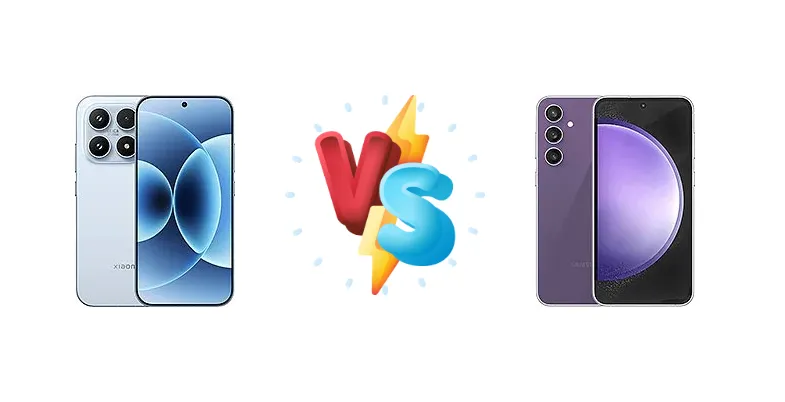
|
🏆 Quick Verdict
For users prioritizing raw performance and cutting-edge charging technology, the Xiaomi 17 emerges as the clear winner. Its Snapdragon 8 Elite Gen 5 offers a substantial leap over the S23 FE’s Exynos 2200 (or Snapdragon 8 Gen 1), justifying its likely higher price tag. However, the S23 FE remains a compelling option for those seeking a balanced experience with a proven camera system.
| PHONES | ||
|---|---|---|
| Phone Names | Xiaomi 17 | Samsung Galaxy S23 FE |
| Network | ||
|---|---|---|
| 2G bands | GSM 850 / 900 / 1800 / 1900 | GSM 850 / 900 / 1800 / 1900 |
| 3G bands | HSDPA 800 / 850 / 900 / 1700(AWS) / 1900 / 2100 | HSDPA 850 / 900 / 1700(AWS) / 1900 / 2100 |
| 4G bands | 1, 2, 3, 4, 5, 7, 8, 12, 17, 18, 19, 20, 25, 26, 28, 34, 38, 39, 40, 41, 42, 48, 66 | 1, 2, 3, 4, 5, 7, 8, 12, 13, 17, 20, 26, 28, 38, 40, 41, 66 - International |
| 5G bands | 1, 2, 3, 5, 7, 8, 12, 18, 20, 25, 26, 28, 38, 40, 41, 48, 66, 77, 78, 80, 81, 83, 84, 89 SA/NSA | 1, 2, 3, 5, 7, 8, 20, 28, 38, 40, 41, 66, 77, 78 SA/NSA/Sub6 - International |
| Speed | HSPA, LTE, 5G | HSPA, LTE, 5G |
| Technology | GSM / HSPA / LTE / 5G | GSM / HSPA / LTE / 5G |
| Launch | ||
|---|---|---|
| Announced | 2025, September 25 | 2023, October 04 |
| Status | Available. Released 2025, September 27 | Available. Released 2023, October 05 |
| Body | ||
|---|---|---|
| Build | Glass front (Dragon Crystal Glass), aluminum frame | Glass front (Gorilla Glass 5), glass back (Gorilla Glass 5), aluminum frame |
| Dimensions | 151.1 x 71.8 x 8.1 mm (5.95 x 2.83 x 0.32 in) | 158 x 76.5 x 8.2 mm (6.22 x 3.01 x 0.32 in) |
| SIM | Nano-SIM + Nano-SIM | · Nano-SIM· Nano-SIM + Nano-SIM· Nano-SIM + Nano-SIM + eSIM (max 2 at a time) |
| Weight | 191 g (6.74 oz) | 209 g (7.37 oz) |
| Display | ||
|---|---|---|
| Protection | Xiaomi Dragon Crystal Glass | Corning Gorilla Glass 5 |
| Resolution | 1220 x 2656 pixels, 19.5:9 ratio (~464 ppi density) | 1080 x 2340 pixels, 19.5:9 ratio (~403 ppi density) |
| Size | 6.3 inches, 97.1 cm2 (~89.5% screen-to-body ratio) | 6.4 inches, 100.5 cm2 (~83.2% screen-to-body ratio) |
| Type | LTPO AMOLED, 68B colors, 2160Hz PWM, 120Hz, Dolby Vision, HDR Vivid, HDR10+, 3500 nits (peak) | Dynamic AMOLED 2X, 120Hz, HDR10+, 1450 nits (peak) |
| Platform | ||
|---|---|---|
| CPU | Octa-core (2x4.6 GHz Oryon V3 Phoenix L + 6x3.62 GHz Oryon V3 Phoenix M) | Octa-core (1x2.8 GHz Cortex-X2 & 3x2.50 GHz Cortex-A710 & 4x1.8 GHz Cortex-A510) - InternationalOcta-core (1x3.00 GHz Cortex-X2 & 3x2.50 GHz Cortex-A710 & 4x1.80 GHz Cortex-A510) - USA |
| Chipset | Qualcomm SM8850-AC Snapdragon 8 Elite Gen 5 (3 nm) | Exynos 2200 (4 nm) - InternationalQualcomm SM8450 Snapdragon 8 Gen 1 (4 nm) - USA |
| GPU | Adreno 840 | Xclipse 920 - InternationalAdreno 730 - USA |
| OS | Android 16, HyperOS 3 | Android 13, up to 4 major Android upgrades, One UI 8 |
| Memory | ||
|---|---|---|
| Card slot | No | No |
| Internal | 256GB 12GB RAM, 512GB 12GB RAM, 512GB 16GB RAM, 1TB 16GB RAM | 128GB 8GB RAM, 256GB 8GB RAM |
| Main Camera | ||
|---|---|---|
| Features | Laser AF, color spectrum sensor, Leica lens, Dual-LED dual-tone flash, HDR, panorama | LED flash, HDR, panorama |
| Triple | 50 MP, f/1.7, 23mm (wide), 1/1.31", 1.2µm, dual pixel PDAF, OIS 50 MP, f/2.0, 60mm (telephoto), 1/2.76", 0.64µm, PDAF (10cm - ∞), OIS, 2.6x optical zoom 50 MP, f/2.4, 17mm, 102˚ (ultrawide), 1/2.76", 0.64µm | 50 MP, f/1.8, 23mm (wide), 1/1.57", 1.0µm, dual pixel PDAF, OIS 8 MP, f/2.4, 76mm (telephoto), 1/4.5", 1.0µm, PDAF, OIS, 3x optical zoom 12 MP, f/2.2, 13mm, 123˚ (ultrawide), 1/3.0", 1.12µm |
| Video | 8K@30fps (HDR), 4K@30/60fps (HDR10+, 10-bit Dolby Vision HDR, 10-bit LOG), 1080p@30/60/120/240/960fps, 720p@1920fps, gyro-EIS | 8K@24fps, 4K@30/60fps, 1080p@30/60/120/240fps |
| Selfie camera | ||
|---|---|---|
| Features | HDR, panorama | - |
| Single | 50 MP, f/2.2, 21mm (wide), PDAF | 10 MP, f/2.4, 25mm (wide), 1/3.0", 1.22µm |
| Video | 4K@30/60fps, 1080p@30/60fps, HDR10+, gyro-EIS | 4K@30/60fps, 1080p@30/60fps; gyro-EIS |
| Sound | ||
|---|---|---|
| 35mm jack | No | No |
| Loudspeaker | Yes, with stereo speakers (with Dolby Atmos) | Yes, with stereo speakers |
| Comms | ||
|---|---|---|
| Bluetooth | 5.4, A2DP, LE, aptX HD, aptX Adaptive, LHDC 5 | 5.3, A2DP, LE |
| Infrared port | Yes | - |
| NFC | Yes | Yes |
| Positioning | GPS (L1+L5), BDS (B1I+B1c+B2a), GALILEO (E1+E5a), QZSS (L1+L5), NavIC (L5), GLONASS | GPS, GLONASS, GALILEO, BDS |
| Radio | No | Unspecified |
| USB | USB Type-C 3.2, Display Port, OTG | USB Type-C, OTG |
| WLAN | Wi-Fi 802.11 a/b/g/n/ac/6/7, dual-band, Wi-Fi Direct | Wi-Fi 802.11 a/b/g/n/ac/6e, dual-band, Wi-Fi Direct |
| Features | ||
|---|---|---|
| Sensors | Fingerprint (under display, ultrasonic), accelerometer, proximity, gyro, compass, barometer | Fingerprint (under display, optical), accelerometer, gyro, compass |
| Battery | ||
|---|---|---|
| Charging | 100W wired, PD3.0, QC3+, 100W PPS 50W wireless 22.5W reverse wireless | 25W wired, PD3.0, 50% in 30 min 15W wireless Reverse wireless |
| Type | Si/C Li-Ion 7000 mAh | Li-Ion 4500 mAh |
| Misc | ||
|---|---|---|
| Colors | Black, Blue, Pink, White | Mint, Cream, Graphite, Purple, Indigo, Tangerine |
| Models | - | SM-S711B, SM-S711B/DS, SM-S711U1, SM-S711U, SM-S711W, SM-S7110, SM-S711N |
| Price | About 540 EUR | $ 219.95 / C$ 327.90 / £ 248.99 / € 272.00 / ₹ 34,999 |
| SAR | - | 0.80 W/kg (head) 0.72 W/kg (body) |
| SAR EU | - | 0.76 W/kg (head) 1.04 W/kg (body) |
Xiaomi 17
- Significantly faster processor with Snapdragon 8 Elite Gen 5
- Ultra-fast 100W wired charging
- Advanced wireless and reverse wireless charging capabilities
- Price likely to be higher than the S23 FE
- Camera details currently unknown
Samsung Galaxy S23 FE
- Proven camera system with reliable performance
- Refined software experience with One UI
- More affordable price point
- Slower processor compared to the Xiaomi 17
- Significantly slower charging speeds
Display Comparison
The Samsung Galaxy S23 FE boasts a respectable 985 nits of peak brightness, ensuring excellent visibility outdoors. However, the Xiaomi 17’s display specifications are currently unknown, but given Xiaomi’s recent flagship trends, we anticipate a comparable or superior brightness level. The S23 FE’s panel is likely a standard AMOLED, while the Xiaomi 17 could potentially incorporate LTPO technology for adaptive refresh rates and improved power efficiency. Bezels are expected to be minimal on both devices, but the Xiaomi 17 may benefit from a newer generation panel with improved color accuracy and viewing angles.
Camera Comparison
The Samsung Galaxy S23 FE’s camera system is well-regarded, but details on the Xiaomi 17’s camera are currently unavailable. We can assume Xiaomi will focus on a high-resolution main sensor, potentially exceeding the S23 FE’s capabilities. The S23 FE’s image processing leans towards vibrant, saturated colors, while Xiaomi typically aims for a more natural look. The presence of OIS (Optical Image Stabilization) is expected on both devices, but the effectiveness will depend on the sensor size and lens aperture. The S23 FE’s video capabilities are solid, but the Xiaomi 17 could potentially offer advanced features like 8K recording or improved dynamic range.
Performance
The core difference lies in the chipsets. The Xiaomi 17’s Qualcomm SM8850-AC Snapdragon 8 Elite Gen 5 (3nm) with its Oryon V3 Phoenix cores represents a significant architectural upgrade over the S23 FE’s Exynos 2200 (4nm) or Snapdragon 8 Gen 1 (4nm). The 3nm process node of the Snapdragon 8 Elite Gen 5 promises superior power efficiency and thermal performance, translating to sustained peak performance during intensive tasks. The Oryon cores, designed by Qualcomm, are expected to deliver a substantial IPC (Instructions Per Clock) boost compared to the Cortex-X2 and Cortex-A710 cores found in the S23 FE’s chipsets. While the S23 FE is no slouch, the Xiaomi 17 is positioned to dominate in benchmarks and real-world gaming scenarios. The Xiaomi 17 will likely utilize LPDDR5x RAM, further enhancing memory bandwidth and responsiveness.
Battery Life
The Samsung Galaxy S23 FE achieves an 8:28h active use score, demonstrating respectable battery life. The Xiaomi 17’s battery capacity is unknown, but its 100W wired charging is a game-changer. This allows for a full charge in a fraction of the time compared to the S23 FE’s 25W charging (50% in 30 minutes). The Xiaomi 17 also features 50W wireless charging and 22.5W reverse wireless charging, significantly outpacing the S23 FE’s 15W wireless and limited reverse wireless capabilities. While battery life will depend on usage patterns, the Xiaomi 17’s faster charging mitigates concerns about running out of power.
Buying Guide
Buy the Xiaomi 17 if you demand the absolute fastest Android performance for gaming and demanding applications, and if 100W charging is a priority. You're willing to pay a premium for the latest technology. Buy the Samsung Galaxy S23 FE if you value a refined software experience, a well-regarded camera system, and a more conservative price point. You prioritize a balanced package over bleeding-edge specs.