
Xiaomi 17 vs OnePlus 11R: A Deep Dive into Performance and Value
| Phones Images | |||||
|---|---|---|---|---|---|
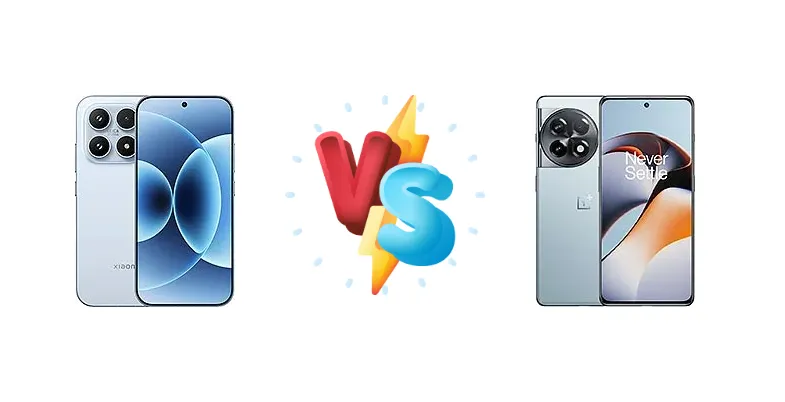
|
🏆 Quick Verdict
For users prioritizing raw performance and future-proofing, the Xiaomi 17 is the clear winner, thanks to its Snapdragon 8 Elite Gen 5. However, the OnePlus 11R delivers exceptional value, offering a very similar experience for most everyday tasks and gaming at a significantly lower cost, making it the better choice for budget-conscious buyers.
| PHONES | ||
|---|---|---|
| Phone Names | Xiaomi 17 | OnePlus 11R |
| Network | ||
|---|---|---|
| 2G bands | GSM 850 / 900 / 1800 / 1900 | GSM 850 / 900 / 1800 / 1900 |
| 3G bands | HSDPA 800 / 850 / 900 / 1700(AWS) / 1900 / 2100 | HSDPA 850 / 900 / 1700(AWS) / 2100 |
| 4G bands | 1, 2, 3, 4, 5, 7, 8, 12, 17, 18, 19, 20, 25, 26, 28, 34, 38, 39, 40, 41, 42, 48, 66 | 1, 3, 4, 5, 8, 28, 34, 38, 39, 40, 41 |
| 5G bands | 1, 2, 3, 5, 7, 8, 12, 18, 20, 25, 26, 28, 38, 40, 41, 48, 66, 77, 78, 80, 81, 83, 84, 89 SA/NSA | 1, 3, 5, 8, 28, 40, 41, 77, 78 SA/NSA |
| Speed | HSPA, LTE, 5G | HSPA, LTE (3CA), 5G |
| Technology | GSM / HSPA / LTE / 5G | GSM / CDMA / HSPA / LTE / 5G |
| - | CDMA 800 | |
| Launch | ||
|---|---|---|
| Announced | 2025, September 25 | 2023, February 07 |
| Status | Available. Released 2025, September 27 | Available. Released 2023, February 21 |
| Body | ||
|---|---|---|
| Build | Glass front (Dragon Crystal Glass), aluminum frame | Glass front, glass back (Gorilla Glass 5), plastic frame |
| Dimensions | 151.1 x 71.8 x 8.1 mm (5.95 x 2.83 x 0.32 in) | 163.4 x 74.3 x 8.7 mm (6.43 x 2.93 x 0.34 in) |
| SIM | Nano-SIM + Nano-SIM | Nano-SIM + Nano-SIM |
| Weight | 191 g (6.74 oz) | 204 g (7.20 oz) |
| Display | ||
|---|---|---|
| Protection | Xiaomi Dragon Crystal Glass | - |
| Resolution | 1220 x 2656 pixels, 19.5:9 ratio (~464 ppi density) | 1240 x 2772 pixels, 20:9 ratio (~451 ppi density) |
| Size | 6.3 inches, 97.1 cm2 (~89.5% screen-to-body ratio) | 6.74 inches, 109.2 cm2 (~90.0% screen-to-body ratio) |
| Type | LTPO AMOLED, 68B colors, 2160Hz PWM, 120Hz, Dolby Vision, HDR Vivid, HDR10+, 3500 nits (peak) | Fluid AMOLED, 1B colors, 120Hz, HDR10+, 1450 nits (peak) |
| Platform | ||
|---|---|---|
| CPU | Octa-core (2x4.6 GHz Oryon V3 Phoenix L + 6x3.62 GHz Oryon V3 Phoenix M) | Octa-core (1x3.0 GHz Cortex-X2 & 3x2.5 GHz Cortex-A710 & 4x1.80 GHz Cortex-A510) |
| Chipset | Qualcomm SM8850-AC Snapdragon 8 Elite Gen 5 (3 nm) | Qualcomm SM8475 Snapdragon 8+ Gen 1 (4 nm) |
| GPU | Adreno 840 | Adreno 730 |
| OS | Android 16, HyperOS 3 | Android 13, upgradable to Android 15, OxygenOS 15 |
| Memory | ||
|---|---|---|
| Card slot | No | No |
| Internal | 256GB 12GB RAM, 512GB 12GB RAM, 512GB 16GB RAM, 1TB 16GB RAM | 128GB 8GB RAM, 256GB 16GB RAM, 512GB 18GB RAM |
| - | UFS 3.1 | |
| Main Camera | ||
|---|---|---|
| Features | Laser AF, color spectrum sensor, Leica lens, Dual-LED dual-tone flash, HDR, panorama | Color spectrum sensor, LED flash, HDR, panorama |
| Single | - | 16 MP, f/2.4, 24mm (wide), 1/3.09", 1.0µm |
| Triple | 50 MP, f/1.7, 23mm (wide), 1/1.31", 1.2µm, dual pixel PDAF, OIS 50 MP, f/2.0, 60mm (telephoto), 1/2.76", 0.64µm, PDAF (10cm - ∞), OIS, 2.6x optical zoom 50 MP, f/2.4, 17mm, 102˚ (ultrawide), 1/2.76", 0.64µm | 50 MP, f/1.8, 24mm (wide), 1/1.56", 1.0µm, multi-directional PDAF, OIS 8 MP, f/2.2, 120˚ (ultrawide), 1/4.0", 1.12µm 2 MP (macro) |
| Video | 8K@30fps (HDR), 4K@30/60fps (HDR10+, 10-bit Dolby Vision HDR, 10-bit LOG), 1080p@30/60/120/240/960fps, 720p@1920fps, gyro-EIS | 4K@30/60fps, 1080p@30/60/240fps, gyro-EIS |
| Selfie camera | ||
|---|---|---|
| Features | HDR, panorama | HDR |
| Single | 50 MP, f/2.2, 21mm (wide), PDAF | 16 MP, f/2.4, 24mm (wide), 1/3.09", 1.0µm |
| Video | 4K@30/60fps, 1080p@30/60fps, HDR10+, gyro-EIS | 1080p@30fps |
| Sound | ||
|---|---|---|
| 3.5mm jack | - | No |
| 35mm jack | No | No |
| Loudspeaker | Yes, with stereo speakers (with Dolby Atmos) | Yes, with stereo speakers |
| - | 24-bit/192kHz audio | |
| Comms | ||
|---|---|---|
| Bluetooth | 5.4, A2DP, LE, aptX HD, aptX Adaptive, LHDC 5 | 5.3, A2DP, LE, aptX HD |
| Infrared port | Yes | Yes |
| NFC | Yes | Yes |
| Positioning | GPS (L1+L5), BDS (B1I+B1c+B2a), GALILEO (E1+E5a), QZSS (L1+L5), NavIC (L5), GLONASS | GPS (L1+L5), GLONASS (G1), BDS (B1I+B1c+B2a), GALILEO (E1+E5a), QZSS (L1+L5) |
| Radio | No | No |
| USB | USB Type-C 3.2, Display Port, OTG | USB Type-C 2.0 |
| WLAN | Wi-Fi 802.11 a/b/g/n/ac/6/7, dual-band, Wi-Fi Direct | Wi-Fi 802.11 a/b/g/n/ac/6, dual-band |
| Features | ||
|---|---|---|
| Sensors | Fingerprint (under display, ultrasonic), accelerometer, proximity, gyro, compass, barometer | Fingerprint (under display, optical), accelerometer, gyro, proximity, compass |
| Battery | ||
|---|---|---|
| Charging | 100W wired, PD3.0, QC3+, 100W PPS 50W wireless 22.5W reverse wireless | 100W wired |
| Type | Si/C Li-Ion 7000 mAh | Li-Po 5000 mAh |
| Misc | ||
|---|---|---|
| Colors | Black, Blue, Pink, White | Galactic Silver, Sonic Black, Solar Red |
| Models | - | CPH2487 |
| Price | About 540 EUR | About 600 EUR |
| SAR | - | 1.16 W/kg (head) 0.61 W/kg (body) |
Xiaomi 17
- Unmatched performance with Snapdragon 8 Elite Gen 5
- Industry-leading 100W wired and 50W wireless charging
- Potential for superior camera capabilities
- Likely higher price tag
- Potential for increased heat generation under sustained load (despite 3nm process)
OnePlus 11R
- Excellent value for money
- Fast 100W wired charging
- Solid performance with Snapdragon 8+ Gen 1
- Older chipset compared to the Xiaomi 17
- Lacks wireless charging capabilities
Display Comparison
While both phones are expected to feature high refresh rate AMOLED displays, the Xiaomi 17’s display specifications are currently unknown. The OnePlus 11R boasts a 6.72-inch 120Hz AMOLED panel. The Snapdragon 8 Elite Gen 5’s integrated display engine likely supports advanced features like variable refresh rate (LTPO) for improved power efficiency, a feature not confirmed on the 11R. The Xiaomi 17’s panel is expected to have higher peak brightness and potentially better color accuracy, given its flagship positioning.
Camera Comparison
Camera details for the Xiaomi 17 are currently unavailable. The OnePlus 11R features a 50MP main sensor with OIS, a 8MP ultrawide, and a 2MP macro lens. While the 2MP macro lens is largely a marketing feature, the 50MP main sensor delivers solid image quality. The Xiaomi 17, being a flagship, is expected to feature a larger main sensor, potentially with a more advanced image signal processor (ISP) within the Snapdragon 8 Elite Gen 5, resulting in superior low-light performance and dynamic range. Expect Xiaomi to focus on computational photography enhancements.
Performance
The core difference lies in the chipsets. The Xiaomi 17’s Snapdragon 8 Elite Gen 5, built on a 3nm process, features a unique Oryon V3 Phoenix CPU architecture (2x4.6 GHz Phoenix L + 6x3.62 GHz Phoenix M). This contrasts sharply with the OnePlus 11R’s Snapdragon 8+ Gen 1 (4nm) which uses a more traditional Cortex-X2, A710, and A510 configuration. The 3nm process and Oryon architecture of the Xiaomi 17 promise significant gains in both performance and power efficiency, translating to faster app loading, smoother multitasking, and potentially longer battery life under heavy load. The 8+ Gen 1 is still a very capable chip, but the Xiaomi 17 is expected to offer a noticeable performance advantage, particularly in sustained workloads.
Battery Life
The OnePlus 11R offers 100W wired charging, capable of fully charging its 5000mAh battery in around 25 minutes. The Xiaomi 17 significantly raises the bar with 100W wired charging, PD3.0, QC3+, 100W PPS, 50W wireless, and 22.5W reverse wireless charging. This combination provides unparalleled charging flexibility and speed. While the 11R’s 5000mAh battery is respectable, the Xiaomi 17’s optimized chipset and potentially larger battery capacity (speculation based on flagship trends) could offer comparable or even better real-world battery life despite the faster charging speeds.
Buying Guide
Buy the Xiaomi 17 if you demand the absolute best Android performance, need the fastest charging speeds available (including 50W wireless), and are willing to pay a premium for cutting-edge technology. Buy the OnePlus 11R if you prioritize value, still want a powerful and responsive experience for gaming and daily use, and prefer to save money without sacrificing core functionality. The 11R is ideal for users who don't need the latest and greatest, but want a reliable and fast phone.