
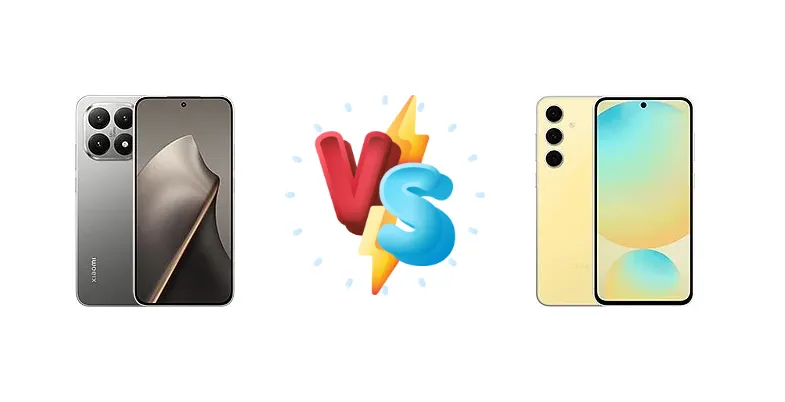
Xiaomi 15T vs Samsung Galaxy S24 FE: A Deep Dive into Battery, Performance, and Value
| Phones Images | |||||
|---|---|---|---|---|---|
|
🏆 Quick Verdict
For users prioritizing exceptional battery life and rapid charging, the Xiaomi 15T is the clear winner, boasting a 57:44h endurance score and 67W charging. However, the Samsung Galaxy S24 FE offers a more polished software experience and potentially longer-term battery health with its 2000 cycle rating, making it ideal for Samsung ecosystem users.
| PHONES | ||
|---|---|---|
| Phone Names | Xiaomi 15T | Samsung Galaxy S24 FE |
| Network | ||
|---|---|---|
| 2G bands | GSM 850 / 900 / 1800 / 1900 | GSM 850 / 900 / 1800 / 1900 |
| 3G bands | HSDPA 800 / 850 / 900 / 1700(AWS) / 1900 / 2100 | HSDPA 850 / 900 / 1700(AWS) / 1900 / 2100 |
| 4G bands | 1, 2, 3, 4, 5, 7, 8, 12, 13, 17, 18, 19, 20, 26, 28, 32, 38, 40, 41, 42, 48, 66, 71 | 1, 2, 3, 4, 5, 7, 8, 12, 17, 18, 19, 20, 25, 26, 28, 32, 38, 40, 41, 66 - International |
| 5G bands | 1, 2, 3, 5, 7, 8, 12, 20, 26, 28, 38, 40, 41, 48, 66, 71, 75, 77, 78 SA/NSA | 1, 2, 3, 5, 7, 8, 12, 20, 25, 26, 28, 38, 40, 41, 66, 75, 77, 78 SA/NSA/Sub6 - International |
| Speed | HSPA, LTE, 5G | HSPA, LTE, 5G |
| Technology | GSM / HSPA / LTE / 5G | GSM / HSPA / LTE / 5G |
| Launch | ||
|---|---|---|
| Announced | 2025, September 24 | 2024, September 26 |
| Status | Available. Released 2025, September 24 | Available. Released 2024, October 03 |
| Body | ||
|---|---|---|
| Build | Glass front (Gorilla Glass 7i), plastic frame, fiber-reinforced plastic back | Glass front (Gorilla Glass Victus+), glass back (Gorilla Glass Victus+), aluminum frame |
| Dimensions | 163.2 x 78 x 7.5 mm (6.43 x 3.07 x 0.30 in) | 162 x 77.3 x 8 mm (6.38 x 3.04 x 0.31 in) |
| SIM | · Nano-SIM + Nano-SIM + eSIM + eSIM (max 2 at a time)· Nano-SIM + Nano-SIM | · Nano-SIM· Nano-SIM + Nano-SIM· Nano-SIM + eSIM· eSIM + eSIM |
| Weight | 194 g (6.84 oz) | 213 g (7.51 oz) |
| Display | ||
|---|---|---|
| Protection | Corning Gorilla Glass 7i, Mohs level 6 | Corning Gorilla Glass Victus+, Mohs level 5 |
| Resolution | 1280 x 2772 pixels, 19.5:9 ratio (~447 ppi density) | 1080 x 2340 pixels, 19.5:9 ratio (~385 ppi density) |
| Size | 6.83 inches, 114.5 cm2 (~90.0% screen-to-body ratio) | 6.7 inches, 110.2 cm2 (~88.0% screen-to-body ratio) |
| Type | AMOLED, 68B colors, 120Hz, 3840Hz PWM, Dolby Vision, HDR10+, 3200 nits (peak) | Dynamic AMOLED 2X, 120Hz, HDR10+, 1900 nits (peak) |
| Platform | ||
|---|---|---|
| CPU | Octa-core (1x3.25 GHz Cortex-A725 & 3x3.0 GHz Cortex-A725 & 4x2.1 GHz Cortex-A725) | 10-core (1x3.1 GHz + 2x2.9 GHz + 3x2.6 GHz + 4x1.95 GHz) |
| Chipset | Mediatek Dimensity 8400 Ultra (4 nm) | Exynos 2400e (4 nm) |
| GPU | Mali-G720 MC7 | Xclipse 940 |
| OS | Android 15, upgradable to Android 16, HyperOS 3 | Android 14, up to 7 major Android upgrades, One UI 8.0 |
| Memory | ||
|---|---|---|
| Card slot | No | No |
| Internal | 256GB 12GB RAM, 512GB 12GB RAM | 128GB 8GB RAM, 256GB 8GB RAM, 512GB 8GB RAM |
| Main Camera | ||
|---|---|---|
| Features | Leica lens, Color spectrum sensor, Ultra HDR, LED flash, HDR, panorama | LED flash, HDR, panorama |
| Triple | 50 MP, f/1.7, 23mm (wide), 1/1.55", 1.0µm, PDAF, OIS 50 MP, f/1.9, 46mm (telephoto), 1/2.76", 0.64µm, PDAF, 2x optical zoom 12 MP, f/2.2, 15mm, 120˚ (ultrawide), 1/3.06", 1.12µm | 50 MP, f/1.8, 24mm (wide), 1/1.57", 1.0µm, dual pixel PDAF, OIS 8 MP, f/2.4, 75mm (telephoto), 1/4.4", 1.0µm, PDAF, OIS, 3x optical zoom 12 MP, f/2.2, 13mm, 123˚ (ultrawide), 1/3.0", 1.12µm |
| Video | 4K@30/60fps, 1080p@30/60/120/240/960fps, gyro-EIS, 10-bit Rec. 2020, HDR10+ | 8K@30fps, 4K@30/60/120fps, 1080p@30/60/120/240fps |
| Selfie camera | ||
|---|---|---|
| Features | HDR | - |
| Single | 32 MP, f/2.2, 21mm (wide), 1/3.44", 0.64µm | 10 MP, f/2.4, 26mm (wide), 1/3.0", 1.22µm |
| Video | 4K@30fps, 1080p@30/60fps, HDR10+ | 4K@30/60fps, 1080p@30/60fps; gyro-EIS |
| Sound | ||
|---|---|---|
| 35mm jack | No | No |
| Loudspeaker | Yes, with stereo speakers (with Dolby Atmos) | Yes, with stereo speakers |
| Comms | ||
|---|---|---|
| Bluetooth | 6.0, A2DP, LE | 5.3, A2DP, LE |
| Infrared port | Yes | - |
| NFC | Yes (market/region dependent) | Yes |
| Positioning | GPS (L1+L5), BDS (B1I+B1c+B2a), GALILEO (E1+E5a), QZSS (L1+L5), NavIC (L5), GLONASS | GPS, GLONASS, GALILEO, BDS |
| Radio | No | Unspecified |
| USB | USB Type-C 2.0, OTG | USB Type-C 3.2, OTG |
| WLAN | Wi-Fi 802.11 a/b/g/n/ac/6e, dual-band or tri-band, Wi-Fi Direct | Wi-Fi 802.11 a/b/g/n/ac/6e, dual-band or tri-band (market/region dependent), Wi-Fi Direct |
| Features | ||
|---|---|---|
| Sensors | Fingerprint (under display, optical), accelerometer, gyro, proximity, compass | Fingerprint (under display, optical), accelerometer, gyro, compass |
| Battery | ||
|---|---|---|
| Charging | 67W wired, PD3.0, 100% in 50 min | 25W wired, PD, QC2, 50% in 30 min 15W wireless Reverse wireless |
| Type | 5500 mAh | 4700 mAh |
| Misc | ||
|---|---|---|
| Colors | Black, Gray, Rose Gold | Blue, Graphite, Gray, Mint, Yellow |
| Models | 25069PTEBG | SM-S721B, SM-S721B/DS, SM-S721U1, SM-S721U, SM-S721W, SM-S7210, SM-S721N |
| Price | $ 535.47 / £ 349.00 / € 435.43 | $ 249.74 / C$ 498.99 / £ 335.00 / € 387.00 / ₹ 34,180 |
| SAR | - | 0.94 W/kg (head) 0.71 W/kg (body) |
| SAR EU | 0.99 W/kg (head) 0.99 W/kg (body) | 0.86 W/kg (head) 1.29 W/kg (body) |
| EU LABEL | ||
|---|---|---|
| Battery | 57:44h endurance, 1600 cycles | 42:00h endurance, 2000 cycles |
| Energy | Class A | Class B |
| Free fall | Class A (270 falls) | Class A (270 falls) |
| Repairability | Class C | Class C |
Xiaomi 15T
- Exceptional battery life (57:44h endurance)
- Ultra-fast 67W wired charging
- Brighter display (1525 nits)
- Potentially less refined software experience
- Lower battery cycle rating (1600)
Samsung Galaxy S24 FE
- Familiar Samsung One UI
- Wireless and reverse wireless charging
- Higher battery cycle rating (2000)
- Significantly shorter battery life (42:00h endurance)
- Slower 25W wired charging
Display Comparison
The Xiaomi 15T edges out the S24 FE in display brightness, achieving a measured 1525 nits compared to the S24 FE’s 1372 nits. While both utilize 4nm chipsets, the brighter display on the 15T will be more visible outdoors. We lack panel technology details (LTPO, PWM frequency) for both, but the higher peak brightness is a tangible advantage for the 15T in direct sunlight. Color accuracy is assumed to be comparable given both brands' reputations, but independent testing would be needed to confirm.
Camera Comparison
Without detailed camera specs, a direct comparison is limited. However, the focus should be on the main sensor and image processing. Samsung typically excels in image processing, delivering vibrant and shareable photos. Xiaomi has improved significantly in recent years, but Samsung’s algorithms are generally more refined. The absence of information regarding OIS and lens apertures makes a definitive judgment impossible, but the S24 FE’s brand reputation suggests a more consistent camera experience. We can safely ignore the likely presence of low-resolution macro lenses on both devices.
Performance
The chipset battle pits MediaTek’s Dimensity 8400 Ultra against Samsung’s Exynos 2400e. The Dimensity 8400 Ultra’s octa-core configuration, with its three high-performance Cortex-A725 cores clocked at 3.0 GHz, appears to offer a strong raw performance advantage. The Exynos 2400e’s 10-core setup, while complex, features a wider range of core clock speeds, potentially optimizing for efficiency. However, the Exynos 2400e has a history of thermal throttling, a concern not yet confirmed for the 15T. The 15T’s performance will likely be more consistent under sustained load. RAM speed is not specified, but both are expected to utilize LPDDR5x for fast memory access.
Battery Life
Battery life is where the Xiaomi 15T truly shines, delivering a remarkable 57:44h endurance score and 14:56h of active use. This significantly surpasses the S24 FE’s 42:00h endurance and 11:48h active use. While the S24 FE boasts 2000 battery cycles compared to the 15T’s 1600, the 15T’s larger endurance advantage means it will likely reach the end of its lifespan later despite the lower cycle count. The 15T’s 67W charging is also dramatically faster, achieving a full charge in 50 minutes, while the S24 FE takes 30 minutes to reach 50% with its 25W charger. The S24 FE adds the convenience of 15W wireless and reverse wireless charging, features absent on the 15T.
Buying Guide
Buy the Xiaomi 15T if you need uncompromising battery life, incredibly fast charging, and don't mind a less refined software experience. It’s perfect for power users, travelers, or anyone who frequently finds themselves away from a charger. Buy the Samsung Galaxy S24 FE if you prefer a familiar Samsung One UI, value wireless charging and reverse wireless capabilities, and prioritize a potentially longer battery lifespan despite a shorter endurance score.