
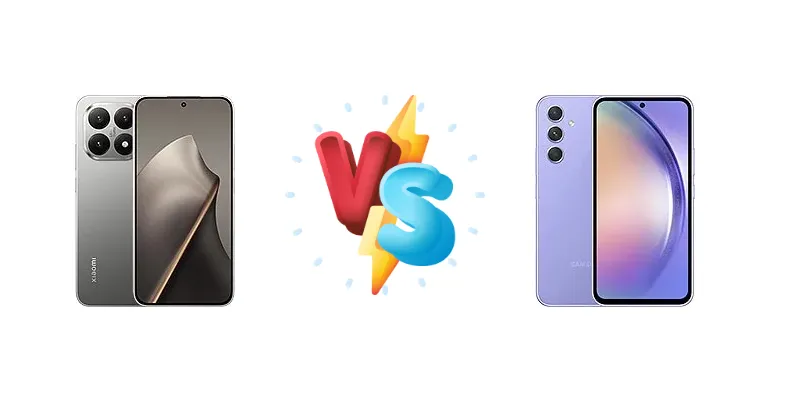
Xiaomi 15T vs Samsung Galaxy A54: A Deep Dive into Mid-Range Champions
| Phones Images | |||||
|---|---|---|---|---|---|
|
🏆 Quick Verdict
For users prioritizing raw performance and incredibly fast charging, the Xiaomi 15T is the clear winner. Its Dimensity 8400 Ultra and 67W charging significantly outperform the Galaxy A54’s Exynos 1380 and 25W charging. However, the A54 remains a strong contender for those deeply embedded in the Samsung ecosystem and valuing a polished software experience.
| PHONES | ||
|---|---|---|
| Phone Names | Xiaomi 15T | Samsung Galaxy A54 |
| Network | ||
|---|---|---|
| 2G bands | GSM 850 / 900 / 1800 / 1900 | GSM 850 / 900 / 1800 / 1900 |
| 3G bands | HSDPA 800 / 850 / 900 / 1700(AWS) / 1900 / 2100 | HSDPA 850 / 900 / 1700(AWS) / 1900 / 2100 |
| 4G bands | 1, 2, 3, 4, 5, 7, 8, 12, 13, 17, 18, 19, 20, 26, 28, 32, 38, 40, 41, 42, 48, 66, 71 | 1, 2, 3, 4, 5, 7, 8, 12, 17, 20, 26, 28, 32, 38, 40, 41, 66 - International |
| 5G bands | 1, 2, 3, 5, 7, 8, 12, 20, 26, 28, 38, 40, 41, 48, 66, 71, 75, 77, 78 SA/NSA | 1, 3, 7, 8, 20, 28, 38, 40, 41, 77, 78 SA/NSA/Sub6 - International |
| Speed | HSPA, LTE, 5G | HSPA, LTE, 5G |
| Technology | GSM / HSPA / LTE / 5G | GSM / HSPA / LTE / 5G |
| - | 25, 41, 66, 71 SA/NSA/Sub6/mmWave - USA | |
| Launch | ||
|---|---|---|
| Announced | 2025, September 24 | 2023, March 15 |
| Status | Available. Released 2025, September 24 | Available. Released 2023, March 24 |
| Body | ||
|---|---|---|
| Build | Glass front (Gorilla Glass 7i), plastic frame, fiber-reinforced plastic back | Glass front (Gorilla Glass 5), glass back (Gorilla Glass 5), plastic frame |
| Dimensions | 163.2 x 78 x 7.5 mm (6.43 x 3.07 x 0.30 in) | 158.2 x 76.7 x 8.2 mm (6.23 x 3.02 x 0.32 in) |
| SIM | · Nano-SIM + Nano-SIM + eSIM + eSIM (max 2 at a time)· Nano-SIM + Nano-SIM | · Nano-SIM + eSIM· Nano-SIM + Nano-SIM |
| Weight | 194 g (6.84 oz) | 202 g (7.13 oz) |
| - | IP67 dust/water resistant (up to 1m for 30 min) | |
| Display | ||
|---|---|---|
| Protection | Corning Gorilla Glass 7i, Mohs level 6 | Corning Gorilla Glass 5 |
| Resolution | 1280 x 2772 pixels, 19.5:9 ratio (~447 ppi density) | 1080 x 2340 pixels, 19.5:9 ratio (~403 ppi density) |
| Size | 6.83 inches, 114.5 cm2 (~90.0% screen-to-body ratio) | 6.4 inches, 100.5 cm2 (~82.9% screen-to-body ratio) |
| Type | AMOLED, 68B colors, 120Hz, 3840Hz PWM, Dolby Vision, HDR10+, 3200 nits (peak) | Super AMOLED, 120Hz, HDR10+, 1000 nits (HBM) |
| Platform | ||
|---|---|---|
| CPU | Octa-core (1x3.25 GHz Cortex-A725 & 3x3.0 GHz Cortex-A725 & 4x2.1 GHz Cortex-A725) | Octa-core (4x2.4 GHz Cortex-A78 & 4x2.0 GHz Cortex-A55) |
| Chipset | Mediatek Dimensity 8400 Ultra (4 nm) | Exynos 1380 (5 nm) |
| GPU | Mali-G720 MC7 | Mali-G68 MP5 |
| OS | Android 15, upgradable to Android 16, HyperOS 3 | Android 13, up to 4 major Android upgrades, One UI 7 |
| Memory | ||
|---|---|---|
| Card slot | No | microSDXC (uses shared SIM slot) |
| Internal | 256GB 12GB RAM, 512GB 12GB RAM | 128GB 4GB RAM, 128GB 6GB RAM, 128GB 8GB RAM, 256GB 6GB RAM, 256GB 8GB RAM |
| Main Camera | ||
|---|---|---|
| Features | Leica lens, Color spectrum sensor, Ultra HDR, LED flash, HDR, panorama | LED flash, panorama, HDR |
| Single | - | 32 MP, f/2.2, 26mm (wide), 1/2.8", 0.8µm |
| Triple | 50 MP, f/1.7, 23mm (wide), 1/1.55", 1.0µm, PDAF, OIS 50 MP, f/1.9, 46mm (telephoto), 1/2.76", 0.64µm, PDAF, 2x optical zoom 12 MP, f/2.2, 15mm, 120˚ (ultrawide), 1/3.06", 1.12µm | 50 MP, f/1.8, 23mm (wide), 1/1.56", 1.0µm, PDAF, OIS 12 MP, f/2.2, 13mm, 123˚ (ultrawide), 1/3.X", 1.12µm 5 MP (macro) |
| Video | 4K@30/60fps, 1080p@30/60/120/240/960fps, gyro-EIS, 10-bit Rec. 2020, HDR10+ | 4K@30fps, 1080p@30/60fps, 720p@480fps, gyro-EIS |
| Selfie camera | ||
|---|---|---|
| Features | HDR | - |
| Single | 32 MP, f/2.2, 21mm (wide), 1/3.44", 0.64µm | 32 MP, f/2.2, 26mm (wide), 1/2.8", 0.8µm |
| Video | 4K@30fps, 1080p@30/60fps, HDR10+ | 4K@30fps, 1080p@30/60fps |
| Sound | ||
|---|---|---|
| 3.5mm jack | - | No |
| 35mm jack | No | No |
| Loudspeaker | Yes, with stereo speakers (with Dolby Atmos) | Yes, with stereo speakers |
| Comms | ||
|---|---|---|
| Bluetooth | 6.0, A2DP, LE | 5.3, A2DP, LE |
| Infrared port | Yes | - |
| NFC | Yes (market/region dependent) | Yes (market/region dependent) |
| Positioning | GPS (L1+L5), BDS (B1I+B1c+B2a), GALILEO (E1+E5a), QZSS (L1+L5), NavIC (L5), GLONASS | GPS, GLONASS, GALILEO, BDS |
| Radio | No | No |
| USB | USB Type-C 2.0, OTG | USB Type-C 2.0, OTG |
| WLAN | Wi-Fi 802.11 a/b/g/n/ac/6e, dual-band or tri-band, Wi-Fi Direct | Wi-Fi 802.11 a/b/g/n/ac/6, dual-band, Wi-Fi Direct |
| Features | ||
|---|---|---|
| Sensors | Fingerprint (under display, optical), accelerometer, gyro, proximity, compass | Fingerprint (under display, optical), accelerometer, gyro, compass, barometer (USA only) |
| - | Virtual proximity sensing | |
| Battery | ||
|---|---|---|
| Charging | 67W wired, PD3.0, 100% in 50 min | 25W wired |
| Type | 5500 mAh | 5000 mAh |
| Misc | ||
|---|---|---|
| Colors | Black, Gray, Rose Gold | Lime, Graphite, Violet, White |
| Models | 25069PTEBG | SM-A546V, SM-A546U, SM-A546U1, SM-A546B, SM-A546B/DS, SM-A546E, SM-A546E/DS, SM-A5460, SM-A546M, SM-A546M/DS, SM-A546W |
| Price | $ 535.47 / £ 349.00 / € 435.43 | € 210.00 / $ 119.11 / £ 169.95 / ₹ 28,999 |
| SAR | - | 0.81 W/kg (head) 0.67 W/kg (body) |
| SAR EU | 0.99 W/kg (head) 0.99 W/kg (body) | 0.69 W/kg (head) 1.34 W/kg (body) |
| Tests | ||
|---|---|---|
| Battery life | - | Endurance rating 119h |
| Camera | - | Photo / Video |
| Display | - | Contrast ratio: Infinite (nominal) |
| Loudspeaker | - | -26.6 LUFS (Good) |
| Performance | - | AnTuTu: 506678 (v9) GeekBench: 2703 (v5.1), 2797 (v6) GFXBench: 25fps (ES 3.1 onscreen) |
| EU LABEL | ||
|---|---|---|
| Battery | 57:44h endurance, 1600 cycles | - |
| Energy | Class A | - |
| Free fall | Class A (270 falls) | - |
| Repairability | Class C | - |
Xiaomi 15T
- Significantly faster charging (67W vs 25W)
- More powerful processor (Dimensity 8400 Ultra)
- Brighter display for outdoor visibility
- Software experience may not be as refined as Samsung’s
- Camera system details are currently unknown
Samsung Galaxy A54
- Established Samsung ecosystem and software support
- Potentially better camera image processing
- Likely includes a dedicated telephoto lens
- Slower processor (Exynos 1380)
- Significantly slower charging (25W)
- Dimmer display
Display Comparison
The Xiaomi 15T boasts a significantly brighter display, reaching a measured 1525 nits compared to the Galaxy A54’s 980 nits. This translates to superior visibility outdoors under direct sunlight. While the A54 claims an 'Infinite' contrast ratio, this is typical marketing hyperbole; both utilize OLED panels offering excellent contrast. The 15T’s higher peak brightness is a tangible benefit for HDR content consumption and general usability in bright environments. We lack PWM frequency data for both, but the A54’s display is generally considered comfortable for extended viewing.
Camera Comparison
Both phones feature capable camera systems, but details beyond 'Photo/Video' are limited. The A54 likely benefits from Samsung’s well-regarded image processing algorithms, focusing on vibrant colors and pleasing aesthetics. The 15T’s camera performance will heavily rely on the capabilities of its primary sensor and the efficiency of Mediatek’s image signal processor. Without sensor size information, it’s difficult to definitively declare a winner. The A54’s inclusion of a dedicated telephoto lens (assumed, based on Samsung’s A-series tradition) provides versatility the 15T may lack. We can safely assume the 2MP macro cameras on both devices offer limited practical value.
Performance
The Mediatek Dimensity 8400 Ultra in the Xiaomi 15T, built on a 4nm process, represents a substantial leap in performance over the Samsung Galaxy A54’s 5nm Exynos 1380. The Dimensity 8400 Ultra’s octa-core configuration, with its higher clock speeds (3.25 GHz Cortex-A725), will deliver noticeably faster app loading times, smoother multitasking, and superior gaming performance. The Exynos 1380, while competent, is geared towards efficiency rather than outright speed. The 15T’s superior chipset will also benefit AI-driven tasks and image processing. The lack of LPDDR5x specification for the A54 suggests slower RAM speeds compared to what the 15T likely utilizes, further widening the performance gap.
Battery Life
The Xiaomi 15T’s battery endurance score of 57:44h, with 1600 charge cycles, is a significant advantage over the Galaxy A54’s 119h endurance rating. While the A54’s endurance rating is a legacy metric, the 14:56h active use score of the 15T versus the A54’s 11:15h demonstrates a clear real-world benefit. Crucially, the 15T’s 67W wired charging, supporting PD3.0, allows for a full charge in just 50 minutes, while the A54’s 25W charging is considerably slower. This difference in charging speed is a major convenience factor for power users.
Buying Guide
Buy the Xiaomi 15T if you need a phone for demanding tasks like gaming, video editing, or frequent multitasking, and if minimizing charging downtime is crucial. Buy the Samsung Galaxy A54 if you prefer a refined, user-friendly experience with a strong emphasis on camera versatility and seamless integration with other Samsung devices, even if it means sacrificing some raw processing power.