
Xiaomi 15T vs Realme GT 5G: A Deep Dive into Performance and Battery Life
| Phones Images | |||||
|---|---|---|---|---|---|
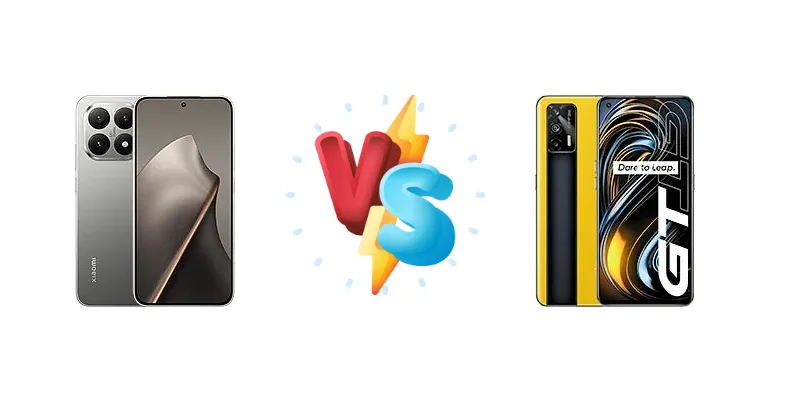
|
🏆 Quick Verdict
For most users, the Xiaomi 15T emerges as the stronger choice. Its significantly brighter display (1525 nits vs 650 nits) and superior battery endurance (57:44h vs 98h – noting the GT’s endurance is an older rating) outweigh the marginally faster charging of the Realme GT 5G. The Dimensity 8400 Ultra also offers a more modern architecture.
| PHONES | ||
|---|---|---|
| Phone Names | Xiaomi 15T | Realme GT 5G |
| Network | ||
|---|---|---|
| 2G bands | GSM 850 / 900 / 1800 / 1900 | GSM 850 / 900 / 1800 / 1900 |
| 3G bands | HSDPA 800 / 850 / 900 / 1700(AWS) / 1900 / 2100 | HSDPA 850 / 900 / 1700(AWS) / 1900 / 2100 |
| 4G bands | 1, 2, 3, 4, 5, 7, 8, 12, 13, 17, 18, 19, 20, 26, 28, 32, 38, 40, 41, 42, 48, 66, 71 | 1, 2, 3, 4, 5, 7, 8, 12, 17, 18, 19, 20, 26, 34, 38, 39, 40, 41 |
| 5G bands | 1, 2, 3, 5, 7, 8, 12, 20, 26, 28, 38, 40, 41, 48, 66, 71, 75, 77, 78 SA/NSA | 1, 3, 28, 41, 77, 78, 79 SA/NSA |
| Speed | HSPA, LTE, 5G | HSPA, LTE, 5G |
| Technology | GSM / HSPA / LTE / 5G | GSM / CDMA / HSPA / EVDO / LTE / 5G |
| - | CDMA2000 1xEV-DO | |
| Launch | ||
|---|---|---|
| Announced | 2025, September 24 | 2021, March 04 |
| Status | Available. Released 2025, September 24 | Available. Released 2021, March 10 |
| Body | ||
|---|---|---|
| Build | Glass front (Gorilla Glass 7i), plastic frame, fiber-reinforced plastic back | Glass front, glass back or eco leather back, plastic frame |
| Dimensions | 163.2 x 78 x 7.5 mm (6.43 x 3.07 x 0.30 in) | 158.5 x 73.3 x 8.4 mm (Glass) / 9.1 mm (Leather) |
| SIM | · Nano-SIM + Nano-SIM + eSIM + eSIM (max 2 at a time)· Nano-SIM + Nano-SIM | Nano-SIM + Nano-SIM |
| Weight | 194 g (6.84 oz) | 186 g (6.56 oz) |
| Display | ||
|---|---|---|
| Protection | Corning Gorilla Glass 7i, Mohs level 6 | - |
| Resolution | 1280 x 2772 pixels, 19.5:9 ratio (~447 ppi density) | 1080 x 2400 pixels, 20:9 ratio (~409 ppi density) |
| Size | 6.83 inches, 114.5 cm2 (~90.0% screen-to-body ratio) | 6.43 inches, 99.8 cm2 (~85.9% screen-to-body ratio) |
| Type | AMOLED, 68B colors, 120Hz, 3840Hz PWM, Dolby Vision, HDR10+, 3200 nits (peak) | Super AMOLED, 120Hz, HDR10+ |
| Platform | ||
|---|---|---|
| CPU | Octa-core (1x3.25 GHz Cortex-A725 & 3x3.0 GHz Cortex-A725 & 4x2.1 GHz Cortex-A725) | Octa-core (1x2.84 GHz Cortex-X1 & 3x2.42 GHz Cortex-A78 & 4x1.80 GHz Cortex-A55 |
| Chipset | Mediatek Dimensity 8400 Ultra (4 nm) | Qualcomm SM8350 Snapdragon 888 5G (5 nm) |
| GPU | Mali-G720 MC7 | Adreno 660 |
| OS | Android 15, upgradable to Android 16, HyperOS 3 | Android 11, upgradable to Android 14, Realme UI 5.0 |
| Memory | ||
|---|---|---|
| Card slot | No | No |
| Internal | 256GB 12GB RAM, 512GB 12GB RAM | 128GB 8GB RAM, 256GB 12GB RAM |
| - | UFS 3.1 | |
| Main Camera | ||
|---|---|---|
| Features | Leica lens, Color spectrum sensor, Ultra HDR, LED flash, HDR, panorama | Dual-LED dual-tone flash, HDR, panorama |
| Triple | 50 MP, f/1.7, 23mm (wide), 1/1.55", 1.0µm, PDAF, OIS 50 MP, f/1.9, 46mm (telephoto), 1/2.76", 0.64µm, PDAF, 2x optical zoom 12 MP, f/2.2, 15mm, 120˚ (ultrawide), 1/3.06", 1.12µm | 64 MP, f/1.8, 26mm (wide), 1/1.73", 0.8µm, PDAF 8 MP, f/2.3, 16mm, 119˚ (ultrawide), 1/4.0", 1.12µm 2 MP (macro) |
| Video | 4K@30/60fps, 1080p@30/60/120/240/960fps, gyro-EIS, 10-bit Rec. 2020, HDR10+ | 4K@30/60fps, 1080p@30/60/240fps, gyro-EIS |
| Selfie camera | ||
|---|---|---|
| Features | HDR | HDR, panorama |
| Single | 32 MP, f/2.2, 21mm (wide), 1/3.44", 0.64µm | 16 MP, f/2.5, 26mm (wide), 1/3.0", 1.0µm |
| Video | 4K@30fps, 1080p@30/60fps, HDR10+ | 1080p@30fps |
| Sound | ||
|---|---|---|
| 3.5mm jack | - | Yes |
| 35mm jack | No | Yes |
| Loudspeaker | Yes, with stereo speakers (with Dolby Atmos) | Yes, with stereo speakers |
| - | 24-bit/192kHz audio | |
| Comms | ||
|---|---|---|
| Bluetooth | 6.0, A2DP, LE | 5.2, A2DP, LE, aptX HD |
| Infrared port | Yes | - |
| NFC | Yes (market/region dependent) | Yes |
| Positioning | GPS (L1+L5), BDS (B1I+B1c+B2a), GALILEO (E1+E5a), QZSS (L1+L5), NavIC (L5), GLONASS | GPS (L1+L5), GLONASS, BDS, GALILEO, QZSS |
| Radio | No | No |
| USB | USB Type-C 2.0, OTG | USB Type-C 2.0, OTG |
| WLAN | Wi-Fi 802.11 a/b/g/n/ac/6e, dual-band or tri-band, Wi-Fi Direct | Wi-Fi 802.11 a/b/g/n/ac/6, dual-band, Wi-Fi Direct |
| Features | ||
|---|---|---|
| Sensors | Fingerprint (under display, optical), accelerometer, gyro, proximity, compass | Fingerprint (under display, optical), accelerometer, gyro, proximity, compass |
| Battery | ||
|---|---|---|
| Charging | 67W wired, PD3.0, 100% in 50 min | 65W wired, 100% in 35 min |
| Type | 5500 mAh | 4500 mAh |
| Misc | ||
|---|---|---|
| Colors | Black, Gray, Rose Gold | Gold/Black, Blue, Silver |
| Models | 25069PTEBG | RMX2202 |
| Price | $ 535.47 / £ 349.00 / € 435.43 | About 330 EUR |
| SAR EU | 0.99 W/kg (head) 0.99 W/kg (body) | - |
| Tests | ||
|---|---|---|
| Battery life | - | Endurance rating 98h |
| Camera | - | Photo / Video |
| Display | - | Contrast ratio: Infinite (nominal) |
| Loudspeaker | - | -24.5 LUFS (Very good) |
| Performance | - | AnTuTu: 703986 (v8), 810433 (v9) GeekBench: 3555 (v5.1) GFXBench: 55fps (ES 3.1 onscreen) |
| EU LABEL | ||
|---|---|---|
| Battery | 57:44h endurance, 1600 cycles | - |
| Energy | Class A | - |
| Free fall | Class A (270 falls) | - |
| Repairability | Class C | - |
Xiaomi 15T
- Significantly brighter display for outdoor visibility
- Superior battery life and endurance
- More efficient and modern chipset (Dimensity 8400 Ultra)
- Slightly slower charging speed
- Camera specifications are unknown
Realme GT 5G
- Faster charging speed (35 minutes)
- Snapdragon 888 offers peak performance
- Potentially optimized for gaming
- Significantly dimmer display
- Snapdragon 888 prone to thermal throttling
- Older battery endurance rating
Display Comparison
The Xiaomi 15T boasts a substantial advantage in display quality with a measured peak brightness of 1525 nits, making it far more usable outdoors compared to the Realme GT 5G’s 650 nits. While the GT 5G claims an 'Infinite' contrast ratio, this is a standard marketing term and doesn't necessarily translate to a superior viewing experience. The 15T’s higher brightness is a tangible benefit for everyday use, especially in sunny conditions. We lack PWM frequency data for both, but the brightness difference alone makes the 15T the clear winner for visual clarity.
Camera Comparison
Both devices offer 'Photo / Video' capabilities, but detailed camera specifications are missing. Given the market positioning, we can assume both feature multi-camera setups. However, without sensor size or aperture information, a direct comparison is difficult. The Realme GT 5G likely focuses on quick capture and social media-ready images, while Xiaomi often emphasizes image processing and dynamic range. The absence of detail makes it impossible to declare a clear winner; the camera experience will likely depend on software tuning.
Performance
The chipset battle pits Mediatek’s 4nm Dimensity 8400 Ultra against Qualcomm’s 5nm Snapdragon 888. While the Snapdragon 888 initially appears superior on paper due to its Cortex-X1 prime core, the Dimensity 8400 Ultra’s newer architecture and more efficient node offer better sustained performance and thermal management. The 888 is known to throttle under prolonged load, a potential issue for gamers. The 15T’s CPU configuration (1x3.25 GHz Cortex-A725, 3x3.0 GHz Cortex-A725, 4x2.1 GHz Cortex-A725) is designed for balanced performance, while the GT 5G’s (1x2.84 GHz Cortex-X1, 3x2.42 GHz Cortex-A78, 4x1.80 GHz Cortex-A55) prioritizes peak speed. Both likely utilize LPDDR5 RAM, but the 15T’s more modern chipset benefits from improved memory controller efficiency.
Battery Life
The Xiaomi 15T’s endurance rating of 57:44h significantly surpasses the Realme GT 5G’s 98h (though the GT’s rating is older and potentially less representative of current software/usage patterns). This difference is likely due to the Dimensity 8400 Ultra’s superior power efficiency. While the GT 5G charges slightly faster at 35 minutes (65W) compared to the 15T’s 50 minutes (67W), the 15T’s longer battery life and 1600 charge cycles offer a more compelling long-term value proposition. The inclusion of PD3.0 charging on the 15T also adds to its versatility.
Buying Guide
Buy the Xiaomi 15T if you prioritize all-day battery life, a vibrant and easily viewable display, and a more efficient processor for sustained performance. Buy the Realme GT 5G if you absolutely need the fastest possible charging speed (35 minutes vs 50 minutes) and are willing to trade off battery life and display quality for it. Gamers may also slightly prefer the GT 5G's Snapdragon 888, but thermal throttling could be a concern.