
Xiaomi 15T vs Nothing Phone (2): A Deep Dive into Performance and Battery Life
| Phones Images | |||||
|---|---|---|---|---|---|
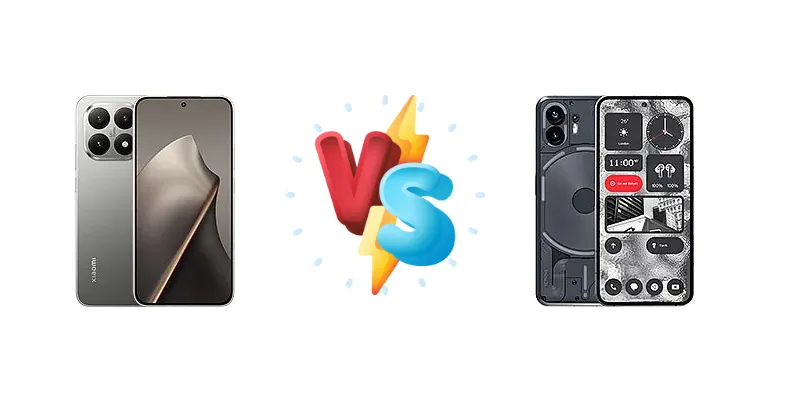
|
🏆 Quick Verdict
For the average user prioritizing longevity and raw power, the Xiaomi 15T emerges as the winner. Its significantly longer 57:44h battery endurance and faster 67W charging outweigh the Nothing Phone (2)'s more polished software and design. However, the Nothing Phone (2) is a strong contender for those valuing aesthetics and a streamlined user interface.
| PHONES | ||
|---|---|---|
| Phone Names | Xiaomi 15T | Nothing Phone (2) |
| Network | ||
|---|---|---|
| 2G bands | GSM 850 / 900 / 1800 / 1900 | GSM 850 / 900 / 1800 / 1900 |
| 3G bands | HSDPA 800 / 850 / 900 / 1700(AWS) / 1900 / 2100 | HSDPA 800 / 850 / 900 / 1700(AWS) / 1900 / 2100 |
| 4G bands | 1, 2, 3, 4, 5, 7, 8, 12, 13, 17, 18, 19, 20, 26, 28, 32, 38, 40, 41, 42, 48, 66, 71 | 1, 2, 3, 4, 5, 7, 8, 12, 17, 18, 19, 20, 25, 26, 28, 30, 32, 34, 38, 39, 40, 41, 42, 48, 66, 71 |
| 5G bands | 1, 2, 3, 5, 7, 8, 12, 20, 26, 28, 38, 40, 41, 48, 66, 71, 75, 77, 78 SA/NSA | 1, 2, 3, 5, 7, 8, 12, 20, 25, 28, 30, 38, 40, 41, 66, 71, 75, 77, 78 SA/NSA |
| Speed | HSPA, LTE, 5G | HSPA, LTE, 5G |
| Technology | GSM / HSPA / LTE / 5G | GSM / HSPA / LTE / 5G |
| Launch | ||
|---|---|---|
| Announced | 2025, September 24 | 2023, July 11 |
| Status | Available. Released 2025, September 24 | Available. Released 2023, July 17 |
| Body | ||
|---|---|---|
| Build | Glass front (Gorilla Glass 7i), plastic frame, fiber-reinforced plastic back | Glass front (Gorilla Glass 5), glass back (Gorilla Glass 5), aluminum frame |
| Dimensions | 163.2 x 78 x 7.5 mm (6.43 x 3.07 x 0.30 in) | 162.1 x 76.4 x 8.6 mm (6.38 x 3.01 x 0.34 in) |
| SIM | · Nano-SIM + Nano-SIM + eSIM + eSIM (max 2 at a time)· Nano-SIM + Nano-SIM | Nano-SIM + Nano-SIM |
| Weight | 194 g (6.84 oz) | 201.2 g (7.09 oz) |
| Display | ||
|---|---|---|
| Protection | Corning Gorilla Glass 7i, Mohs level 6 | Corning Gorilla Glass 5 |
| Resolution | 1280 x 2772 pixels, 19.5:9 ratio (~447 ppi density) | 1080 x 2412 pixels, 20:9 ratio (~394 ppi density) |
| Size | 6.83 inches, 114.5 cm2 (~90.0% screen-to-body ratio) | 6.7 inches, 108.0 cm2 (~87.2% screen-to-body ratio) |
| Type | AMOLED, 68B colors, 120Hz, 3840Hz PWM, Dolby Vision, HDR10+, 3200 nits (peak) | LTPO OLED, 1B colors, 120Hz, 1920Hz PWM, HDR10+, 1600 nits (HBM), 1600 nits (peak) |
| Platform | ||
|---|---|---|
| CPU | Octa-core (1x3.25 GHz Cortex-A725 & 3x3.0 GHz Cortex-A725 & 4x2.1 GHz Cortex-A725) | Octa-core (1x3.0 GHz Cortex-X2 & 3x2.5 GHz Cortex-A710 & 4x1.80 GHz Cortex-A510) |
| Chipset | Mediatek Dimensity 8400 Ultra (4 nm) | Qualcomm SM8475 Snapdragon 8+ Gen 1 (4 nm) |
| GPU | Mali-G720 MC7 | Adreno 730 |
| OS | Android 15, upgradable to Android 16, HyperOS 3 | Android 13, upgradable to Android 15, up to 3 major Android upgrades, Nothing OS 3.0 |
| Memory | ||
|---|---|---|
| Card slot | No | No |
| Internal | 256GB 12GB RAM, 512GB 12GB RAM | 128GB 8GB RAM, 256GB 12GB RAM, 512GB 12GB RAM |
| Main Camera | ||
|---|---|---|
| Dual | - | 50 MP, f/1.9, 24mm (wide), 1/1.56", 1.0µm, PDAF, OIS 50 MP, f/2.2, 114˚ (ultrawide), 1/2.76", 0.64µm, AF |
| Features | Leica lens, Color spectrum sensor, Ultra HDR, LED flash, HDR, panorama | LED flash, panorama, HDR |
| Triple | 50 MP, f/1.7, 23mm (wide), 1/1.55", 1.0µm, PDAF, OIS 50 MP, f/1.9, 46mm (telephoto), 1/2.76", 0.64µm, PDAF, 2x optical zoom 12 MP, f/2.2, 15mm, 120˚ (ultrawide), 1/3.06", 1.12µm | - |
| Video | 4K@30/60fps, 1080p@30/60/120/240/960fps, gyro-EIS, 10-bit Rec. 2020, HDR10+ | 4K@30/60fps, 1080p@30/60fps, gyro-EIS, live HDR, OIS |
| Selfie camera | ||
|---|---|---|
| Features | HDR | HDR |
| Single | 32 MP, f/2.2, 21mm (wide), 1/3.44", 0.64µm | 32 MP, f/2.5, (wide), 1/2.74", 0.8µm |
| Video | 4K@30fps, 1080p@30/60fps, HDR10+ | 1080p@30fps |
| Sound | ||
|---|---|---|
| 35mm jack | No | No |
| Loudspeaker | Yes, with stereo speakers (with Dolby Atmos) | Yes, with stereo speakers |
| Comms | ||
|---|---|---|
| Bluetooth | 6.0, A2DP, LE | 5.3, A2DP, LE, aptX HD, aptX Adaptive |
| Infrared port | Yes | - |
| NFC | Yes (market/region dependent) | Yes |
| Positioning | GPS (L1+L5), BDS (B1I+B1c+B2a), GALILEO (E1+E5a), QZSS (L1+L5), NavIC (L5), GLONASS | GPS (L1+L5), GLONASS (L1), BDS (B1I+B1c), GALILEO (E1), QZSS (L1), NavIC |
| Radio | No | No |
| USB | USB Type-C 2.0, OTG | USB Type-C 2.0, OTG |
| WLAN | Wi-Fi 802.11 a/b/g/n/ac/6e, dual-band or tri-band, Wi-Fi Direct | Wi-Fi 802.11 a/b/g/n/ac/6, dual-band, Wi-Fi Direct |
| Features | ||
|---|---|---|
| Sensors | Fingerprint (under display, optical), accelerometer, gyro, proximity, compass | Fingerprint (under display, optical), accelerometer, proximity, gyro, compass |
| Battery | ||
|---|---|---|
| Charging | 67W wired, PD3.0, 100% in 50 min | 45W wired, PD3.0, PPS, QC4, 100% in 55 min 15W wireless, 100% in 130 min 5W reverse wireless |
| Type | 5500 mAh | Li-Ion 4700 mAh |
| Misc | ||
|---|---|---|
| Colors | Black, Gray, Rose Gold | White, Dark Gray |
| Models | 25069PTEBG | A065 |
| Price | $ 535.47 / £ 349.00 / € 435.43 | $ 379.99 / £ 370.00 |
| SAR EU | 0.99 W/kg (head) 0.99 W/kg (body) | - |
| EU LABEL | ||
|---|---|---|
| Battery | 57:44h endurance, 1600 cycles | - |
| Energy | Class A | - |
| Free fall | Class A (270 falls) | - |
| Repairability | Class C | - |
Xiaomi 15T
- Exceptional battery life (57:44h endurance)
- Faster 67W wired charging
- Potentially stronger multi-core performance with Dimensity 8400 Ultra
- Camera specifications are unknown
- Software experience (MIUI) may not appeal to all users
Nothing Phone (2)
- Unique and stylish design
- Clean and minimalist Nothing OS
- Wireless and reverse wireless charging
- Shorter battery life compared to Xiaomi 15T
- Slower wired charging speed
Display Comparison
The Xiaomi 15T boasts a significantly brighter display, reaching a measured peak of 1525 nits, compared to the Nothing Phone (2)'s 998 nits. This translates to superior visibility under direct sunlight. While both utilize 4nm chipsets, the display brightness difference is a key advantage for outdoor users. The 15T's panel specifications (beyond peak brightness) are not provided, but the higher nits value suggests a more vibrant and readable experience. The Nothing Phone (2)'s display, while still good, will appear comparatively dimmer in bright conditions.
Camera Comparison
The provided data for the Nothing Phone (2) simply states 'Photo / Video,' lacking specific sensor details. This suggests the camera is a key selling point, but without sensor size or aperture information, a direct comparison is difficult. The Xiaomi 15T's camera specifications are also absent. Given Nothing's marketing focus on camera quality, it's reasonable to assume a competitive sensor, but the lack of detail hinders a thorough assessment. We can infer that both phones will likely offer capable cameras, but the Nothing Phone (2) may lean towards image processing that emphasizes a specific aesthetic.
Performance
Both devices employ 4nm chipsets, but their architectures differ significantly. The Xiaomi 15T utilizes the Mediatek Dimensity 8400 Ultra, featuring a unique octa-core configuration with three Cortex-A725 cores clocked at 3.0 GHz. The Nothing Phone (2) is powered by the Qualcomm Snapdragon 8+ Gen 1, with a Cortex-X2 prime core at 3.0 GHz. While clock speeds are similar, the Snapdragon 8+ Gen 1 is known for its efficient thermal management and strong GPU performance. However, the Dimensity 8400 Ultra's core configuration may offer advantages in multi-threaded tasks. The 15T's CPU architecture suggests a focus on sustained performance, while the Snapdragon 8+ Gen 1 prioritizes peak performance and efficiency.
Battery Life
The Xiaomi 15T dominates in battery endurance, achieving a remarkable 57:44h rating and supporting 1600 charge cycles, indicating long-term battery health. This is substantially higher than the Nothing Phone (2)'s older 103h endurance rating. While the Nothing Phone (2) offers the convenience of 15W wireless charging and 5W reverse wireless charging, the Xiaomi 15T compensates with significantly faster 67W wired charging, reaching 100% in just 50 minutes, compared to the Nothing Phone (2)'s 55 minutes. The 15T's active use score of 14:56h also surpasses the Nothing Phone (2)'s 14:21h, confirming its superior battery performance.
Buying Guide
Buy the Xiaomi 15T if you need maximum battery life, fast charging, and uncompromising performance for demanding tasks like gaming or video editing. You'll benefit from the Dimensity 8400 Ultra's power and the assurance of all-day (and then some) usage. Buy the Nothing Phone (2) if you prefer a distinctive design, a clean and minimalist software experience with Nothing OS, and wireless charging convenience, even if it means slightly shorter battery life and a marginally slower charging speed.