
Xiaomi 15T vs Google Pixel 8a: A Deep Dive into Performance, Battery, and Value
| Phones Images | |||||
|---|---|---|---|---|---|
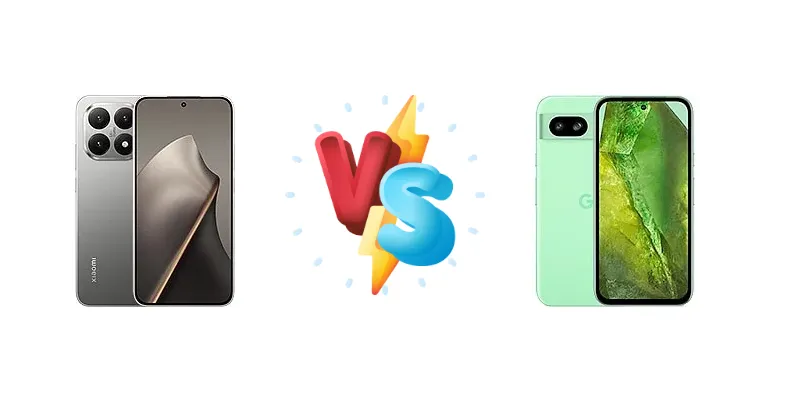
|
🏆 Quick Verdict
For users prioritizing all-day battery life and rapid recharging, the Xiaomi 15T is the clear winner. Its 57:44 hour endurance significantly outpaces the Pixel 8a’s 40:06 hours. However, the Pixel 8a’s Tensor G3 offers a unique software experience and strong image processing capabilities.
| PHONES | ||
|---|---|---|
| Phone Names | Xiaomi 15T | Google Pixel 8a |
| Network | ||
|---|---|---|
| 2G bands | GSM 850 / 900 / 1800 / 1900 | GSM 850 / 900 / 1800 / 1900 |
| 3G bands | HSDPA 800 / 850 / 900 / 1700(AWS) / 1900 / 2100 | HSDPA 800 / 850 / 900 / 1700(AWS) / 1900 / 2100 |
| 4G bands | 1, 2, 3, 4, 5, 7, 8, 12, 13, 17, 18, 19, 20, 26, 28, 32, 38, 40, 41, 42, 48, 66, 71 | 1, 2, 3, 4, 5, 7, 8, 12, 17, 18, 19, 20, 26, 28, 32, 38, 40, 41, 42, 66 - G6GPR (International) |
| 5G bands | 1, 2, 3, 5, 7, 8, 12, 20, 26, 28, 38, 40, 41, 48, 66, 71, 75, 77, 78 SA/NSA | 1, 2, 3, 5, 7, 8, 12, 20, 26, 28, 38, 40, 41, 66, 75, 76, 77, 78 SA/NSA/Sub6 - G6GPR (International) |
| Speed | HSPA, LTE, 5G | HSPA, LTE, 5G |
| Technology | GSM / HSPA / LTE / 5G | GSM / HSPA / LTE / 5G |
| Launch | ||
|---|---|---|
| Announced | 2025, September 24 | 2024, May 07 |
| Status | Available. Released 2025, September 24 | Available. Released 2024, May 14 |
| Body | ||
|---|---|---|
| Build | Glass front (Gorilla Glass 7i), plastic frame, fiber-reinforced plastic back | Glass front (Gorilla Glass 3), aluminum frame, plastic back |
| Dimensions | 163.2 x 78 x 7.5 mm (6.43 x 3.07 x 0.30 in) | 152.1 x 72.7 x 8.9 mm (5.99 x 2.86 x 0.35 in) |
| SIM | · Nano-SIM + Nano-SIM + eSIM + eSIM (max 2 at a time)· Nano-SIM + Nano-SIM | Nano-SIM + eSIM |
| Weight | 194 g (6.84 oz) | 188 g (6.63 oz) |
| Display | ||
|---|---|---|
| Protection | Corning Gorilla Glass 7i, Mohs level 6 | Corning Gorilla Glass 3, Mohs level 5 |
| Resolution | 1280 x 2772 pixels, 19.5:9 ratio (~447 ppi density) | 1080 x 2400 pixels, 20:9 ratio (~430 ppi density) |
| Size | 6.83 inches, 114.5 cm2 (~90.0% screen-to-body ratio) | 6.1 inches, 90.3 cm2 (~81.6% screen-to-body ratio) |
| Type | AMOLED, 68B colors, 120Hz, 3840Hz PWM, Dolby Vision, HDR10+, 3200 nits (peak) | OLED, HDR, 120Hz, 2000 nits (peak) |
| Platform | ||
|---|---|---|
| CPU | Octa-core (1x3.25 GHz Cortex-A725 & 3x3.0 GHz Cortex-A725 & 4x2.1 GHz Cortex-A725) | Nona-core (1x3.0 GHz Cortex-X3 & 4x2.45 GHz Cortex-A715 & 4x2.15 GHz Cortex-A510) |
| Chipset | Mediatek Dimensity 8400 Ultra (4 nm) | Google Tensor G3 (4 nm) |
| GPU | Mali-G720 MC7 | Immortalis-G715s MC10 |
| OS | Android 15, upgradable to Android 16, HyperOS 3 | Android 14, upgradable to Android 16, up to 7 major Android upgrades |
| Memory | ||
|---|---|---|
| Card slot | No | No |
| Internal | 256GB 12GB RAM, 512GB 12GB RAM | 128GB 8GB RAM, 256GB 8GB RAM |
| Main Camera | ||
|---|---|---|
| Dual | - | 64 MP (16 MP eff.), f/1.9, 26mm (wide), 1/1.73", 0.8µm, dual pixel PDAF, OIS 13 MP, f/2.2, 120˚ (ultrawide), 1.12µm |
| Features | Leica lens, Color spectrum sensor, Ultra HDR, LED flash, HDR, panorama | Dual-LED flash, Pixel Shift, Ultra HDR, panorama, Best Take |
| Triple | 50 MP, f/1.7, 23mm (wide), 1/1.55", 1.0µm, PDAF, OIS 50 MP, f/1.9, 46mm (telephoto), 1/2.76", 0.64µm, PDAF, 2x optical zoom 12 MP, f/2.2, 15mm, 120˚ (ultrawide), 1/3.06", 1.12µm | - |
| Video | 4K@30/60fps, 1080p@30/60/120/240/960fps, gyro-EIS, 10-bit Rec. 2020, HDR10+ | 4K@30/60fps, 1080p@30/60/120/240fps, OIS |
| Selfie camera | ||
|---|---|---|
| Features | HDR | HDR, panorama |
| Single | 32 MP, f/2.2, 21mm (wide), 1/3.44", 0.64µm | 13 MP, f/2.2, 20mm (ultrawide), 1.12µm |
| Video | 4K@30fps, 1080p@30/60fps, HDR10+ | 4K@30fps, 1080p@30/60fps |
| Sound | ||
|---|---|---|
| 35mm jack | No | No |
| Loudspeaker | Yes, with stereo speakers (with Dolby Atmos) | Yes, with stereo speakers |
| Comms | ||
|---|---|---|
| Bluetooth | 6.0, A2DP, LE | 5.3, A2DP, LE |
| Infrared port | Yes | - |
| NFC | Yes (market/region dependent) | Yes |
| Positioning | GPS (L1+L5), BDS (B1I+B1c+B2a), GALILEO (E1+E5a), QZSS (L1+L5), NavIC (L5), GLONASS | GPS, GLONASS, GALILEO, BDS, QZSS, NavIC |
| Radio | No | No |
| USB | USB Type-C 2.0, OTG | USB Type-C 3.2 |
| WLAN | Wi-Fi 802.11 a/b/g/n/ac/6e, dual-band or tri-band, Wi-Fi Direct | Wi-Fi 802.11 a/b/g/n/ac/6e, dual/tri-band (market/region dependent) |
| Features | ||
|---|---|---|
| Sensors | Fingerprint (under display, optical), accelerometer, gyro, proximity, compass | Fingerprint (under display, optical), accelerometer, gyro, proximity, compass, barometer |
| Battery | ||
|---|---|---|
| Charging | 67W wired, PD3.0, 100% in 50 min | 18W wired, PD3.0 7.5W wireless Bypass charging |
| Type | 5500 mAh | Li-Po 4492 mAh |
| Misc | ||
|---|---|---|
| Colors | Black, Gray, Rose Gold | Obsidian, Porcelain, Bay, Aloe |
| Models | 25069PTEBG | GKV4X, G6GPR, G8HHN, G576D |
| Price | $ 535.47 / £ 349.00 / € 435.43 | $ 229.98 / C$ 417.99 / £ 279.00 / € 299.99 / ₹ 33,300 |
| SAR EU | 0.99 W/kg (head) 0.99 W/kg (body) | - |
| EU LABEL | ||
|---|---|---|
| Battery | 57:44h endurance, 1600 cycles | 40:06h endurance, 1000 cycles |
| Energy | Class A | Class B |
| Free fall | Class A (270 falls) | Class A (270 falls) |
| Repairability | Class C | Class B |
Xiaomi 15T
- Exceptional battery life (57:44h endurance)
- Ultra-fast 67W wired charging
- Powerful Mediatek Dimensity 8400 Ultra chipset
- Lacks wireless charging
- Software experience may not be as refined as Pixel
Google Pixel 8a
- Google’s Tensor G3 chip with AI capabilities
- Excellent computational photography
- Clean and streamlined Android experience
- Significantly shorter battery life (40:06h endurance)
- Slow 18W wired charging
Display Comparison
Both the Xiaomi 15T and Google Pixel 8a feature displays capable of reaching 1500+ nits of peak brightness – the 15T hitting 1525 nits and the Pixel 8a at 1508 nits. This ensures excellent visibility even in direct sunlight. While both utilize 4nm chipsets, display technology details beyond brightness are absent. The lack of LTPO information suggests neither phone offers adaptive refresh rates for optimal power efficiency, a common omission in this price bracket. Bezels are assumed to be comparable given the similar overall form factors.
Camera Comparison
Camera details beyond the main sensors are limited. The Pixel 8a is known for its computational photography, leveraging Google’s image processing algorithms. The Tensor G3’s dedicated image signal processor (ISP) plays a crucial role here. While sensor sizes and apertures are unknown for both, the Pixel’s software enhancements often compensate for hardware limitations. The Xiaomi 15T’s camera performance will likely rely more on raw sensor capabilities and lens quality. The absence of information regarding OIS (Optical Image Stabilization) makes it difficult to assess low-light performance definitively.
Performance
The Xiaomi 15T’s Mediatek Dimensity 8400 Ultra, built on a 4nm process, employs an octa-core configuration with a unique tri-cluster of Cortex-A725 cores (1x3.25 GHz & 3x3.0 GHz) alongside four Cortex-A725 cores at 2.1 GHz. This contrasts with the Google Pixel 8a’s Google Tensor G3, a nona-core chip featuring a Cortex-X3 prime core at 3.0 GHz, four Cortex-A715 cores at 2.45 GHz, and four Cortex-A510 cores at 2.15 GHz. The Tensor G3’s architecture prioritizes AI and machine learning tasks, potentially offering advantages in areas like voice recognition and image processing. However, the Dimensity 8400 Ultra’s core count and clock speeds suggest a potential edge in sustained CPU-intensive workloads. RAM specifications are missing, but LPDDR5x is expected on both devices.
Battery Life
The Xiaomi 15T’s battery endurance of 57:44 hours is a significant advantage over the Pixel 8a’s 40:06 hours. This translates to a substantial difference in real-world usage, particularly for heavy users. The 15T supports 67W wired charging, achieving a full charge in just 50 minutes with PD3.0 compatibility. The Pixel 8a, limited to 18W wired charging, takes considerably longer to replenish its battery. The Pixel 8a does offer 7.5W wireless charging and 'bypass charging' which allows charging directly to the battery bypassing heat build-up, features absent on the 15T.
Buying Guide
Buy the Xiaomi 15T if you need exceptional battery life, fast 67W charging, and prioritize raw endurance for power users and travelers. Buy the Google Pixel 8a if you prefer a streamlined Android experience, Google’s computational photography prowess, and a more compact form factor, even if it means sacrificing battery longevity.